For startups in 2026, the question isn’t just “How much does an app cost?”—it is “How much capital do I need to reach product-market fit?”
The mobile app market has shifted. Investors no longer fund “ideas”; they fund traction. This puts founders in a difficult position: you need a high-quality product to get users, but you have a limited runway to build it.
Choosing Flutter—Google’s open-source UI software development kit—is your first major financial win. By allowing you to build for iOS, Android, Web, and Desktop from a single codebase, Flutter typically reduces development costs by 30% to 40% compared to native development.
However, the final price tag is fluid. It depends on whether you are building a simple validation MVP or an AI-powered Fintech platform. Startups often make critical budgeting errors by looking at surface-level estimates rather than the Total Cost of Ownership (TCO).
This guide provides a transparent, data-driven breakdown of Flutter app development costs for startups, helping you plan realistically, avoid scope creep, and secure the right runway for your launch.
What Determines the Cost of Building a Flutter App?
The cost of a Flutter app is never a fixed number; it is the sum of time, talent, and technical complexity. To estimate your budget accurately, you must understand the five core pillars that drive expenses.
1. App Complexity
Complexity is the single biggest cost driver. In today’s market, “complexity” is defined by the number of screens, the logic connecting them, and the data processing required.
- Simple Apps (MVP): These focus on validation. They have standard UI, limited screens (5–7), and basic logic (e.g., a To-Do list or simple content app).
- Medium Complexity: These apps include user authentication, real-time messaging, API integrations, and perhaps a basic recommendation engine.
- High Complexity: These require custom backend architecture, real-time data synchronization, high security (HIPAA/GDPR), and complex state management.
2. The “AI Premium”: Cost of Intelligence in 2026
In 2026, investors rarely fund “dumb” apps. They look for AI integration. However, the type of AI you build drastically changes your Flutter development budget.
Level 1: API Integration (The Wrapper)
- What it is: Your Flutter app connects to existing models like OpenAI (GPT-4), Google Gemini, or Claude via API.
- Cost Impact: $5,000 – $15,000 setup.
- Ongoing Cost: You pay per “token” (usage) to the provider.
- Use Case: Chatbots, text summarization, simple image generation.
Level 2: Custom Model Training (The Asset)
- What it is: You train a proprietary machine learning model on your own data (e.g., a medical diagnosis AI or a specialized legal assistant).
- Cost Impact: $50,000 – $150,000+.
- Why so expensive? This requires hiring Data Scientists (Python stack) alongside your Flutter developers. The Flutter side is just the UI; the cost lies in data cleaning, model training, and hosting expensive GPU servers.
Level 3: Edge AI (On-Device)
- What it is: Running AI directly on the user’s phone (using LiteRT (TensorFlow Lite) for Flutter) for privacy and offline capability.
- Cost Impact: $20,000 – $40,000 extra.
- Complexity: Requires highly optimized code to ensure the app doesn’t drain the user’s battery or lag the UI.
3. UI/UX Design Customization
Design impacts cost more than founders expect.
- Standard Design: Using Flutter’s native Material Design (Android) and Cupertino (iOS) widgets is cost-effective.
- Custom Branding: If you need custom animations, unique gestures, and a “never-before-seen” interface, expect the design budget to double. Complex animations require significant engineering time to ensure smooth 60fps performance across devices.
4. Backend Architecture
Flutter handles the “front end” (what users see), but the “back end” (the brain) drives the cost.
- BaaS (Backend as a Service): Using Firebase is cheaper and faster for startups ($500–$2,000 setup).
- Custom Backend: Building a custom server (Node.js, Python, Go) requires more developers and time ($5,000–$15,000+), but offers greater scalability for enterprise apps.
5. Developer Location
Who builds your app is as important as what you build. Rates vary globally based on the cost of living (detailed breakdown below).
The Cost Formula
To simplify the estimation, use this standard calculation used by project managers:
Most agencies will add a Project Management fee (usually 10–15% of development cost) to ensure agile delivery.
Looking for a complete flutter app development cost breakdown? Read our Complete 2026 Pricing Guide
Typical Flutter App Development Cost Ranges (2026 Estimates)
Startups need realistic benchmarks. Below is a breakdown of costs based on complexity and stage of business.
Cost by Complexity Level
| App Complexity | Typical Use Case | Development Time | Estimated Cost Range |
| Simple / MVP | Idea validation, internal tools, basic data display | 6–10 weeks | $10,000 – $25,000 |
| Medium Complexity | Consumer apps, e-commerce, social networking | 3–6 months | $30,000 – $75,000 |
| High Complexity | Enterprise platforms, AI-apps, Fintech, On-demand | 6–12 months | $80,000 – $200,000+ |
Cost by App Category: Detailed Industry Benchmarks
The industry you operate in dictates your compliance, security, and feature requirements. A healthcare app is not just “content”; it is legal liability. Below is the granular cost breakdown by industry, including the “Enterprise/Scale” tier which many guides omit.
| Industry / Category | MVP Cost (Seed Stage) | Scale/Enterprise Cost (Series A+) | Key Cost Drivers |
| Fintech & Banking | $60,000 – $100,000 | $150,000 – $350,000+ | Bank-grade security (AES-256), KYC/AML compliance flows, Plaid/Stripe integration, real-time fraud detection algorithms, high-concurrency backend. |
| Healthcare (mHealth) | $50,000 – $80,000 | $120,000 – $300,000+ | HIPAA/GDPR compliance, HL7/FHIR integration for hospital records, secure video tele-consultation, IoT integration (wearables). |
| E-Commerce / Retail | $25,000 – $50,000 | $80,000 – $200,000+ | AI recommendation engines, AR “Try-on” features, complex inventory synchronization (ERP integration), multi-vendor marketplace logic. |
| On-Demand (Uber-like) | $40,000 – $70,000 | $100,000 – $250,000+ | Dual-app logic (Driver + User + Admin), complex geospatial routing algorithms, websocket-based real-time tracking, automated payout systems. |
| Social Media | $35,000 – $60,000 | $150,000 – $400,000+ | Video compression/streaming at scale (like TikTok), AI content moderation, massive database sharding for millions of users. |
| EdTech / LMS | $30,000 – $55,000 | $90,000 – $200,000+ | Gamification engines, interactive video players, offline download capabilities (DRM protection), progress analytics dashboards. |
Deep Dive: Developer Rates by Region
Geographic arbitrage is a startup’s best tool for budget control. While US developers are expensive, they offer ease of communication. Offshore teams (India, Ukraine, Vietnam) offer high-quality code at a fraction of the price.
Hourly Rate Comparison (2026)
| Region | Average Hourly Rate | Pros for Startups | Cons for Startups |
| North America (USA/Canada) | $100 – $180+ | Cultural fit, same time zone, high strategic input. | Very high cost; burns runway quickly. |
| Western Europe (UK/Germany) | $80 – $150 | High quality, strong data privacy focus (GDPR). | Still costly for bootstrapped founders. |
| Eastern Europe (Poland/Ukraine) | $40 – $80 | Strong engineering culture, good English proficiency. | Time zone gaps can slow communication slightly. |
| Latin America (Brazil/Mexico) | $45 – $85 | Real-time collaboration with US (Time zone alignment). | Talent pool is smaller than Asia. |
| Asia (India/Vietnam/Philippines) | $20 – $45 | Best ROI, massive talent pool, highly scalable teams. | Requires vetting for communication skills. |
Strategy for Startups: Many successful startups use a hybrid model. They hire a local Product Manager or CTO in their home country and a dedicated Flutter team in India or Eastern Europe to handle the heavy lifting of execution.
The Step-by-Step Development Process (Where the Money Goes)
To better understand why the costs are what they are, it helps to break down the timeline. A professional flutter app development agency doesn’t just “start coding.” There is a rigorous process to ensure the app actually works.
Phase 1: Discovery & Strategy (10% of Budget)
Before a single line of code is written, the team defines the Scope of Work (SoW).
- Deliverables: Product Requirements Document (PRD), User Personas, Competitor Analysis.
- Why pay for this? It prevents “scope creep” later, which is the reason apps go over budget.
Phase 2: UI/UX Design (15-20% of Budget)
This is where the app takes shape visually.
- Wireframing: Low-fidelity sketches of the user flow.
- Prototyping: High-fidelity, clickable screens that look like the final app.
- Why pay for this? Fixing a design error costs $100. Fixing that same error after it’s coded costs $10,000.
Phase 3: Development (50-55% of Budget)
The “heavy lifting” phase.
- Frontend: Coding the screens in Flutter.
- Backend: Setting up the database and APIs.
- Integration: Connecting the two.
Phase 4: QA & Testing (15-20% of Budget)
Skipping testing to save money is a false economy. A buggy app leads to bad reviews, which increases your Customer Acquisition Cost (CAC).
- Deliverables: Bug reports, stress testing (can the app handle 10,000 users?), security audits.
Phase 5: Deployment & Launch (5% of Budget)
- Tasks: Uploading to App Store/Play Store, handling rejection notices (common with Apple), setting up live server environments.
Hidden Costs: What Nobody Tells You
Budgeting only for development is a recipe for failure. You must account for the “Hidden Costs” of launching a product.
1. Third-Party API Fees
Your app relies on other services to function. These costs scale with your user base.
- Google Maps API: Free tier exists, but scales to ~$7 per 1,000 loads.
- SMS Verification (Twilio): ~$0.0079 per message.
- Payment Gateways: Standard ~2.9% + $0.30 per transaction (deducted from revenue, not upfront cost, but impacts margins).
2. App Store Fees
- Apple App Store: $99/year developer membership.
- Google Play Store: $25 one-time registration fee.
- Commission: Both stores take 15%–30% of in-app digital purchases.
3. Server and Cloud Hosting
Unless your app is purely offline (rare), you need a server.
- MVP Stage: $50–$200/month (Firebase/AWS Free tiers help initially).
- Scaling Stage: $500–$2,000+/month as users grow.
Maintenance & TCO: The 15-25% Rule
The Total Cost of Ownership (TCO) includes not just building the app, but keeping it alive. Industry standards suggest budgeting 15% to 25% of the initial development cost annually for maintenance.
Why does maintenance cost money?
- OS Updates: Every year, iOS and Android release new versions (e.g., iOS 18, Android 16). Your app must be updated to remain compatible and avoid crashing.
- Flutter Upgrades: Flutter updates frequently. Upgrading your codebase ensures you get performance boosts and security patches.
- Security Audits: Regular checks to patch vulnerabilities, especially for Fintech or Health apps.
- Bug Fixes: No code is perfect. Users will find bugs that need immediate fixing.
Example Math:
If your MVP costs **$40,000** to build, you should budget roughly $6,000 to $10,000 per year ($500–$800/month) for ongoing support and server costs.
Flutter vs. Native vs. Hybrid: ROI Comparison
Is Flutter truly the best financial choice? Let’s compare it against Native (Swift/Kotlin) and React Native.
| Feature | Flutter | React Native | Native (iOS + Android) |
| Performance | Near Native (60fps) | High, but relies on bridges | Best Possible |
| Development Cost | Low (Single Codebase) | Low/Medium | High (Two Teams) |
| Time to Market | Fastest | Fast | Slow |
| Maintenance Cost | Low | Medium (Dependency issues) | High (Duplicate effort) |
| UI Consistency | Pixel-perfect on all screens | Can vary by platform | Native look & feel |
Verdict: For 90% of startups, Flutter offers the best balance of Performance vs. Price.
Real Startup Scenarios: Cost Examples
To make this concrete, here are three realistic scenarios for startups in 2026.
Scenario A: The “Uber for X” MVP
Concept: A service booking app connecting cleaners with homeowners.
- Features: User app (booking, map, payment), Provider app (accept jobs, profile), Admin panel.
- Tech Stack: Flutter, Firebase, Stripe, Google Maps.
- Team: 2 Developers, 1 QA, 1 PM (Part-time).
- Timeline: 3.5 Months.
- Total Cost: $35,000 – $45,000.
Scenario B: The AI-Powered SaaS Tool
Concept: A productivity app that summarizes emails using AI.
- Features: Email API integration, OpenAI/Gemini API integration, subscription management, local storage.
- Tech Stack: Flutter, Node.js Backend, Python (AI service).
- Team: 3 Developers, 1 Backend Engineer, 1 Designer.
- Timeline: 5 Months.
- Total Cost: $55,000 – $75,000.
Scenario C: The Corporate Wellness Platform
Concept: Enterprise app for employee health tracking with wearable integration.
- Features: Wearable API (Apple Health/Google Fit), Data visualization, HIPAA compliance, SSO login.
- Tech Stack: Flutter, AWS (Secure Cloud), Custom Encryption.
- Team: Full Agile Squad (5-6 members).
- Timeline: 8+ Months.
- Total Cost: $110,000 – $150,000.
Frequently Asked Questions (FAQ)
1. Is Flutter good for a startup MVP?
Yes, it is the industry standard for MVPs. It allows you to enter the market 30-50% faster than native development and validates your idea on both iOS and Android simultaneously, maximizing your reach.
2. How much does it cost to hire a Flutter developer?
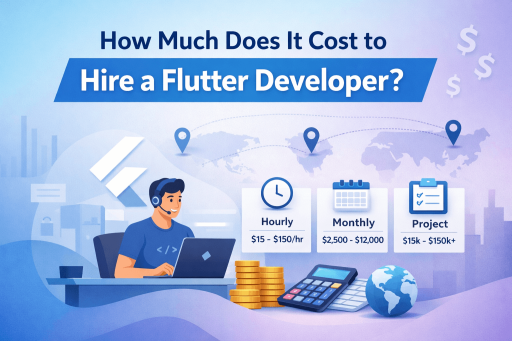
It depends on location. In India, a mid-level Flutter developer costs $25–$40/hour. In Eastern Europe, $50–$80/hour. In the US, $100–$150/hour.
3. Can I convert my Flutter app to a web app later?
Yes! Flutter supports Web and Desktop (Windows/macOS/Linux) natively. You can often reuse 90-95% of your mobile code to launch a web version, saving massive amounts of money compared to rewriting it in React or Angular.
4. Why are huge estimates ($100k+) common?
Agencies often quote for “production-grade” scale immediately. This includes unit testing, CI/CD pipelines, load balancing, and premium design. As a startup, you can often start smaller and scale up, but ensure your architecture is built to handle growth.
5. How much should I budget for marketing vs. development?
A common rule of thumb is the 50/50 rule. If you spend $30,000 building the app, you should have at least $30,000 reserved for marketing and user acquisition during the first 6 months.
Conclusion: How to Get an Accurate Estimate
Understanding the Flutter app development cost for startups requires looking beyond the price tag. It’s about understanding value. A $15,000 app that crashes and fails to retain users is a waste of money. A $50,000 app that scales effortlessly, secures user data, and offers a premium AI-enhanced experience is an asset that attracts investors.
Your Next Step:
Don’t guess. Before you write a single line of code, define your Scope of Work (SoW) clearly. List your “Must-Haves” vs. “Nice-to-Haves.”
Would you like us to review your feature list and provide a detailed cost breakdown for your specific idea? Contact us for a free consultation

I’m Navin Sharma, a passionate Full Stack Developer with over 20 years of experience in the tech industry. Throughout my career, I’ve had the privilege of working on a variety of exciting projects, developing everything from dynamic web applications to complex back-end systems. My expertise spans both front-end and back-end technologies, and I thrive on building solutions that are not only functional but also scalable and user-friendly.
Beyond my hands-on development work, I’ve contributed to several well-respected tech and startup blogs, where I share my insights on the latest trends, development strategies, and best practices in the world of web development. I also have a strong background in app analysis, where I’ve helped companies optimize their products for better performance and enhanced user experience.
Whether I’m working on a challenging coding problem or mentoring fellow developers, I’m always eager to learn, innovate, and push the boundaries of what’s possible with technology.