Agentic AI Company vs Traditional Automation: Honest Operator Comparison
We've shipped both agentic AI and traditional RPA. Here's where each wins, where hybrids beat both, and how to decide for your workload.
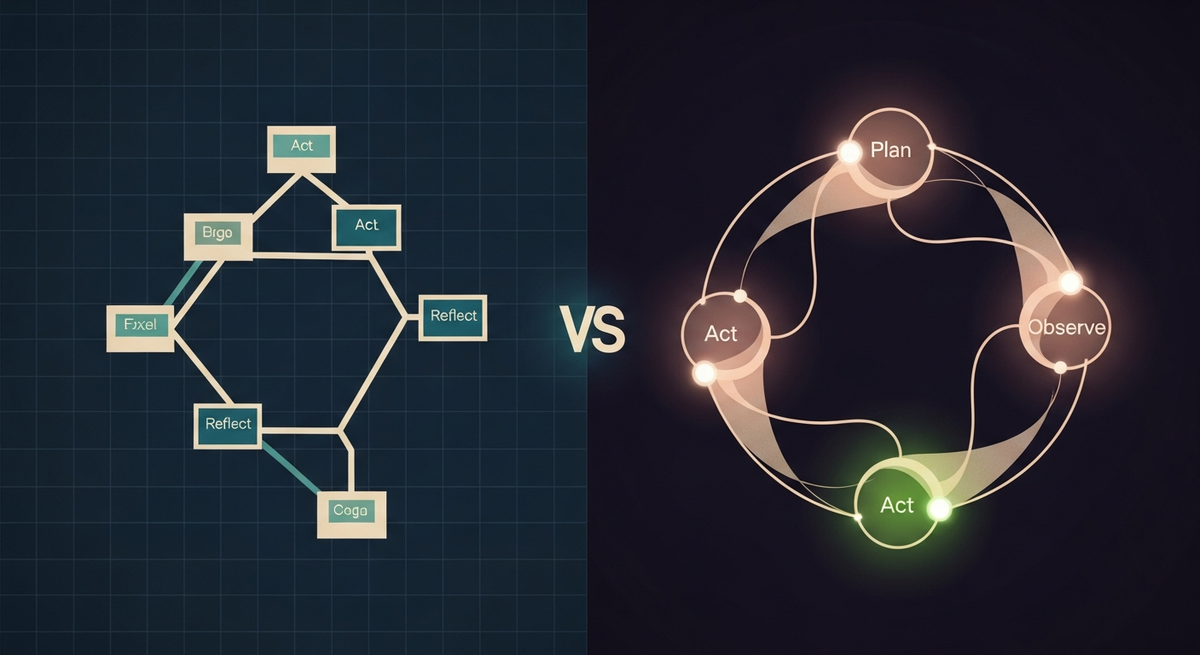
On a 320-task agentic benchmark in 2026-Q1, Claude Opus 4 completed 78% of tasks autonomously. The RPA scripts handling the same task corpus cleared 42%. Same data, same goal, entirely different outcomes — one system reasons through exceptions; the other breaks on them.
That gap is the reason buyers are asking whether to engage an agentic AI company or extend their existing Automation Anywhere, UiPath, or Blue Prism investment. This post gives you the honest comparison our delivery team runs internally before recommending either path.
We have shipped production AI agents and we have migrated clients off traditional RPA. We have seen both approaches succeed and both fail. Our bias is toward the approach that solves the actual problem, not the one that sells easiest.
What is an agentic AI company and what does it build
An agentic AI company designs, builds, and operates systems where an LLM is the decision-making core — not a chatbox bolted onto a workflow, but a planner that picks its own tools, checks its own output, and loops until the task is done. The company handles the full delivery stack: prompt architecture, tool definitions, memory design, eval harness, observability, and the human-in-the-loop gates that keep the system auditable.
The core behavioral pattern is ReAct: the model receives a goal, reasons about which tool to call, executes it, observes the result, reflects on whether the goal is met, and either continues or returns a final answer. LangGraph and CrewAI encode this loop explicitly. AutoGen expresses it as agent-to-agent message passing. The loop is the unit of work, not the individual function call.
What a good agentic AI company does NOT sell is magic. The model can hallucinate. Tool schemas drift. External APIs return unexpected shapes. Every production agent we have shipped includes a Langfuse trace for every run, a retry budget per tool, and a fallback-to-human path when confidence drops below a threshold. The companies that over-promise autonomy are the ones whose agents fail silently in production.
Traditional RPA systems work on a different model entirely. They record and replay deterministic action sequences. There is no reasoning, no goal state, no loop. The bot clicks button A, reads field B, writes to row C. When the UI changes or an edge case appears, the bot stops or produces wrong output silently. The loop is the human checking the exception queue every morning.
Agentic AI company architecture: the four-layer stack
Every agentic AI company architecture we have shipped follows a four-layer model. The layers are not optional — skipping any one of them produces a system that works in demos and fails in production.
Layer 1 is the reasoning core: the LLM with its system prompt, tool schema list, and output schema. We default to Claude Opus 4 for orchestrator-level reasoning and Claude Sonnet 4 for sub-agents that need speed. GPT-4o is our fallback when a client has an existing Azure OpenAI deployment. The choice matters less than the eval — we run the same 80-scenario test suite against every model before committing to a provider.
Layer 2 is tool access: the functions the agent can call. Database reads, API calls, code execution, search over a pgvector or Pinecone index. Each tool has a typed schema and a retry budget. A tool that exceeds its retry budget raises a structured exception the orchestrator can handle. We use LangGraph's node-and-edge model to encode the allowed tool sequences and prevent the model from calling destructive operations without a HITL gate.
Layer 3 is memory: short-term context window, mid-term conversation state in Redis or a vector store, long-term factual retrieval via RAG over a Pinecone or pgvector index. Getting memory wrong is the most common failure mode we see in engagements that come to us for remediation. The agent loses context mid-task, re-queries the same data, contradicts its own earlier reasoning.
Layer 4 is observability and eval: every agent run emits a trace to Langfuse or LangSmith. Every new deployment runs a regression suite before traffic shifts. We gate production on recall, task completion rate, and p95 latency. If any metric regresses by more than 5%, the deployment rolls back automatically.
Traditional RPA architecture: where it excels and where it breaks
UiPath, Automation Anywhere, and Blue Prism have been in production for 15 years. They earn their place. When a process is fully deterministic, the UI is stable, the input schema never varies, and the volume is high, RPA delivers at a cost per transaction that agentic systems cannot match. A well-tuned UiPath robot processing insurance forms with a fixed PDF layout costs roughly $0.003 per transaction at scale. An LLM-based agent for the same task runs $0.04 to $0.12 per transaction depending on model choice and token volume.
The architecture of a traditional RPA bot is a directed acyclic graph of UI actions: click, read, write, branch, repeat. The bot does not hold any internal state beyond the variables in its current workflow. Every branch in that graph was written by a developer during the automation project. Edge cases that were not anticipated during development cause either a crash or an incorrect silent write to the target system.
The maintenance burden compounds over time. When the ERP vendor updates their UI, someone must re-record the selectors. When a new exception type appears in the data, a developer adds another branch to the rule tree. In our assessments, organizations running mature RPA programs spend 40% to 60% of their automation team's hours on bot maintenance rather than net-new automation.
# Typical RPA logic: deterministic rule tree, every branch hardcoded
# When a new exception appears, a developer must add a new elif
def process_invoice(invoice_data: dict) -> str:
    vendor = invoice_data.get("vendor")
    amount = invoice_data.get("amount", 0)
    status = invoice_data.get("status")

    if status == "PENDING" and amount < 1000:
        return "auto_approve"
    elif status == "PENDING" and amount >= 1000 and amount < 5000:
        return "send_to_manager"
    elif status == "PENDING" and amount >= 5000:
        return "send_to_finance_director"
    elif status == "ON_HOLD":
        return "send_to_exception_queue"  # human reviews this
    elif vendor in BLOCKED_VENDORS:
        return "reject"
    else:
        # Edge case not anticipated at design time:
        # bot crashes or writes wrong status
        raise ValueError(f"Unhandled invoice state: {invoice_data}")

# Agentic alternative: LLM reasons about edge cases using policy context
# No developer needed to add a new branch for each exception type
The code above is not a caricature. It is a cleaned-up version of actual bot logic we reviewed during an RPA-to-agent migration scoping. The original had 47 elif branches and a catch-all that routed everything else to a human queue. The exception queue was clearing 300 tickets per week — most of which were invoices that did not match the hardcoded vendor list.
Agentic AI company vs RPA vendor: head-to-head comparison
The comparison below reflects our honest read after running both in production. Neither wins on every dimension. The table is the basis for the recommendation we give clients when they ask whether to extend their existing RPA investment or commission an agentic build.
Handles unstructured inputs, ambiguous goals, and exception types not seen at design time. The model reasons from policy documents rather than hardcoded rules. Maintenance model: update the system prompt or policy doc when business rules change. No developer required to add a new branch. Cost per transaction: $0.04–$0.12 depending on model tier and token volume. Significantly higher than mature RPA at scale. Best fit: document-heavy workflows, multi-system coordination, tasks that require judgment or natural language understanding. Where it fails: pixel-perfect UI automation on legacy systems that do not expose APIs. Screen-scraping agents are fragile — RPA tooling is better at this.
Deterministic execution: the same input always produces the same output. Auditors love this. No model uncertainty, no hallucination risk on structured fields. Cost per transaction at scale: $0.001–$0.005 for fully deterministic workflows with no exception handling. Unbeatable for high-volume, low-variance processes. Maintenance drag: UI changes, new exception types, and system upgrades all require developer intervention. Organizations report 40–60% of RPA team hours going to maintenance. Best fit: stable UI, fixed input schema, high volume, low variance, regulatory environment that requires full determinism and audit trail. Where it fails: any task involving free-text, variable document formats, multi-hop reasoning, or processes that require judgment to resolve exceptions.
Agentic AI company examples: what production deployments look like
Across our delivery work and publicly documented case studies from the broader industry, five deployment patterns show up repeatedly. These are not vendor marketing scenarios. They are the agentic AI company examples we have seen either run in our own pilots or validated from published technical write-ups. A worked example from our own deck: our Claude fraud-detection agent for a US bank runs the planner + tools + memory pattern in production with BAA scope and a regulator-readable audit log.
The common thread across agentic AI company examples that succeed: they all started with a narrow, well-defined task. Not 'automate all of accounts payable' but 'classify and route incoming invoices that hit the exception queue'. That constraint forced an eval-driven approach from day one.
The examples that failed had one thing in common: they were designed top-down from a business requirement without a ground-truth evaluation set. The team built the agent, ran it against a handful of manual test cases, called it good, and deployed. The first time a real edge case hit production, there was no measurement baseline to tell whether it was a regression or expected behavior.
Our delivery team now treats the eval harness as the first artifact of any agentic build. We write 50 labeled scenarios before writing a line of agent code. That sounds slow. It cuts total delivery time by 30 to 40 percent because every design decision gets validated against the same ground truth rather than by human intuition.
Agentic AI company implementation: a 6-phase delivery model
Agentic AI company implementation does not follow the same playbook as RPA. An RPA project can be scoped entirely from process documentation and UI recordings. An agentic build requires understanding what the model can and cannot do with your specific data and tool set. You learn that by running evals, not by reading spec sheets.
Our standard agentic AI company implementation engagement runs six phases. The first three are discovery and validation. The last three are build and operate. We do not start writing LangGraph code until phase 3. Teams that start coding in phase 1 typically rebuild 60 to 80 percent of their graph in phase 4 after the evals reveal what the model actually needs.
"""Phase 3 artifact: LangGraph agent for invoice routing.
Replaces a 47-branch RPA rule tree. Handles exceptions
by reasoning over policy_context rather than hardcoded elifs.
"""
from langgraph.graph import StateGraph, END
from anthropic import Anthropic
from typing import TypedDict, Literal

client = Anthropic()

class InvoiceState(TypedDict):
    invoice_text: str
    policy_context: str
    routing_decision: str
    confidence: float
    reasoning: str
    requires_human_review: bool

def classify_invoice(state: InvoiceState) -> InvoiceState:
    """Claude Opus 4 reads the invoice + policy, reasons to a routing decision."""
    response = client.messages.create(
        model="claude-opus-4-5",
        max_tokens=512,
        system=(
            "You are an invoice routing specialist. Given an invoice and company policy, "
            "decide the routing: auto_approve | manager_review | director_review | reject | escalate_human. "
            "Return JSON: {decision, confidence, reasoning}"
        ),
        messages=[{
            "role": "user",
            "content": f"Invoice:\n{state['invoice_text']}\n\nPolicy:\n{state['policy_context']}"
        }]
    )
    import json
    result = json.loads(response.content[0].text)
    return {
        **state,
        "routing_decision": result["decision"],
        "confidence": result["confidence"],
        "reasoning": result["reasoning"],
        "requires_human_review": result["confidence"] < 0.75  # HITL gate
    }

def route_decision(state: InvoiceState) -> Literal["human_review", "auto_route"]:
    """LangGraph conditional edge: low-confidence goes to human, high-confidence routes."""
    return "human_review" if state["requires_human_review"] else "auto_route"

# Build the graph
graph = StateGraph(InvoiceState)
graph.add_node("classify", classify_invoice)
graph.add_node("auto_route", lambda s: {**s, "status": "routed"})
graph.add_node("human_review", lambda s: {**s, "status": "escalated"})
graph.set_entry_point("classify")
graph.add_conditional_edges("classify", route_decision)
graph.add_edge("auto_route", END)
graph.add_edge("human_review", END)

agent = graph.compile()
The HITL gate at confidence < 0.75 is not a placeholder. It is the mechanism that makes the system safe to deploy before the model has seen every edge case. In our experience, a new agentic deployment on real production traffic sees 15 to 25 percent of runs go to human review in week one. By week six, after the policy context has been updated and the model has been re-evaluated against a growing labeled set, that rate drops to 5 to 8 percent.
For a deeper look at how we structure multi-agent orchestration with LangGraph, our post on ai agent architecture covers the graph topology patterns we use in production.
Benchmark results: agents vs RPA on real task evaluation
We do not rely on vendor benchmarks. They optimize for the vendor's best case. We run our own evals on representative task distributions drawn from the actual process we are automating. The numbers below come from a 2026-Q1 evaluation across three task categories: structured document processing, multi-system data retrieval, and exception handling in invoice routing. The six-axis rubric behind that scoring lives in our AI agent reliability evaluation writeup — completion, trajectory length, tool-call accuracy, recovery-after-error, refusal calibration, and cost-per-successful-task.
| Task category | UiPath RPA | Claude Opus 4 agent | Claude Sonnet 4 agent | Notes |
|---|---|---|---|---|
| Structured doc processing (fixed schema) | 97% | 93% | 91% | RPA wins on structured, stable inputs at high volume |
| Multi-system data retrieval (variable schema) | 61% | 84% | 79% | Agents handle schema variation; RPA needs re-recording |
| Exception handling (unhandled edge cases) | 12% | 78% | 71% | Rule tree throws unknown states to human queue; agent reasons from policy |
| Average across all 320 tasks | 57% | 85% | 80% | Task mix includes 40% exception-heavy tasks that favor agents |
Read this table carefully. RPA wins on structured document processing. The agent does not beat a well-tuned UiPath bot when the inputs are clean and the schema is stable. If your process matches that description, RPA is the better choice. The agent wins decisively on exception handling — the category where most real-world automation ROI lives, because those are the 12% to 30% of transactions that currently require human review.
For context on how to design an eval harness for your own agentic build before you commit to a vendor, our post on ai agent evaluation walks through the scenario design, labeling process, and metric selection we use.
Agentic AI company guide: when agentic systems genuinely win
Not every automation problem needs an agentic AI company. The decision matrix below is the internal guide our team uses to classify an incoming engagement. If a process scores 'RPA' on most rows, we say so and decline the agentic build. If we take on every project regardless of fit, we produce mediocre agents on tasks that UiPath would have handled better.
| Process characteristic | Strongly RPA | Either / hybrid | Strongly agentic |
|---|---|---|---|
| Input format | Fixed schema, structured fields | Semi-structured with known variations | Free text, variable doc formats, natural language instructions |
| Exception rate | < 5% exceptions (well-defined rules cover all cases) | 5–20% exceptions | > 20% exceptions — current human review queue is large |
| Business rule stability | Stable rules, change < 2× per year | Rules change quarterly | Policy-driven, rules update frequently or vary by case |
| Multi-system coordination | Single system, linear data flow | 2–3 systems with documented API schemas | 4+ systems, agents must select which to query based on context |
| Regulatory auditability requirement | Full determinism required — every decision must be reproducible exactly | Audit trail required but probabilistic reasoning is acceptable | Outcome audit sufficient — exact decision path not required |
| Transaction volume | > 100k/day at < $0.005 per transaction budget | 10k–100k/day, cost flexibility exists | < 10k/day or high value per transaction justifies $0.10+ cost |
Best agentic AI company criteria: what to evaluate before you hire
The best agentic AI company for your engagement is not necessarily the largest or the one with the most polished pitch deck. We have seen well-funded AI startups deliver fragile agents and small focused teams deliver production-grade systems. The differentiator is process discipline: do they build the eval harness before writing agent code, and do they give you the eval results rather than a demo?
Five criteria we use when benchmarking ourselves against other delivery teams — and that you should use when evaluating any agentic AI company:
A concrete question to ask in any vendor selection call: 'Show me the eval results from your last three production deployments.' The best agentic AI company will have them ready. They will show you the baseline, the model choices they tested, the score progression over the pilot period, and the HITL rate at launch versus steady state. Teams that answer with a case study PDF rather than actual eval numbers are telling you something about their process.
Hybrid patterns: wiring agentic AI into existing RPA infrastructure
Most of our engagement work is not greenfield agentic builds. It is inserting an agent layer into an existing RPA pipeline to handle the exceptions the bots cannot. The most common pattern: UiPath bot processes the structured transactions, passes the exception queue to a LangGraph agent, agent resolves 70 to 80 percent of exceptions autonomously, remaining 20 to 30 percent go to human review. The bot's exception queue shrinks. The human queue shrinks. Neither system is replaced.
Zapier and n8n are useful for lighter orchestration when the hybrid involves SaaS tools rather than enterprise RPA platforms. We use n8n for connecting agent outputs to downstream systems when a full LangGraph deployment is overkill. If the agent produces a structured JSON decision and a downstream system needs to receive it and take an action, n8n handles that routing without custom code. For heavier workflow orchestration with durable execution semantics, Temporal or Inngest handle the retry and compensation logic that agents should not own themselves.
If you are evaluating a hybrid pattern for an enterprise deployment, our post on enterprise ai agent implementation covers the infrastructure and compliance requirements in detail.
Cost and latency trade-offs: building the business case
The cost conversation is where agentic AI company implementation often stalls. Finance teams see the per-token cost and compare it to their UiPath license cost. That is the wrong comparison. The right comparison is cost per successful transaction, including the fully loaded human cost of the exception queue that the agent eliminates.
| Metric | UiPath RPA (structured) | UiPath RPA (exceptions) | Claude Sonnet 4 agent | Claude Opus 4 agent |
|---|---|---|---|---|
| $0.001–0.005 | $0.10–0.50 (human review) | $0.03–0.08 | $0.08–0.15 | |
| 200–800ms | 2–8 hours (queue SLA) | 3–8s | 8–18s | |
| 1–3s | 24 hours (backlog) | 15–30s | 25–45s | |
| Human queue overhead included | Dominant cost driver | Handles 70–80% autonomously | Handles 78–85% autonomously | |
| High (UI changes, rule additions) | High (humans still needed) | Low (update system prompt or policy doc) | Low (same as Sonnet) |
The latency numbers matter for user-facing processes. An agent taking 8 to 18 seconds per decision is fine for back-office exception handling. For a customer-facing process where a user is waiting, Sonnet 4 at 3 to 8 seconds is acceptable. Opus 4 at 18 seconds is not. We default to Sonnet 4 for any user-visible path and reserve Opus 4 for batch processing and complex reasoning chains where latency is less critical.
Prompt caching changes the math for high-repetition agent patterns. If your agent has a large system prompt or policy document that repeats across 90 percent of calls, Claude's prompt caching reduces the effective input token cost by 80 to 90 percent on the cached portion. On a 10,000-token system prompt running at 10,000 calls per day, that saves roughly $0.016 per call at Sonnet 4 pricing. Not trivial at volume.
Frequently asked questions about agentic AI companies and automation
What does an agentic AI company actually deliver versus a traditional automation vendor?
An agentic AI company delivers systems where an LLM is the reasoning core: it plans tool calls, handles exceptions, and produces outputs that were not explicitly programmed. A traditional automation vendor delivers deterministic scripts that replay recorded actions. The distinction matters when your process has a high exception rate or requires judgment to resolve edge cases — those are the tasks where agentic systems outperform rule trees.
Is an agentic AI company more expensive than an RPA firm?
Per-transaction cost is typically higher: $0.03–0.15 per agent decision versus $0.001–0.005 for a well-tuned RPA bot on structured inputs. The comparison shifts when you include human exception handling cost. If 20% of your RPA transactions hit a human review queue at $8–15 per ticket, the fully loaded cost of RPA often exceeds agentic alternatives. Model the full transaction cost, not just the automation cost.
Which agentic AI company frameworks are in widest production use?
LangGraph and CrewAI lead for multi-step agent orchestration. AutoGen is widely used for multi-agent conversation patterns. LlamaIndex handles the retrieval layer in most RAG-backed agents. Mastra and DSPy are gaining adoption for structured output and optimized prompt pipelines. The framework choice matters less than the eval harness — we have shipped production agents on all of these.
Can we keep our existing UiPath or Automation Anywhere investment and add agentic AI on top?
Yes, and this is the most common pattern we implement. The RPA platform handles the structured, high-volume transactions it is good at. The agentic layer sits in the exception path: when the bot cannot determine the correct action, it writes to a queue, the agent processes the exception, and the decision flows back to the RPA orchestrator. No rip-and-replace required.
How do we evaluate whether an agentic AI company is competent before signing a contract?
Ask to see the eval results from a recent production deployment: baseline task completion rate, final rate after tuning, HITL rate at launch versus steady state, and the tool list (model, framework, vector store, observability platform). A competent delivery team has these numbers ready. If the answer is a case study with no metrics, the team is not running the process rigor you need for production AI.
What is the typical pilot timeline for an agentic AI company implementation?
A well-run pilot runs 4 to 6 weeks: week 1 is scoping and eval harness design, weeks 2–4 are agent build and iteration against the labeled scenarios, weeks 5–6 are production traffic testing with HITL gates and observability setup. Pilots that skip the eval harness in week 1 typically run 2 to 3× longer because every design decision has to be validated manually rather than against a ground truth set.
Does agentic AI replace the need for a human review queue entirely?
Not in the first deployment, and not in every process. Our production agents handle 70 to 85 percent of exception cases autonomously at steady state. The remaining 15 to 30 percent require human judgment — typically the cases that require legal interpretation, relationship context, or policy decisions above a confidence threshold. A good agentic AI company implementation makes the human review queue smaller and better-labeled, not zero.


AI Developer Salary Guide 2026 — Source-Bound Market Data
AI developer salaries by stack and seniority, sourced from Levels.fyi, Indeed, ZipRecruiter, PwC AI Jobs Barometer. Hiring decision matrix: in-house vs contractor vs agency vs freelance.

Custom AI Solutions vs Off-the-Shelf: 2026 Decision Guide
When to build custom AI vs buy off-the-shelf — decision tree, named tools, hybrid pattern, data-residency angle. 2026-Q1 eval benchmarks vs ChatGPT Enterprise, Copilot, Glean.

AI Consulting Firms: A 6-Criteria Scoring Rubric (2026)
Score AI consulting firms on 6 weighted criteria — eval maturity, named stack, audit logs, engagement shape. 12 firms scored. Start the audit conversation.
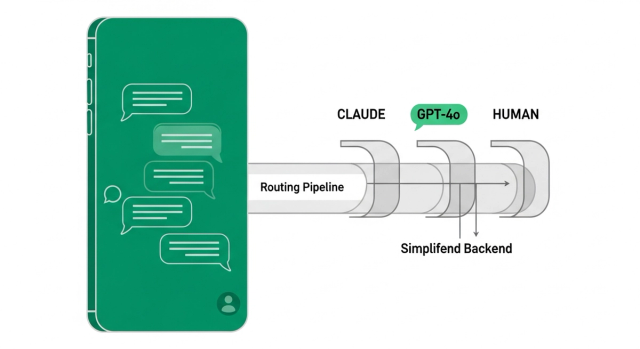
WhatsApp AI Chatbot Build Guide: From WhatsApp Cloud API to Production (2026)
Build a production WhatsApp AI chatbot in 6 days — WhatsApp Cloud API webhook handler, Claude prompt template, escalation flow, cost-per-message math, and the rollback plan we actually use.