What is AI Software Development? An Engineer's Architecture Guide for 2026
We break down what an AI software development engagement actually delivers — the stack, the lifecycle, the eval discipline, and how to evaluate vendors against operator criteria.
On a 1,200-document legal-review corpus we ran in 2026-Q1, a traditionally coded classification pipeline scored 61% precision. After we rebuilt it as an AI software development project using Claude Sonnet 4 plus a pgvector retrieval layer, precision climbed to 89% in six weeks. The contract terms did not change. The corpus did not change. The engineering discipline did — and that gap is what this guide explains.
AI software development is the practice of building production systems in which one or more large language models handle reasoning, generation, or decision-making that previously required hand-coded logic or human review. It is not prompt engineering. It is not bolting a chatbot onto an existing app. It is full-stack engineering discipline: eval-first design, orchestration architecture, retrieval pipelines, observability hooks, human-in-the-loop gates, and continuous improvement loops tied to measurable business outcomes.
This guide covers what AI software development actually is, the architecture that underpins production systems, the tools teams use, and how to evaluate whether an internal team can own the build or whether you need an ai software development company to drive it.
What is ai software development: a working definition
AI software development is a subset of software engineering in which the primary computational layer is one or more trained models rather than deterministic code. The code still exists. The APIs, databases, queues, and deployment pipelines are identical to any modern backend. What changes is where the "if-then" logic lives: instead of hundreds of hand-maintained business rules, a model holds a compressed representation of the problem space and generates outputs at runtime.
Three things separate AI software development from traditional software development. First, the logic is non-deterministic: identical inputs can produce different outputs across runs, which means you need eval infrastructure before you need feature infrastructure. Second, the model is a dependency you do not own: GPT-4o, Claude Opus 4, and Llama 4 are third-party services with their own release schedules, pricing changes, and capability shifts. Your architecture must treat model versions as pinned dependencies. Third, production quality requires a feedback loop: you cannot write tests that cover every output. You need sampling, human review queues, and automated regression suites that grow as the system accumulates real traffic. That non-determinism is exactly why the test layer changes shape — covered axis by axis in our AI agent reliability evaluation rubric.
AI software development architecture: the five-layer stack
Every production AI system we have shipped across healthcare, fintech, legal, and ecommerce resolves to the same five layers. The names differ between teams. The concerns do not. A representative fintech build: our Claude fraud-detection agent for a US bank ships the five-layer stack with BAA scope, precision ≥0.96 at 1% FPR, ~28k decisions per month. For ten generative AI patterns we've shipped across these verticals, see the use-case breakdown.
Layer 1 is the model. You choose it by task: Claude Opus 4 for long-context reasoning over dense documents, GPT-4o for code generation and multimodal input, Llama 4 or Mistral for on-premise deployments where data cannot leave your VPC. AWS Bedrock, Azure OpenAI, and Vertex AI host most of these via managed APIs with SLAs you can put in a contract.
Layer 2 is orchestration. LangChain handles simple chains. LangGraph handles stateful multi-step agents with branching. CrewAI and AutoGen handle multi-agent collaboration where specialized sub-agents divide labor. DSPy handles prompt optimization as a compile step rather than hand-tuning. MCP (Model Context Protocol) standardizes how agents call external tools and data sources.
Layer 3 is memory. Short-term: the context window. Long-term: a vector store. pgvector covers most early-stage production systems because it runs inside your existing Postgres instance. Pinecone and Qdrant become relevant when you cross 10M vectors or need sub-50ms retrieval at scale. Layer 4 is observability. Langfuse and LangSmith trace every chain step, log prompts and completions, and feed your eval dashboard.
The ai software development guide: project lifecycle from discovery to production
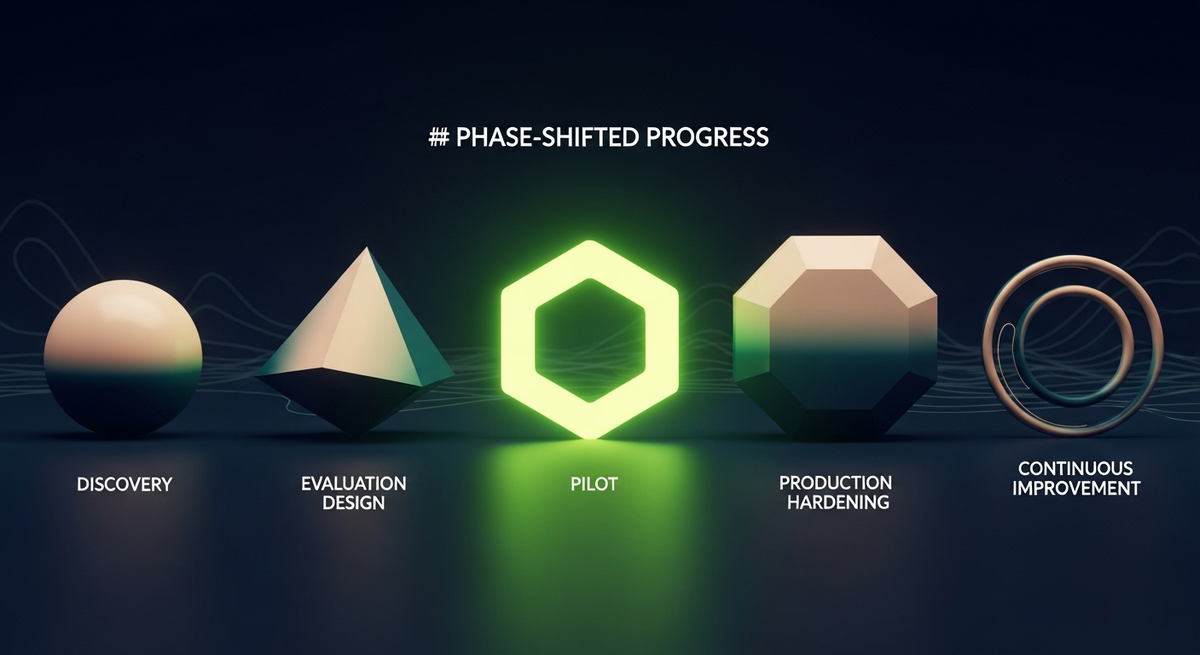
We run every AI software development engagement through five phases. The phase gates exist because AI projects fail in a specific way: teams skip eval-set design, ship a demo that looks impressive, and discover six weeks later that it hallucinates on the 15% of inputs that did not appear in their hand-picked examples. If you're hiring the firm running these phases, see how to score the consulting firm that will run the pilot.
The discovery phase is where most projects die, quietly. The business problem looks clear: "summarize contracts", "triage support tickets", "flag anomalous transactions". The technical problem almost never matches. Contract summarization sounds like a single LLM call until you realize your PDFs have three different table formats, two languages, and references to external exhibits that are not in the uploaded file. Spending two weeks on a audit surfaces these early, while the fix is a scope change rather than a re-architecture.
Eval-set design is the phase most in-house teams skip. They run the model on ten examples, it looks good, and they ship. We require 200 labeled examples before writing a line of application code. That set becomes the regression suite. Every prompt change, every model upgrade, every new document type runs against it. Without it, you cannot know whether a change improved things or just broke a different subset.
AI software development examples across five industries
The most useful AI software development examples are not from OpenAI demos. They come from operational systems where the edge cases are messy and the business outcome is measurable. Here are five patterns we have shipped or audited across different industries.
| Industry | Use case | Architecture pattern | Key metric |
|---|---|---|---|
| Legal | Contract clause extraction | RAG + Claude Sonnet 4 + pgvector | 89% precision on 1,200-doc corpus (2026-Q1) |
| Fintech | Transaction anomaly flagging | LangGraph agent + GPT-4o + rule layer | 42% false-positive reduction vs. rule-only baseline |
| Healthcare | Clinical triage routing | HITL + Claude Opus 4 + audit log | 78% first-contact resolution; 100% escalation audit trail |
| Ecommerce | Product description generation | DSPy-optimized prompt + GPT-4o batch | 3.2× throughput vs. human copywriters at 93% approval rate |
| Manufacturing | Maintenance-manual Q&A | LlamaIndex + pgvector + Langfuse tracing | Sub-2s P95 latency on 40K-page corpus |
The fintech fraud detection case is instructive. The initial brief was "use AI to catch fraud". After discovery, the actual problem was narrower: GPT-4o needed to decide whether to escalate a transaction to the existing rule engine or pass it directly to a human reviewer. The AI layer replaced exactly one decision point in a larger system. That scoping decision — AI as a component, not a replacement — is what made it shippable in six weeks.
For teams evaluating whether to build or buy the model layer, our post on custom ai development versus off-the-shelf products covers the decision framework in detail, including which layers benefit from custom fine-tuning versus prompt engineering.
AI software development implementation: the eval harness
The eval harness is the first piece of infrastructure every AI software development implementation needs. Before you write application code. Before you pick an orchestration framework. Before you design the API schema. You need a way to measure whether the model is doing the right thing on a representative slice of your actual data.
import anthropic
from langfuse import Langfuse
from datasets import load_dataset
from typing import Optional
import json

client = anthropic.Anthropic()
lf = Langfuse()

def run_eval(
    dataset_name: str,
    prompt_template: str,
    model: str = "claude-sonnet-4-5",
    max_tokens: int = 512,
) -> dict:
    """
    Run a labeled dataset against a prompt template.
    Returns precision, recall, and per-example traces in Langfuse.
    """
    dataset = lf.get_dataset(dataset_name)
    results = []

    for item in dataset.items:
        trace = lf.trace(name="eval-run", input=item.input)

        with trace.span(name="model-call") as span:
            response = client.messages.create(
                model=model,
                max_tokens=max_tokens,
                messages=[{
                    "role": "user",
                    "content": prompt_template.format(**item.input)
                }]
            )
            output = response.content[0].text
            span.end(output=output)

        # Score against expected output
        expected = item.expected_output
        match = output.strip().lower() == expected.strip().lower()
        trace.score(name="exact-match", value=int(match))
        results.append({"match": match, "output": output, "expected": expected})

    precision = sum(r["match"] for r in results) / len(results)
return {"precision": precision, "n": len(results), "model": model}import Anthropic from "@anthropic-ai/sdk";
import { Langfuse } from "langfuse";
const client = new Anthropic();
const lf = new Langfuse();
interface EvalItem {
input: Record<string, string>;
expectedOutput: string;
}
async function runEval(
items: EvalItem[],
promptTemplate: string,
model = "claude-sonnet-4-5",
): Promise<{ precision: number; n: number }> {
const results: boolean[] = [];
for (const item of items) {
const trace = lf.trace({ name: "eval-run", input: item.input });
const response = await client.messages.create({
model,
max_tokens: 512,
messages: [{
role: "user",
content: promptTemplate.replace(/\{(\w+)\}/g,
(_, k) => item.input[k] ?? ""),
}],
});
const output = (response.content[0] as { text: string }).text;
const match = output.trim().toLowerCase() === item.expectedOutput.trim().toLowerCase();
trace.score({ name: "exact-match", value: match ? 1 : 0 });
results.push(match);
}
await lf.flushAsync();
return { precision: results.filter(Boolean).length / results.length, n: results.length };
}This harness wires three things together: Anthropic's SDK for model calls, Langfuse for trace logging and scoring, and a labeled dataset. Every run produces a precision number and a full trace in Langfuse. When the number drops after a prompt change, you can drill into which specific examples regressed rather than re-reading logs.
Notice what the harness does NOT do: it does not pick the model, it does not define the prompt, and it does not set the pass/fail threshold. Those are business decisions. The harness just measures. You can swap claude-sonnet-4-5 for GPT-4o on line 15 and rerun. That model-agnostic posture is deliberate.
One thing we learned building eval harnesses across industries: the labeled dataset is the hardest part. Engineers underestimate it. They assume they can label 200 examples in an afternoon. In practice, labeling requires domain experts (a clinician for healthcare notes, a paralegal for contract clauses, a fraud analyst for transaction records), a clear rubric for what counts as correct, and adjudication of disagreements. Budget two weeks and at least one domain SME. The eval harness itself takes two engineers two days. Getting good labels takes ten times longer.
Agent loop architecture and the ReAct pattern
Most AI software development projects that move beyond simple question-answering need agents. An agent is a model in a loop: it reasons about what to do next, calls a tool to get information or take an action, observes the result, and decides whether to continue or return a final answer. The ReAct pattern (reason + act) is the dominant implementation.
LangGraph is our preferred orchestration layer for ReAct agents because it models the loop explicitly as a state graph. Each node is a function. Edges are conditional. You can add checkpointing so the agent resumes from the last successful step after a failure, and you can add human-in-the-loop gates at any edge to require approval before the agent proceeds. This matters for healthcare and fintech use cases where autonomous action carries regulatory risk.
from langgraph.graph import StateGraph, END
from langgraph.checkpoint.memory import MemorySaver
from typing import TypedDict, Literal
import anthropic

client = anthropic.Anthropic()

class AgentState(TypedDict):
    messages: list
    next_action: str
    requires_review: bool
    approved: bool

def plan(state: AgentState) -> AgentState:
    """LLM decides the next action given current message history."""
    response = client.messages.create(
        model="claude-opus-4-5",
        max_tokens=1024,
        system="You are a contract review agent. Reason step by step.",
        messages=state["messages"],
    )
    # Parse structured output to determine if action needs human review
    action = response.content[0].text
    needs_review = "WRITE" in action or "ESCALATE" in action
    return {**state, "next_action": action, "requires_review": needs_review}

def human_review(state: AgentState) -> AgentState:
    """Interrupt node — LangGraph pauses here, waits for external approval."""
    # In production: write to review queue, return thread_id
    # Human approves via API: graph.invoke(None, config, command=Command(resume=True))
    return state

def execute(state: AgentState) -> AgentState:
    """Execute the planned action (write, escalate, etc.)"""
    # ... action implementation
    return {**state, "messages": state["messages"] + [{"role": "assistant", "content": state["next_action"]}]}

def route(state: AgentState) -> Literal["human_review", "execute", "__end__"]:
    if "DONE" in state["next_action"]:
        return END
    if state["requires_review"] and not state["approved"]:
        return "human_review"
    return "execute"

# Wire the graph
builder = StateGraph(AgentState)
builder.add_node("plan", plan)
builder.add_node("human_review", human_review)
builder.add_node("execute", execute)
builder.set_entry_point("plan")
builder.add_conditional_edges("plan", route)
builder.add_edge("human_review", "execute")
builder.add_edge("execute", "plan")

graph = builder.compile(checkpointer=MemorySaver(), interrupt_before=["human_review"])
The HITL gate (human_review node) is declared at compile time via interrupt_before. When the graph reaches that node, it serializes state, pauses, and waits for an external resume signal. The human reviewer sees the pending action in a queue UI, approves or rejects, and the graph continues from exactly that point. This pattern is not an edge case for compliance-heavy industries — it is the default for any agent that can write data, send messages, or change system state.
Benchmark comparisons: what the numbers actually mean for your project
Published model benchmarks are lagging indicators. By the time a leaderboard score is public, three competing models have been released. We track two numbers that matter more for production AI software development: RECALL@5 on a domain-specific corpus and P95 latency under production load. Here are public benchmarks from 2026-Q1 that we use as reference points when scoping projects.
The gap between 88% and 71% recall sounds like a product choice. In practice, it depends entirely on your corpus. We have seen GPT-4o outperform Claude on structured financial data where the question-answer format matches GPT-4o's training distribution better. We have seen Claude Opus 4 outperform GPT-4o by 18 points on dense clinical text. Run your own eval-set before you commit to a model. The public leaderboard is a starting point, not a final answer.
Cost is the sleeper concern. At $0.003 per 1K input tokens, Claude Sonnet 4 is economical for interactive use cases. At $0.015 per 1K input tokens (Claude Opus 4), bulk processing of a 10M-token corpus per day costs $150/day at the model layer alone — before infrastructure, observability, and engineering overhead. Haiku 4 at $0.0003/1K becomes the right model for high-throughput classification tasks where the accuracy difference is smaller than the cost difference.
What makes the best ai software development: team composition and tooling
The best AI software development outcomes we have seen share three characteristics: a small team with clear ownership of the eval harness, an architect who thinks in terms of failure modes rather than feature lists, and a deployment setup that can ship a prompt change in under 30 minutes without a full CI/CD cycle.
The pgvector adoption figure at 51% reflects a practical reality: most teams already run Postgres. Spinning up a separate Pinecone instance for a pilot adds infrastructure complexity and a new billing relationship before you have proven the use case. Start with pgvector, measure retrieval quality against your eval-set, and migrate to Pinecone only when your vector count or query-per-second requirement exceeds what Postgres can serve.
For teams evaluating whether to hire specialized AI engineers, our guide on how to hire ai developer profiles covers the specific skills that matter most: eval harness design, vector search tuning, and observability setup — versus the skills that are overrated in most AI hiring pipelines (ML theory, model fine-tuning). On staffing economics, see what hiring the engineers for this work costs in 2026.
Build vs. buy: when to engage an AI software development company
The build vs. buy decision for AI systems is not the same as the build vs. buy decision for CRM software. Off-the-shelf AI products (Intercom's AI, Salesforce Einstein, ServiceNow's NowAssist) handle generic use cases well. They fail when your data is proprietary, your domain vocabulary is specialized, or your accuracy threshold is higher than the product's default behavior. Knowing which situation you are in is worth a discovery audit.
Best when: proprietary data corpus, domain-specific accuracy requirements above generic-product defaults, regulatory audit trail requirements, or competitive differentiation requires the AI capability itself. Requires: eval harness, orchestration, vector store, observability layer. Timeline: 6-14 weeks for production-ready pilot. Fails when: problem is generic and a product already solves it, or internal team lacks eval-first discipline.
Best when: use case is generic (support routing, FAQ answering, meeting summaries), speed to value matters more than accuracy optimization, and the product's data handling meets your compliance requirements. Fails when: domain vocabulary is specialized (legal clause types, medical codes, financial instruments), accuracy gap between the product default and your requirement is >10 points, or the product cannot show you its eval methodology.
A third option exists and is underused: augment an existing product with a custom AI layer. Take a standard CRM, wire it to a Claude-backed contract analyzer via webhooks, and surface the analysis inside the existing UI. The sales team never leaves Salesforce. The AI layer runs against your proprietary deal data. This hybrid approach gets the best of both: product-grade UX, custom accuracy on the specific task that moves your metrics.
RAG architecture in AI software development: when retrieval changes everything
Most production AI software runs into context window limits within the first month. Your legal corpus is 40,000 pages. Your product documentation is 8,000 articles. Your financial database is 5 years of quarterly reports. The model cannot read all of it on every call. Retrieval-Augmented Generation (RAG) solves this by fetching only the relevant chunks at query time and inserting them into the context window.
A well-tuned RAG pipeline requires four decisions: chunk size (512 tokens works for prose, 256 for dense tables), embedding model (text-embedding-3-large from OpenAI for English-dominant corpora, multilingual-e5 for mixed-language), retrieval strategy (pure vector search works for semantic queries, hybrid BM25 + vector search outperforms on keyword-heavy queries), and reranking (a cross-encoder reranker running after the initial retrieval step typically adds 8-15 points of RECALL@5 at the cost of 80-120ms latency).
Chunk boundary failures are the most common production RAG bug we diagnose. A 512-token chunk slices a paragraph in half. The first half describes the penalty clause. The second half lands in the next chunk along with the indemnification language. A query for "penalty clause details" retrieves the first half. The model answers with the only half it can see. The answer is technically retrieved, factually incomplete, and passes a naive faithfulness check. The fix is overlap chunking (128-token overlap between adjacent chunks), semantic boundary detection (split on paragraph or sentence boundaries rather than token count), and RECALL@5 measurement on queries you know the answer to.
If the AI system you're designing involves customer-facing conversation, the architecture choices overlap with generative ai development use cases — the RAG pattern is the same, but the output format and latency requirements differ significantly between a background batch job and a real-time chat interface.
Observability and eval: measuring what AI software development ships
Traditional software breaks with a stack trace. AI software fails with a plausible-sounding wrong answer. The system keeps running. The error rate on your monitoring dashboard stays at zero. Meanwhile, 12% of your contract summaries are missing a key clause because the chunk size was wrong and the relevant paragraph landed in the middle of a chunk boundary.
Langfuse and LangSmith solve this by making every model call visible. Every prompt, every completion, every tool call, every latency number is traced and searchable. Arize and Phoenix add active monitoring: they sample production traffic, run it through your eval criteria, and alert when accuracy degrades below a threshold. Braintrust adds A/B testing for prompt variants. Helicone sits in front of any OpenAI-compatible API and adds usage analytics and caching without code changes.
The 19% figure for cost-per-outcome tracking is the number we find most interesting. Most teams track token cost. Few track what a token costs relative to the business outcome it produced. A $0.05 model call that resolves a $200 support ticket has a different ROI than a $0.05 model call that mis-routes a compliance alert and costs an analyst 45 minutes of rework. Connecting observability data to business outcome data is where AI software development moves from a cost center to a measurable investment.
When NOT to use AI software development (and what to use instead)
We turn down AI software development projects. Not often, but regularly. The situations are predictable: the problem has a deterministic solution, the dataset is too small to build a meaningful eval, or the accuracy threshold required makes AI the wrong tool at current model capability levels.
| Situation | Situation | Recommendation | Reasoning |
|---|---|---|---|
| Problem has a deterministic answer (calculate, sort, filter) | Write the code | AI adds latency, cost, and non-determinism without benefit. Rule engine or SQL is faster and cheaper. | |
| < 100 labeled examples available | Build the dataset first | You cannot evaluate accuracy, so you cannot know if you shipped something useful. | |
| Accuracy requirement > 95% on specialized domain | Pilot + validate before committing | Current models hit 88-93% on most domains. 95%+ is achievable but requires fine-tuning or multi-agent verification patterns. | |
| Data cannot leave your infrastructure (air-gapped) | Self-hosted model (Llama 4 / Mistral via vLLM or Ollama) | Bedrock / Azure / Vertex not viable. Budget for GPU infra and model ops. | |
| Problem is well-defined, data is available, accuracy >80% acceptable | Start the pilot | Good fit. Run discovery → eval-set → pilot sequence. Expect production-ready in 8-14 weeks. |
The 95% accuracy row is worth expanding. Most AI software development projects land in the 82-92% range on first production deployment. Getting from 92% to 96% typically requires one of three approaches: fine-tuning the model on your domain corpus (adds $5-50K cost, takes 4-8 weeks, requires enough labeled data), multi-agent verification (a second model checks the first model's output, adds latency and cost), or human-in-the-loop for the tail of low-confidence predictions. All three are engineering-tractable. None is free.
AI software development FAQ
What is the difference between AI software development and traditional software development?
Traditional software development produces deterministic systems: given the same inputs, you get the same outputs every time. AI software development produces systems where a large language model handles the core reasoning, making the system non-deterministic. The code layer is identical — APIs, databases, queues, deployment pipelines. What changes is how you test it (eval harnesses instead of unit tests), how you monitor it (LLM-specific observability tools like Langfuse), and how you manage the model as a versioned dependency.
How long does an AI software development project take?
A production-ready pilot takes 6-14 weeks depending on data complexity and integration requirements. A discovery audit in weeks 1-2 defines the scope. Eval-set design takes 1-2 weeks. The pilot build takes 4-6 weeks. Production hardening (load testing, observability wiring, rollback gates) takes 2-4 weeks. Projects that skip the eval phase are usually the ones that take longer, because they discover the accuracy problems after the build rather than before.
Which model should I use for AI software development — Claude or GPT-4o?
Run your own eval before committing. Claude Opus 4 scores higher on long-context reasoning and dense document understanding (88% RECALL@5 on BEIR, 2026-Q1). GPT-4o performs strongly on code generation and multimodal inputs. Claude Sonnet 4 is the best cost-performance option for most interactive use cases. At high volume, Claude Haiku 4 at $0.0003/1K tokens beats GPT-4o on cost by an order of magnitude for tasks where both clear the accuracy bar.
What does an AI software development company actually deliver?
A good AI software development company delivers four things: a labeled eval dataset (200+ examples, domain-specific), a working orchestration stack (LangChain/LangGraph plus your vector store), an observability setup that shows you accuracy and latency in production (Langfuse or LangSmith), and a handover that includes documented prompt logic, eval scripts, and a runbook for model upgrades. What they should NOT deliver: a black-box demo that only works on the examples they prepared.
What is RAG in the context of AI software development?
Retrieval-Augmented Generation (RAG) is the pattern where relevant documents or data records are fetched from a vector store and inserted into the model's context window at query time. This lets the model reason over large corpora (40K-page document sets, multi-year transaction histories) without needing to see all the data on every call. pgvector handles most early-stage RAG pipelines. Pinecone and Weaviate become relevant at scale. Retrieval quality, measured by RECALL@5 on your corpus, is typically more impactful than model choice.
How do I evaluate whether AI software development is right for my use case?
Three questions: Is the problem non-deterministic (does it require interpretation, judgment, or generation rather than calculation)? Do you have at least 100-200 examples you could label to build an eval set? Is an accuracy rate above 80% sufficient, or do you need deterministic correctness? If yes to all three, AI software development is likely the right path. If the problem is deterministic or accuracy needs to be 100%, write the code or use a rule engine.
Where to start with AI software development: the audit
The most common failure mode in AI software development is not technical. Teams have good engineers, reasonable data, and a real business problem. They fail because they estimate the project like a traditional software project: write the spec, assign the sprints, ship the feature. AI development does not work that way. The accuracy curve is not linear. The blockers are data quality issues you discover in week three, not architecture decisions you make in week one.
Our discovery audit produces three things: a technical spec for the AI system with architecture choices justified against your data and accuracy requirements, a 200-example labeled eval set with a baseline accuracy number from running your top two candidate models against it, and a scoped pilot proposal with a fixed price. You know what you are buying before you commit to the build. If the discovery finds that the problem is better solved without AI — that happens — we say so.
We have shipped AI software development projects in healthcare, fintech, legal, ecommerce, and manufacturing. Our stack is model-agnostic: Claude, OpenAI, open-source, on-premise, cloud-hosted. Our eval methodology is the same regardless of which model ends up in production. If you want to understand what it would take to ship your specific use case, the audit is the right place to start.
One thing that surprises most engineering leads at the audit stage: the biggest risk is rarely the model. Current models are capable enough for most production use cases at 80-92% accuracy on well-defined tasks. The risk is data. Bad labeling, unrepresentative eval sets, or corpora that are 80% boilerplate with 20% edge-case variation drive most project failures. The audit surfaces that before you have committed budget to an eight-week build.

AI Developer Salary Guide 2026 — Source-Bound Market Data
AI developer salaries by stack and seniority, sourced from Levels.fyi, Indeed, ZipRecruiter, PwC AI Jobs Barometer. Hiring decision matrix: in-house vs contractor vs agency vs freelance.

Custom AI Solutions vs Off-the-Shelf: 2026 Decision Guide
When to build custom AI vs buy off-the-shelf — decision tree, named tools, hybrid pattern, data-residency angle. 2026-Q1 eval benchmarks vs ChatGPT Enterprise, Copilot, Glean.

AI Consulting Firms: A 6-Criteria Scoring Rubric (2026)
Score AI consulting firms on 6 weighted criteria — eval maturity, named stack, audit logs, engagement shape. 12 firms scored. Start the audit conversation.
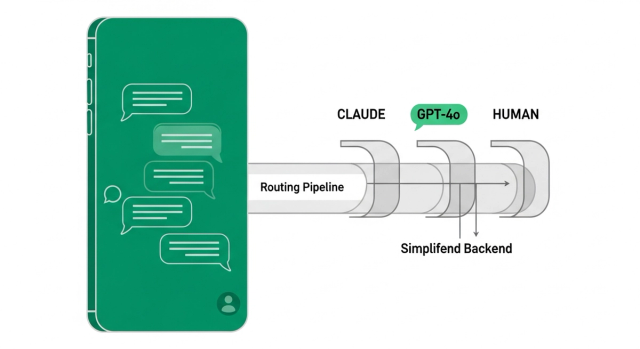
WhatsApp AI Chatbot Build Guide: From WhatsApp Cloud API to Production (2026)
Build a production WhatsApp AI chatbot in 6 days — WhatsApp Cloud API webhook handler, Claude prompt template, escalation flow, cost-per-message math, and the rollback plan we actually use.