The Best AI Chatbots in 2026: A Practitioner Comparison
Top AI chatbots in 2026 compared by workload. Coding, research, writing, long-context, multimodal, cost — practitioner picks with current benchmarks.

By April 2026 the top four AI chatbots cluster within 3 points of each other on MMMU-Pro, within 0.5 points on GPQA Diamond, and within 4 points on SWE-bench Verified. The classic benchmarks are saturated. That changes the question we get from clients: it is no longer "which AI chatbot is smartest," it is "which one wins for this specific workload."
Our team has shipped chatbot systems across healthcare triage, legal Q&A, fintech onboarding, ecommerce support, and HR. We use Claude, ChatGPT, Gemini, Grok, Perplexity, and DeepSeek APIs in production. We pay real bills and route work to the cheapest model that still passes our eval. The shortlist below is grouped by job. That is how the choice actually gets made in practice.
All scores cited here are from public May 2026 leaderboards (SWE-bench, TAU-bench, GPQA Diamond, Humanity's Last Exam, Fiction LiveBench, EQ-Bench, MMMU-Pro, Artificial Analysis pricing). Numbers move monthly. The framework — match the chatbot to the workload — does not.
Why "best ai chatbots" depends entirely on the workload
Three things shifted in 2026 that broke the old "best overall" listicle format. First, every flagship now scores above human PhD level on GPQA Diamond. The top four sit within roughly one question of each other on a 198-question test. Second, multimodal saturated: GPT-5.5, Gemini 3, Claude Opus 4.7, and Qwen 3.5 Omni all sit within 2.4 points on MMMU-Pro. Third, the public benchmarks themselves are leaking into training data, so harder versions like SWE-bench Pro tell a different story than SWE-bench Verified.
What remains genuinely different across the top ai chatbots is specialization. Claude wins agentic coding and policy-following customer service. Gemini wins video, audio, and the cheapest path to frontier reasoning. GPT-5 wins charts, code-from-screenshots, and search-grounded factuality. Grok 4 wins very-long-context comprehension at 2M tokens. DeepSeek V4-Pro wins open-weight cost-efficiency. That is why every section below names the workload first and the model second.
Best AI chatbot for coding and software development
Claude Opus 4.7 is the current pick for hard, multi-file coding work. It leads SWE-bench Verified at 87.6%, with GPT-5.3 Codex at 85.0% and Gemini 3.1 Pro at 80.6%. Our engineers run Claude Code daily for production refactors and PR review. The model handles long file chains without losing track of imports, and its refactor diffs land cleanly more often than the alternatives we've tested. For agentic coding workloads specifically, we cover the orchestration patterns that get the most out of Opus in our Claude with LangGraph multi-agent architecture walkthrough.
If you cannot pay frontier prices, DeepSeek V4-Pro is the alternative we shortlist. Open-weight under MIT license, it scores 80.6% on SWE-bench Verified, within 0.2 points of Claude Opus 4.6, at roughly one tenth the per-output-token cost. Kimi K2.6 Thinking is the strongest fully open-source coding model on LiveBench (78.6 coding average), worth knowing if you need self-hosted inference for compliance.
| Model | SWE-bench Verified | License | Notes |
|---|---|---|---|
| Claude Opus 4.7 | 87.6% | Closed | Best for multi-file refactors, agentic dev |
| GPT-5.3 Codex | 85.0% | Closed | Strong in IDE / OpenAI Codex CLI |
| Gemini 3.1 Pro | 80.6% | Closed | Catches up when you need 1M context |
| DeepSeek V4-Pro | 80.6% | MIT (open) | Roughly 10x cheaper output tokens |
| Kimi K2.6 Thinking | 78.6 (LiveBench) | Open | Best self-hostable agentic coder |
Best AI chatbot for research, citations, and factual answers
For factual recall, the chatbot is less important than whether web search is on. GPT-5-thinking with search reaches 95.1% on SimpleQA. Without search, parametric hallucination still sits in the 10–25% range for every frontier model we've tested. The honest answer for any client building a research tool: ground the model in retrieval, do not trust its memory.
Perplexity AI is the chatbot built around this principle. Every response cites sources, and Sonar Reasoning Pro hit an F-score of 0.858 on SimpleQA, the strongest search-native result we found. We use Perplexity for competitive intelligence and regulatory updates where source attribution matters more than raw fluency. Gemini 2.5 Pro leads aggregate factuality benchmarks when you need a foundation model rather than a search system.
The pattern from our deployments: pair a strong general chatbot with a search-grounded API for any question that touches recent events, regulations, or specific facts. We've moved several production agents from "Claude alone" to "Claude plus Perplexity as a tool" after watching hallucination rates collapse in production logs.
Best AI chatbot for writing and long-form reasoning
Claude Opus 4.7 leads EQ-Bench Creative Writing at Elo 2216, with GPT-5.5 second at 2024 and Claude Sonnet 4.6 third at 1991. EQ-Bench uses human raters and pairwise comparisons across narrative quality, character voice and emotional depth. Those criteria separate good prose from generic chatbot output. When clients ask which model to draft white papers or legal briefs in, Claude is the default answer.
Two specialized cases break the default. Grok 4.1 Thinking leads the separate Creative Writing v3 benchmark at 1721, with a less filtered, more idiosyncratic voice that some teams want for marketing copy. And for analytical writing on dense technical material, GPT-5.5 is closer to Opus than the EQ-Bench gap suggests, particularly when you need code embedded in prose. Our internal style guide picks Claude for narrative work, GPT-5.5 for technical explainers, Grok only when the brand voice asks for it.
Best AI chatbot for long documents and large-context work
Context windows in 2026: GPT-5.4 via Codex, Claude Opus 4.6, Qwen 3.6 Plus, Llama 4 Maverick, and Gemini 3.1 Pro all hit 1M tokens. Grok 4 reaches 2M. Llama 4 Scout takes the title at 10M. Pricing penalties matter. OpenAI charges 2× past 272K tokens; Google charges 2× past 200K. Anthropic, xAI and DeepSeek charge flat rates regardless of depth.
The bigger number does not always win. Fiction LiveBench, which probes story comprehension at depth rather than simple retrieval, shows Grok 4 and Gemini 3.1 Pro as the standouts past 192K tokens. Most other models degrade sharply somewhere around 32K, even when they advertise a million-token window. The headline window is marketing; the depth profile is the truth.
Best AI chatbot for images, charts, video, and document OCR
MMMU-Pro saturated this year. By April 2026 GPT-5.5, Gemini 3, Claude Opus 4.7, and Qwen 3.5 Omni all clear 80% within 2.4 points of each other. GPT-5.4 Pro tops the strict leaderboard at 94%, but for production work the more useful split is which model wins which modality.
Gemini 3 Deep Think wins video and audio understanding. When a client needs to chat with hours of recorded meetings, Gemini is the routing default. GPT-5.5 wins charts, dashboards and code-from-screenshots, which is why we use it for tools that ingest analytics or UI mockups. Claude Opus 4.7 wins long-document OCR and table extraction: invoices, contracts, regulatory PDFs. For pure image Q&A, GPT-5.4 Pro is the highest scorer, but the cost differential rarely justifies it over Gemini 3 Pro for everyday work.
Best AI chatbot for everyday chat — and what is actually free
For most people typing a question into a chat box, the frontier model differences vanish. ChatGPT's free tier (GPT-5 nano routing), Gemini 2.5 Flash, and Claude Haiku 4.5 all deliver fast, coherent answers for daily writing, summarization, brainstorming, and casual coding. DeepSeek's free web chat sits in the same bucket. Surprisingly capable, cheap to run because the underlying model costs $0.14 in and $0.28 out per million tokens.
Speed is the differentiator users actually feel. Llama 4 Scout streams at 2,600 tokens per second through Cerebras and similar inference providers. Mercury 2, built on a diffusion architecture rather than autoregressive decoding, hits 789–1,100 tokens per second on Artificial Analysis benchmarks. Frontier reasoning models live in the 50–150 tokens per second range. Fine for considered work, sluggish for real-time chat. Pick the fast model for everyday questions, escalate to the smart one for the hard 20%.
AI chatbot comparison — pricing, speed, and context at a glance
The table below is the practitioner ai chatbot comparison we use internally for cost and capacity routing. Output prices vary by 640× across the published frontier, which is the single biggest factor in chatbot architecture decisions for any product shipping at scale.
| Model | Input $/1M | Output $/1M | Context window | Tier |
|---|---|---|---|---|
| Claude Opus 4.6 | $5.00 | $25.00 | 1M | Premium |
| Claude Sonnet 4.6 | $3.00 | $15.00 | 200K | Mid |
| GPT-5.4 | $2.50 | $15.00 | 1M (2x past 272K) | Frontier |
| GPT-5.4 Pro | $30.00 | $180.00 | 1M | Premium frontier |
| Gemini 3.1 Pro | ~$1.25 | ~$10.00 | 1M (2x past 200K) | Frontier |
| Gemini 3 Flash | $0.50 | $3.00 | 1M | Mid |
| Gemini 3.1 Flash-Lite | $0.10 | $0.40 | 1M | Cheap |
| Grok 4 | ~$3.00 | ~$15.00 | 2M | Frontier |
| DeepSeek V3.2 | $0.14 | $0.28 | 128K | Ultra-cheap |
| DeepSeek V4-Pro | ~$0.30 | ~$1.20 | 1M | Open frontier |
What makes each AI chatbot architecturally different
A feature checklist hides the real differences. The matrix below maps each chatbot to its defining trait and the deployment context where that trait pays off. This is the decision aid our routing layer is built around.
| Chatbot | Defining trait | Architecture | Pick it when |
|---|---|---|---|
| Claude Opus 4.7 | Multi-step agents, policy-following, prose depth | Closed; safety-tuned | Hard coding, agentic workflows, long-form writing |
| GPT-5.5 | Charts, code-from-vision, search-grounded factuality | Closed; deep tool integration | Mixed media analysis, factual Q&A with search |
| Gemini 3.1 Pro | Video, audio, cheapest frontier reasoning | Closed; native multimodal | Workspace integration, audio/video understanding |
| Grok 4 | Largest usable context (2M), real-time X data | Closed; less filtered | Book-length comprehension, social listening |
| DeepSeek V4-Pro | Frontier scores at ~10× cheaper output cost | Open weights, MIT license, MoE | Self-hosted, compliance-sensitive, cost-bound |
| Perplexity / Sonar | Search-grounded, cited answers | Search-augmented system, not a foundation model | Research workflows, citation-required output |
How to choose the right AI chatbot for your product
Three questions resolve most chatbot decisions for production work. First, what is the workload? Coding routes to Claude or DeepSeek; research routes to Perplexity plus a strong general model; multimodal routes to whichever specialty matches. Second, what is the cost budget per turn? At any meaningful volume, output token cost dominates and the 640× spread matters more than the 3-point benchmark difference. If your chatbot backend runs on Node.js, our guide to apps built with Node.js covers the runtime trade-offs we've seen at scale. When the workload crosses into multi-step tool-using behavior, the build moves from chatbot to agent — covered separately in our AI agent development service.
Third, what are the data residency and compliance constraints? Healthcare and legal deployments often rule out the cheapest US-hosted options outright and push the decision toward Claude on AWS Bedrock, Gemini on Vertex AI, or self-hosted DeepSeek V4-Pro. For chatbot interfaces shipping inside a mobile app, our Flutter mobile app development guide walks through the integration patterns we've used across ten industries.
The question is not which chatbot is best in the abstract. It is which one wins for this workload, this compliance context, and this cost budget. The answer changes per project, and that is the work.
FAQs about the best AI chatbots in 2026
What is the best AI chatbot for coding in 2026?
Claude Opus 4.7 leads SWE-bench Verified at 87.6%, ahead of GPT-5.3 Codex at 85.0% and Gemini 3.1 Pro at 80.6%. For self-hosted or cost-bound deployments, DeepSeek V4-Pro reaches 80.6% under an MIT license at roughly one tenth the output cost.
Which AI chatbot hallucinates the least?
Search-grounded chatbots beat parametric-memory chatbots on factual recall. GPT-5-thinking with web search reaches 95.1% on SimpleQA. Perplexity's Sonar Reasoning Pro hits an F-score of 0.858 on the same benchmark. Without search, hallucination rates stay in the 10–25% range for every frontier model.
What is the best AI chatbot for writing?
Claude Opus 4.7 leads EQ-Bench Creative Writing at Elo 2216, with GPT-5.5 second and Claude Sonnet 4.6 third. Grok 4.1 Thinking leads the separate Creative Writing v3 benchmark. Pick Claude for narrative and analytical writing; pick Grok when you want a less filtered voice for marketing copy.
What is the cheapest capable AI chatbot?
DeepSeek V3.2 at $0.14 input / $0.28 output per million tokens is the cheapest API that still scores in the upper tier on aggregate benchmarks. Gemini 3.1 Flash-Lite at $0.10 / $0.40 is comparable on cost with a million-token context window.
What is the best open-source AI chatbot?
DeepSeek V4-Pro (1.6T parameter MoE, MIT license) is the strongest open-weight frontier model at 80.6% on SWE-bench Verified with 1M token context. Kimi K2.6 Thinking leads open-source on agentic coding benchmarks. Llama 4 Scout has the biggest open context window at 10M tokens but trails Chinese labs on coding.
How do top AI chatbots compare on context window size?
Llama 4 Scout leads at 10M tokens (open source). Grok 4 reaches 2M. Claude Opus 4.6, Gemini 3.1 Pro, GPT-5.4, Qwen 3.6 Plus, and Llama 4 Maverick all hit 1M. DeepSeek V3.2 sits at 128K. But on Fiction LiveBench, most models degrade past ~32K. The advertised window and the usable window are different numbers.
Is paid AI chatbot worth it over free?
For casual chat, the free tiers of ChatGPT, Gemini, and Claude cover most needs. Paid tiers earn the upgrade when you need long-context work (1M tokens), priority rate limits, multimodal inputs, or agentic tool use. Builders shipping chatbot products should compare API costs, not consumer subscription tiers.

Is Cursor AI Worth It? An Honest Review After 6 Months in Production
Six months of Cursor in production: 2026 update covering Composer 2, background agents, Hooks, MCP, the June 2025 pricing reset, real cursor vs Copilot team cost math, and where Continue.dev fits as the open-source alternative.
LLM Development Services: 11 Companies Scored on Eval, Pricing + Audit (2026)
A rubric-driven look at LLM development vendors. Eval methodology, deployment patterns, pricing transparency, and how to score them on the same criteria.
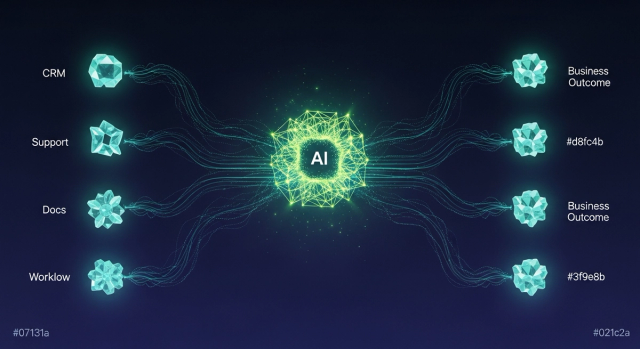
AI Integration for Business: Where It Pays Off (and Where It Doesn't)
AI integration for business in 2026: where it pays off, where it fails, and the IBM/Deloitte numbers behind the gap. Five real integration patterns with 569Xlvalue, plus the five things the 5% of pilots that ship have in common.