Best Flutter Toast Widgets in 2026: SnackBar, fluttertoast, and the Packages Still Worth Knowing
Top 10 Flutter toast widgets to show short-lived popup messages — code examples, customization options, and how to integrate GetWidget's GFToast.
Toast notifications are an Android UX pattern that Flutter inherits, but Flutter's official answer is SnackBar, not toast. Most tutorials treat the two as synonyms and skip the part where iOS does not actually have toasts in its design language. This guide walks through Flutter's built-in SnackBar widget (the right default in most apps), the fluttertoast package and when its cross-platform shim earns the dependency, the flutter toast widget alternatives like flash and another_flushbar, plus the state-management and accessibility patterns no listicle covers.
Two framing notes. First, the toast vs SnackBar distinction matters. SnackBar anchors to the bottom of a Scaffold, sits above the system navigation, and ships in Material as the canonical short-lived feedback element. Toast widgets from fluttertoast and similar packages draw as an Android-style overlay that floats above the entire screen, which is the native Android behavior but feels foreign on iOS. Second, the ten flutter toast widget packages older guides cataloged include several stalled or duplicate options. We name the four worth knowing in 2026 and the ones we have dropped.
Flutter SnackBar: the built-in flutter toast widget alternative
SnackBar is the Material widget Flutter ships for short transient messages. It uses ScaffoldMessenger (introduced in Flutter 2.0) to show messages from anywhere in the widget tree without holding a Scaffold reference. With useMaterial3: true, it picks up M3 styling automatically: rounded corners, color tokens from your ColorScheme, action button styling.
void showSnack(BuildContext context, String message, {String? actionLabel, VoidCallback? onAction}) {
  ScaffoldMessenger.of(context).showSnackBar(
    SnackBar(
      content: Text(message),
      duration: const Duration(seconds: 4),
      behavior: SnackBarBehavior.floating,
      action: actionLabel != null && onAction != null
          ? SnackBarAction(label: actionLabel, onPressed: onAction)
          : null,
    ),
  );
}
Two M3 specifics worth knowing. SnackBarBehavior.floating gives you the M3-recommended floating card style (rounded, margin from edges); the default behavior: fixed snaps to the bottom edge which is the older M2 look. ScaffoldMessenger.removeCurrentSnackBar() is how you dismiss the current snackbar before showing a new one. Without it, snackbars queue and the user sees stale messages after the action that triggered them.
SnackBar has built-in screen reader announcement. TalkBack on Android and VoiceOver on iOS read the content aloud automatically. This is the single biggest reason to default to SnackBar over a third-party flutter toast widget. The a11y comes free, and most toast packages do not match it.
Picking the right notification widget: SnackBar, MaterialBanner, Dialog, or BottomSheet
Before reaching for a toast package, check that SnackBar is even the right widget. Material 3 has four built-in surfaces for transient or modal feedback. Each one signals a different urgency level to users.
| Message type | SnackBar | MaterialBanner | AlertDialog | BottomSheet |
|---|---|---|---|---|
| Confirmation of success (saved, sent) | Yes, default | No | Too heavy | No |
| Recoverable error with undo action | Yes, with SnackBarAction | OK if persistent | No | No |
| Persistent app-wide warning | No, dismisses too fast | Yes, stays until dismissed | Too intrusive | Overkill |
| Action requires user choice | No | Yes, 1-2 actions | Yes, 2-3 actions modal | Yes if 4+ options |
| Form input or multi-step flow | No | No | Yes for short | Yes for long |
The most common mistake we see in code review: using a SnackBar to communicate critical errors. SnackBar dismisses in 4 seconds. If the user looks away or scrolls, they miss the message. For 'we could not save your changes' or 'connection lost' use a MaterialBanner that persists until the user dismisses or fixes it.
When you actually need a flutter toast widget package over SnackBar
Built-in SnackBar covers 80% of toast/notification needs in Material apps. The community packages below earn their place when SnackBar's bottom-anchored placement, Material styling, or single-message limit gets in the way. We shortlisted these four out of the ten the older guides cataloged based on maintenance, Dart 3 compatibility, and unique capability over SnackBar.
| Package | What it adds over SnackBar | When to pick it |
|---|---|---|
| fluttertoast | Android-style overlay floating anywhere on screen | App needs the native Android toast look (not for iOS-first apps) |
| another_flushbar | Top or bottom positioning, dismissable swipe, rich content slots | Apps needing branded notification cards with action and icon slots |
| bot_toast | Multiple notifications stacked, loading toast, custom positioning | Apps with frequent overlapping notifications (chat, real-time updates) |
| toastification | Modern API, animation presets, RTL support, theme presets | Newer apps starting fresh — clean API and good defaults |
Packages we removed from the previous shortlist: flutter_local_notifications (different category — system notifications, not in-app), flash (still maintained but largely overlaps with another_flushbar), overlay_support (low-level, most teams reach for higher abstractions), flutter_styled_toast (stalled), flutter_smart_dialog (broader dialog manager, not focused), top_snackbar_flutter (built-in SnackBar with floating behavior covers this now), getwidget GFToast (still works, but built-in SnackBar with a themed ColorScheme matches the same look without a dependency).
fluttertoast in detail: when it shines and where it breaks
fluttertoast is the most-downloaded toast package and the one most teams adopt first. It draws an Android-native-style toast on Android (using the platform Toast API under the hood) and a Flutter-rendered overlay on iOS that mimics the Android visual. The API is simple, which is the appeal.
import 'package:fluttertoast/fluttertoast.dart';

Fluttertoast.showToast(
  msg: 'Saved successfully',
  toastLength: Toast.LENGTH_SHORT,
  gravity: ToastGravity.BOTTOM,
  backgroundColor: Colors.black87,
  textColor: Colors.white,
  fontSize: 14,
);
Three things to know before you ship fluttertoast in a production app. First, on iOS the Flutter-rendered overlay does not match iOS design language — users notice. Second, the package's Android toast uses the OS Toast API which has been deprecated for app-initiated toasts since Android 11 in favor of SnackBar-style in-app messaging. Third, fluttertoast does not announce its message to TalkBack or VoiceOver in the same way SnackBar does, so a11y users miss the feedback entirely.
Showing a toast from anywhere: state management without BuildContext gymnastics
The common headache with SnackBar is needing a BuildContext from inside the Scaffold's subtree. From a deeply nested widget, that is fine. From a Bloc, repository, or background worker, you have no context. Three patterns we use to solve this without leaking context across layers.
Pattern one: a global ScaffoldMessengerKey on MaterialApp. Pass scaffoldMessengerKey: rootScaffoldMessengerKey to MaterialApp, then call rootScaffoldMessengerKey.currentState?.showSnackBar(...) from anywhere. Simple, but creates a global which testing setups have to mock around.
final rootScaffoldMessengerKey = GlobalKey<ScaffoldMessengerState>();

MaterialApp(
  scaffoldMessengerKey: rootScaffoldMessengerKey,
  // ...
);

// Anywhere:
rootScaffoldMessengerKey.currentState?.showSnackBar(
  const SnackBar(content: Text('Saved')),
);
Pattern two: a state-management-driven event stream. The repository or Bloc emits a 'show snack' event into a stream; a top-level widget listens and calls showSnackBar in response. Cleaner architecturally but more code per snack.
Pattern three: pass context up. Repository methods that need to surface feedback take a callback parameter (onSuccess, onError) and the calling widget shows the snack. Most architecturally clean, but tedious for repos called from many places. We default to pattern one for most apps and graduate to pattern two when the snack logic gets complex enough to need testing in isolation.
Accessibility: SnackBar reads itself; most toast packages do not
Material SnackBar announces its content to screen readers automatically when it appears. fluttertoast, bot_toast, and many other community packages render as Overlay widgets without Semantics announcements — the message appears visually but the screen reader stays silent. For apps with any compliance obligation, this is a real audit risk.
If you ship a non-SnackBar toast in an a11y-sensitive app, wrap the visible toast widget in Semantics with liveRegion: true and explicit label. liveRegion: true tells the screen reader to announce changes to this widget when they happen — without it, the toast appears silently. Test on a real device with TalkBack enabled, not just the simulator.
// If you must use a non-SnackBar toast, wrap it like this:
Semantics(
  liveRegion: true,
  label: 'Saved successfully',
  child: _toastContainer,
);
Testing flutter toast widget code: what changes in widget tests
SnackBar is the easiest to test because it ships as a Material widget inside the Scaffold's overlay. Trigger the action that shows the snack, await pumpAndSettle, and assert find.text(message) is present. Third-party toasts that render in their own overlay route are harder. Your test setup has to know about the package's specific overlay key or finder to assert visibility.
testWidgets('save shows confirmation snackbar', (tester) async {
  await tester.pumpWidget(MyApp());
  await tester.tap(find.byKey(const Key('save_button')));
  await tester.pumpAndSettle();
  expect(find.text('Saved successfully'), findsOneWidget);
});
If your app currently uses fluttertoast and you want toast assertions in widget tests, the package is awkward to test because Toast.showToast() resolves through a platform channel by default — Flutter test harness does not run platform channels. We have migrated several client apps from fluttertoast to SnackBar specifically because test coverage was the gap that mattered for them.
Toasts and snackbars are one piece of the broader Flutter feedback surface. The full Flutter widgets catalog covers the rest. For broader production patterns we apply on every Flutter delivery — state, performance, CI/CD, accessibility — see our Flutter mobile app development field guide.
Cross-platform consistency: making toasts feel native on iOS and Android
One of the recurring challenges with flutter toast widget choices is that Android and iOS have different design conventions for transient feedback. Android has the native Toast pattern. iOS does not have a true equivalent in its design language. The result: whichever widget you pick will feel native on one platform and slightly off on the other unless you account for it.
Our default rule for cross-platform Flutter apps: SnackBar with SnackBarBehavior.floating on both platforms. On Android, this matches the modern Material 3 floating snackbar. On iOS, it reads as a Cupertino-style bottom card that does not break iOS users' expectations. The single SnackBar widget covers both platforms without conditional logic in your code. We consider it one of the best flutter widgets in our shipped pattern library precisely because it removes a platform-fork from every screen that needs feedback.
If your design has decided that toasts must look truly platform-native (Android toast on Android, iOS-style center alert on iOS), you wire that conditionally. Theme.of(context).platform gives you the current platform; render fluttertoast on Android, render a SnackBar with floating behavior on iOS, or build a Cupertino-styled custom overlay. We have shipped both patterns. The single-SnackBar pattern is roughly 80% of the per-screen code and 0% of the platform-fork bugs the conditional pattern introduces.
One last cross-platform note. SnackBar's default placement is above the system navigation bar on both platforms. On iPhone with the home indicator, it floats just above the indicator; on Android with gesture navigation, same. If you have a persistent BottomNavigationBar, SnackBar correctly stacks above it without overlapping. fluttertoast renders at a Y-offset you specify (default 50 dp from bottom) and will collide with a BottomNavigationBar unless you adjust gravity. Another reason SnackBar wins for most apps.
One pattern worth surfacing for teams shipping under tight deadlines. Build a single feedback helper at the start of your project that wraps ScaffoldMessenger.of(context).showSnackBar with sensible defaults: 4-second duration, floating behavior, ColorScheme.error for errors, ColorScheme.primary for confirmations. Every team we have audited that built this helper on day one ships consistent feedback across every screen. Every team that called showSnackBar inline from each handler ended up with subtly different SnackBars from screen to screen, then spent the redesign sprint normalizing them. The cost of the helper is roughly twenty lines of code; the cost of skipping it is a multi-day design audit cleanup task that lands on the team six months after the inconsistency has shipped to production users.
Common questions about flutter toast widgets
Should I use SnackBar or fluttertoast for messages in a Flutter app?
Default to SnackBar. It is Material's built-in answer to transient messages, comes with accessibility support, and integrates with ScaffoldMessenger for showing messages from anywhere. Use fluttertoast only when the app is Android-first and the design specifically requires the native Android toast look.
How long should a flutter toast widget stay visible?
Material 3 default is 4 seconds for SnackBar. The Material spec suggests 4–10 seconds depending on message length; longer than 10 seconds and the message stops feeling transient. For critical messages users must read, use MaterialBanner (persistent) instead of extending SnackBar duration.
How do I show a SnackBar from outside the Scaffold's context?
Use ScaffoldMessenger with a GlobalKey<ScaffoldMessengerState>. Pass it to MaterialApp.scaffoldMessengerKey, then call rootScaffoldMessengerKey.currentState?.showSnackBar(...) from anywhere. This avoids the BuildContext-not-found error when calling from Bloc, repository, or background code.
Can I show multiple toasts at the same time in Flutter?
SnackBar queues sequentially — call showSnackBar twice and the second appears after the first dismisses. For true stacking (multiple visible at once), use bot_toast or toastification. We push teams to dismiss the previous SnackBar with removeCurrentSnackBar() before showing a new one rather than queuing, since queued snacks shown after the triggering action confuse users.
Is fluttertoast still maintained in 2026?
Yes, fluttertoast is still maintained and Dart 3 compatible. The Android implementation uses platform Toast API which has been deprecated for app-initiated toasts since Android 11 in favor of SnackBar-style UI. The package still works but on modern Android it is not using the native toast surface the way the package name implies.
How do I make Flutter toasts accessible to screen readers?
SnackBar announces its content to TalkBack and VoiceOver automatically. fluttertoast, bot_toast, and most Overlay-based packages do not. Wrap the visible toast widget in Semantics with liveRegion: true and an explicit label to force the screen reader to announce it when it appears.
How do I test that a SnackBar appears in a widget test?
Trigger the action, await tester.pumpAndSettle(), then expect(find.text('your message'), findsOneWidget). SnackBar renders inside the Scaffold overlay which the test harness can find directly. fluttertoast and other platform-channel-based packages are harder to test because the test environment does not run platform channels.
What is the difference between SnackBar and MaterialBanner?
SnackBar is transient — appears briefly, dismisses on its own. MaterialBanner is persistent — appears at the top of the Scaffold and stays until the user dismisses or fixes the underlying state. Use SnackBar for confirmation messages; use MaterialBanner for warnings or errors users must acknowledge.

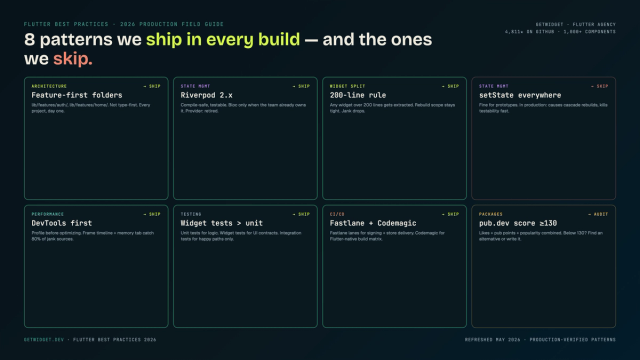
Flutter Mobile App Development: A 2026 Production Field Guide
How we structure Flutter projects at GetWidget in 2026: feature-first layout, Riverpod defaults, Dart 3 records and sealed classes, Material 3 theming, the 200-line widget rule, performance diagnosis, CI/CD pipelines, and the production pitfalls that bite teams after launch.

How to Implement Badges in a Flutter App in 2026: Material 3 Badge, badges Package, and OS-Level Icon Badges
How to add badge notifications to a Flutter app using the badges package — install, position, animate, and style with code examples and best practices.
How to Design Custom Flutter Buttons in 2026: A Practitioner Guide to All 5 M3 Button Widgets
Flutter button widgets in 2026: the five Material 3 button classes (Filled, FilledTonal, Elevated, Outlined, Text), ButtonStyle deep-dive, GFButton when M3 isn't enough, FAB and IconButton patterns, M2 migration map, plus the accessibility and performance bars no tutorial covers.