Enterprise AI Platform Buyer's Guide: A Decision Rubric for 2026
Build vs buy vs orchestrate decision rubric for enterprise AI platforms. Operator-honest comparison across Databricks, Snowflake Cortex, IBM watsonx, AWS Bedrock, Vertex AI, Azure AI Foundry, and DIY orchestration — with cost archetypes and a 12-week deployment shape.
On a 1,840-document internal retrieval corpus we ran in 2026-Q1, AWS Bedrock with Claude Sonnet 4 hit 88% recall@5 at 240ms p95 and $0.014 per 1k tokens. Vertex AI with Gemini 2.5 Pro hit 81% recall@5 at 310ms p95 and $0.011 per 1k tokens. Same prompt, same corpus, same retrieval layer (pgvector with HNSW). The platform you pick changes the answer. So does the model. So does which layer you put where. An enterprise ai platform purchase is one of the highest-leverage decisions a Director of Data or Head of Platform Engineering will make this year, and the buyer's-guide content currently ranking for it is almost entirely written by vendors selling their own platform. This guide is written by an operator that builds on top of all of them.
We deliver Claude, OpenAI, and open-source LLM systems for clients across healthcare, fintech, legal, and ecommerce. Some clients run on Databricks. Some on Snowflake Cortex. Some on Bedrock. Some on Vertex AI. Some on Azure AI Foundry. A few have decided not to buy a platform at all and orchestrate the stack themselves with LangGraph, pgvector, and a model provider. We've shipped on each path. That cross-platform view lets us rank the options honestly. Most buyer's-guide pages can't, because the author sells one of the platforms in the comparison. The sections below cover enterprise ai platform architecture in depth, four enterprise ai platform examples grounded in our delivery work, an enterprise ai platform guide for procurement teams, and an enterprise ai platform implementation schedule with weekly eval gates. The question of which is the best enterprise ai platform depends on the buyer's data plane and governance posture more than on any single vendor scorecard. This guide is also a complement to our conversational ai platform explainer, which covers a related but distinct category aimed at customer-facing chat — not the same buying decision.
What an enterprise AI platform actually is in 2026
An enterprise ai platform is the integrated stack that lets a large organization design, deploy, and operate AI applications at scale, with the governance layer attached. The exact definition drifts by vendor, but in practice every credible platform covers four layers: data and features, model registry and serving, orchestration and retrieval, and governance and audit. If a vendor sells you only one of those layers and calls the bundle a platform, they are selling a tool. A platform is the integration.
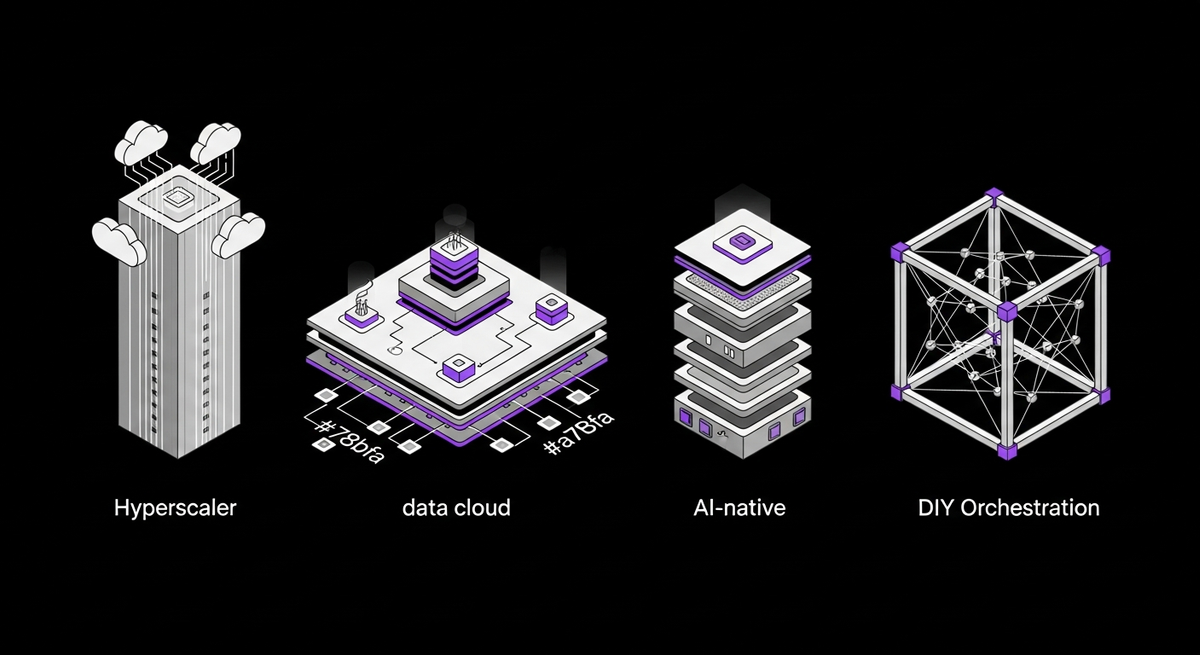
The vendors in this market split into four archetypes. Cloud-native platforms (AWS Bedrock, Vertex AI, Azure AI Foundry) bolt the AI layer onto an existing hyperscaler account. Data-platform incumbents (Databricks, Snowflake Cortex) extend their data plane up into model serving and agents. AI-first platforms (DataRobot, IBM watsonx, C3 AI) sell the full stack as a category buy. And vendor SaaS assistants (Moveworks, Salesforce Einstein, Glean) sell the application layer with the platform hidden underneath. The 4-layer model below is the through-line that lets you compare across archetypes.
Enterprise AI platform reference architecture: the 4 layers that matter
Read the diagram below before any vendor demo. The four columns are not vendor-specific. They are the architectural decomposition any enterprise AI platform must answer. When a vendor pitches you, force the conversation back to these columns: which layer do you own, which do you re-sell, and which do you assume the customer integrates. Most platform RFP failures we've seen start with the buyer accepting a vendor's bundling story without mapping it to this stack.
When we audit a client's existing AI stack, we map their current tooling onto these four columns and look for the gaps. The most common gap is the orchestration column — buyers acquire a model gateway plus a vector store and assume the orchestration is a thin glue layer they will write themselves. Six months later, the glue is a 3,000-line tangle of Python with no eval harness. That gap, more than any vendor choice, is the failure mode we see most often.
Buy vs build vs orchestrate-yourself: the 5-question decision rubric for an enterprise ai platform
Most platform-purchase conversations skip the buy-vs-build question entirely. The vendor's sales motion frames it as buy-vs-buy: which of the bundled platforms wins. The honest question is whether the buyer needs a platform at all. Below is the 5-question rubric we walk every prospective client through before they sign a platform contract. If you answer the first three columns the same way, the fourth column tells you what to do. We have told prospective clients to skip the platform purchase and stay on direct ai software development with their own team. When the math says skip, we say skip.
| Decision factor | BUY a full platform | BUILD on cloud-native | ORCHESTRATE yourself |
|---|---|---|---|
| Use-case count | 8+ use cases · multi-LOB · shared data plane needed | 3-7 use cases · one cloud stack already chosen | 1-2 use cases · scope and team are bounded |
| Team profile | No in-house MLE; data-eng team only | 1-2 MLEs + senior data eng; can integrate but not build infra | Senior MLE + LangGraph/Bedrock fluency in-house |
| Governance posture | Regulated (FINRA / HIPAA / GxP); SOC2 + ISO27001 mandatory at procurement gate | SOC2 required; can inherit from hyperscaler stack | Internal pilot or non-regulated workload |
| Vendor-lock tolerance | High lock acceptable for time-to-value | Medium lock — already inside AWS / GCP / Azure | Low lock — must keep model-layer optionality |
| Total cost ceiling Year 1 | $1M+ all-in is justifiable against revenue | $200K-1M annual platform + usage | Sub-$200K Year 1 budget; mostly compute and FTE |
Side-by-side: Databricks, Snowflake Cortex, DataRobot, IBM watsonx, AWS Bedrock, Vertex AI, Azure AI Foundry
The seven platforms below are the shortlist almost every enterprise AI RFP we see lands on, after vendor SaaS assistants (Moveworks, Salesforce Einstein, Glean) are filtered out for being application-layer, not platform-layer. Every row has a weakest-at cell. No vendor escapes critique. This is the rubric we hand clients during the audit phase before they shortlist.
| Platform | Data plane | Model layer | Governance | Best fit | Weakest at |
|---|---|---|---|---|---|
| Databricks (Mosaic AI) | Native lakehouse + Delta | MosaicML + Bedrock + open-source serving | Unity Catalog, audit log, BYOK | Lakehouse-native orgs with heavy data-eng team | RAG orchestration is bring-your-own; model-gateway routing weaker than Bedrock |
| Snowflake Cortex | Native Snowflake | Cortex hosted LLMs + bring-your-own | Snowflake Horizon governance | Snowflake-heavy data orgs; SQL-first ML teams | Model selection narrower than Bedrock or Vertex; weaker for agent orchestration |
| DataRobot | Connects to lakehouse; not native | Classical ML strong; LLM layer added 2024-2025 | Mature for predictive AI; LLM governance newer | Predictive AI use cases with light gen-AI bolt-on | Generative AI maturity trails Bedrock/Vertex; orchestration limited |
| IBM watsonx | watsonx.data lakehouse | Granite + bring-your-own (Llama, Mistral) | watsonx.governance — strongest of the seven | Regulated industries (banking, healthcare) with IBM relationship | Model layer slower to ship frontier models; weaker dev DX than Bedrock |
| AWS Bedrock | Bring-your-own (S3, Redshift, lakehouse-agnostic) | Claude, Llama, Mistral, Cohere, Titan; broadest | IAM, KMS BYOK, CloudTrail audit, GuardRails | AWS-native orgs; teams wanting model-layer optionality | Data-plane integration is bring-your-own work; no native feature store |
| Vertex AI | BigQuery integration native; lakehouse via partner | Gemini, Claude, Llama; long-context Gemini leader | Vertex Model Garden + governance suite | GCP-native orgs; long-context multimodal use cases | Smaller third-party model catalog than Bedrock; weaker Anthropic integration depth |
| Azure AI Foundry | Microsoft Fabric + ADLS | OpenAI (GPT-4o, GPT-5), Llama, Mistral, Claude via partner | Microsoft Purview + Foundry safety | Microsoft-stack orgs; Office/M365-attached use cases | OpenAI-centric — Claude/Gemini integration deeper on Bedrock/Vertex respectively |
Model layer: Claude Sonnet 4 vs GPT-4o vs Gemini 2.5 across Bedrock, Vertex AI, Azure AI Foundry
Two ordering strategies exist for the model-layer decision. Either pick the platform first and accept whichever frontier models that platform hosts, or pick the model first and let the model choice drive the platform. Both can work. The trade-off below is the one we walk clients through. For Claude-specific orchestration patterns on top of Bedrock or Anthropic Workbench, our deep-dive on claude agents covers the state-machine wiring in depth. Where the model-first ordering wins — clients who want Claude on Bedrock and GPT on Azure routed by workload — our AI development practice builds that routing layer outside the platform's bundled choices.
Default for organizations already committed to one hyperscaler. If you are AWS-native, Bedrock gives you Claude Sonnet 4, Claude Opus 4, Claude Haiku 4, Llama 4, Mistral, Cohere Command, and Titan inside your existing IAM and KMS boundary. If you are GCP-native, Vertex AI gives you Gemini 2.5 Pro with the longest production context window plus Anthropic via partner and Llama 4. Faster to procurement signoff because data residency, audit log, and BYOK are inherited from the hyperscaler. Trade-off: the day Anthropic ships a frontier model only on one platform, your platform choice locks your model choice for that quarter.
Default for organizations whose core use case has a clear model-quality winner. If your eval harness shows Claude Opus 4 is the only model hitting your accuracy bar, pick the platform that hosts Claude with the lowest friction (Bedrock first, Anthropic Workbench second, Vertex via partner third). If your use case is long-context multimodal, Gemini 2.5 Pro on Vertex is the floor. Trade-off: you may end up multi-platform, which means duplicating governance, audit, and BYOK wiring across clouds. We have shipped this pattern and it works, but the FTE cost is real.
The model-first path is more common than vendor sales decks admit. Eval results matter more than procurement convenience when the underlying use case is revenue-bearing. We default to model-first for client work whose business case is conversion-rate or accuracy-driven, and platform-first for use cases that are productivity-bearing or compliance-gated.
Dated benchmark: Bedrock Claude Sonnet 4 vs Vertex AI Gemini 2.5 on a 1,840-doc retrieval corpus, 2026-Q1
Benchmarks without methodology are marketing. The numbers below come from a single internal eval our delivery team ran in 2026-Q1 on a 1,840-document mixed-format corpus (PDF, HTML, internal wiki). Retrieval layer was pgvector with HNSW indexes, top-k retrieval=5, reranker disabled to isolate the model-side win. Eval framework was Ragas plus a custom regression harness in Braintrust. Same prompt, same corpus, same retrieval. Only the model gateway changed. We share this not as a universal claim. Run your own eval. Your corpus is not our corpus.
We unpack the full eval setup in our RAG benchmark methodology writeup, including the Ragas + pgvector stack and the prompt suite we open-sourced.
Enterprise AI platform market sizing: 2026 spend by Gartner + IDC
The buyer-side timing question (do we sign now or wait a quarter) lands on market data. Two reports anchor this for us in 2026. Gartner's Magic Quadrant for Cloud AI Developer Services (2026 edition) places Databricks, Bedrock, and Vertex as the three leaders, with watsonx and Snowflake in the visionary quadrant and DataRobot rated for specific predictive-AI strengths. IDC's 2026 AI Infrastructure tracker measures LLM-serving spend at strong double-digit YoY growth across enterprise buyers. We surface a handful of the most relevant 2026 anchors below, sourced to report names so the reader can verify.
Implementation reality: 12-week rollout schedule with weekly eval gates
Enterprise ai platform rollouts fail at the same two points. The first is week 4, when the proof-of-concept that worked on 20 documents fails at 2,000. The second is week 10, when production traffic exposes the orchestration gap that nobody wrote during pilot. The 12-week schedule below is the one we recommend, with weekly eval gates that catch both failure modes before they compound. The JSON below is a real config our delivery team uses; sanitize and adapt.
{
  "engagement": "enterprise-ai-platform-rollout",
  "duration_weeks": 12,
  "platform": "AWS Bedrock + LangGraph + pgvector",
  "weekly_gates": [
    { "week": 1, "focus": "data plane audit", "exit": "S3 + IAM + KMS + audit log green" },
    { "week": 2, "focus": "corpus ingest + chunking", "exit": "5000+ docs indexed in pgvector" },
    { "week": 3, "focus": "retrieval baseline", "exit": "recall@5 >= 0.80 on 200-q eval set" },
    { "week": 4, "focus": "model gateway wiring", "exit": "Claude Sonnet 4 + GPT-4o + fallback chain live" },
    { "week": 5, "focus": "orchestration v1", "exit": "LangGraph state machine + HITL gate shipped" },
    { "week": 6, "focus": "eval harness", "exit": "Ragas + regression in CI; per-PR eval running" },
    { "week": 7, "focus": "governance + audit", "exit": "audit log retention SLA + model card + red team report" },
    { "week": 8, "focus": "load test", "exit": "p95 latency under 400ms at 50 QPS sustained" },
    { "week": 9, "focus": "shadow traffic", "exit": "10% shadow with no regression vs control" },
    { "week": 10, "focus": "canary", "exit": "5% live with rollback path tested" },
    { "week": 11, "focus": "ramp + observability", "exit": "Langfuse + Datadog dashboards wired" },
    { "week": 12, "focus": "handoff", "exit": "runbook + on-call rotation + retraining cadence" }
  ],
  "non_negotiables": [
    "eval harness exists before week 6",
    "rollback path tested before any live traffic",
    "audit log retention SLA documented before week 7 gate"
  ]
}
Orchestrate-yourself: when LangGraph + pgvector + Bedrock beats any platform purchase
If the decision rubric scored you Orchestrate-yourself, the wiring below is the floor of what your team needs to ship. It is not a toy. It is a real pattern we have shipped in production for clients whose use case did not justify a platform purchase. The Python snippet shows a LangGraph state machine routing through pgvector retrieval and a Bedrock model call. The TypeScript snippet shows the same pattern via the Vercel AI SDK for client-side orchestration. For the broader operator pattern, our piece on agentic ai covers when this kind of self-orchestrated stack outperforms a vendor agent platform.
from langgraph.graph import StateGraph, END
import boto3, psycopg

bedrock = boto3.client('bedrock-runtime', region_name='us-east-1')

def retrieve(state):
    with psycopg.connect(DB_URL) as conn:
        rows = conn.execute(
            'SELECT content FROM docs ORDER BY embedding <=> %s LIMIT 5',
            [state['query_emb']]).fetchall()
    return {'context': [r[0] for r in rows]}

def generate(state):
    body = {'anthropic_version': 'bedrock-2023-05-31',
            'max_tokens': 1024,
            'messages': [{'role': 'user',
                          'content': f"Context: {state['context']}\n\nQ: {state['query']}"}]}
    resp = bedrock.invoke_model(
        modelId='anthropic.claude-sonnet-4-20251022-v1:0',
        body=json.dumps(body))
    return {'answer': json.loads(resp['body'].read())['content'][0]['text']}

g = StateGraph(dict)
g.add_node('retrieve', retrieve)
g.add_node('generate', generate)
g.set_entry_point('retrieve')
g.add_edge('retrieve', 'generate')
g.add_edge('generate', END)
app = g.compile()import { bedrock } from '@ai-sdk/amazon-bedrock';
import { generateText } from 'ai';
import { Pool } from 'pg';
const pool = new Pool({ connectionString: process.env.DATABASE_URL });
export async function answer(query: string, embedding: number[]) {
const { rows } = await pool.query(
'SELECT content FROM docs ORDER BY embedding <=> $1 LIMIT 5',
[embedding]);
const context = rows.map(r => r.content).join('\n\n');
const { text } = await generateText({
model: bedrock('anthropic.claude-sonnet-4-20251022-v1:0'),
prompt: `Context: ${context}\n\nQ: ${query}`,
maxTokens: 1024,
});
return text;
}Two cautions on the orchestrate-yourself path. First, you own the governance work that a platform would have inherited from its parent (audit log retention, BYOK rotation, PII filtering, red-team reports). Second, you own the eval harness. Neither is hard, but both are real engineering. If your team does not have a senior MLE who has shipped one of these before, the platform purchase is probably worth the tax.
Governance + audit: what enterprise procurement actually checks
Procurement does not care about your eval harness. Procurement cares about audit log retention, SOC2 report dates, customer-managed encryption keys, data residency, and a model card with a red-team report attached. The checklist below is the one our regulated-industry clients hand to platform vendors during RFP. Every cell marks pass, partial, or gap as of 2026-Q1. Numbers shift; verify with the vendor before signature. Our AI governance engagement ships these procurement artifacts — model card, audit log schema, SOC2 mapping, CMK policy — as deliverables on a 6-week rollout.
| Control | Databricks | Snowflake Cortex | AWS Bedrock | Vertex AI | Azure AI Foundry | IBM watsonx |
|---|---|---|---|---|---|---|
| SOC2 Type II | pass | pass | pass (inherited) | pass (inherited) | pass (inherited) | pass |
| ISO 27001 | pass | pass | pass | pass | pass | pass |
| GDPR posture | pass | pass | pass | pass | pass | pass |
| BYOK / customer KMS | pass (Unity) | pass (tri-secret) | pass (KMS) | pass (Cloud KMS) | pass (Key Vault) | pass |
| Audit log retention SLA | pass | partial | pass (CloudTrail) | pass (Cloud Audit) | pass (Purview) | pass |
| Model card transparency | partial | partial | pass (per-model) | pass (per-model) | partial | pass |
| Data residency controls | pass | pass | pass (region pin) | pass (region pin) | pass (region pin) | pass |
| Red-team report shared | partial | partial | partial | partial | partial | pass |
Cost breakdown: platform fees, model usage, observability, FTE — the 4 cost lines
Sticker price misleads. Every enterprise ai platform engagement has four cost lines, and the ratio between them varies wildly by archetype. The chart below shows the rough share of total cost of ownership across four archetypes we have delivered against. The vendor-SaaS column looks cheapest on sticker but hides FTE cost in change-management and integration work. The orchestrate-yourself column looks cheapest on platform fees but spends most of its budget on FTE. Read the bars as percentages of total Year-1 TCO, not absolute dollars.
Observability sits at 8-15% across every archetype. Skipping it to save 10% is the highest-regret cost decision we see clients make. The eval harness and observability stack are the cheapest insurance on the entire engagement; the cost of an undetected accuracy regression in production is many multiples. The cost-stack diagram below maps the four archetypes against the four cost lines on a single canvas. It is a useful artifact to put in front of a CFO or Director of Procurement during the platform decision; the diagram makes the FTE-shaped trade-off legible in a way the bar chart alone does not.
Two patterns the diagram makes legible. First: every archetype spends 30-62% of Year-1 TCO on FTE. Platform purchase does not eliminate engineering work, it just shifts where the work goes. Second: model usage dominates cloud-native (38%) but is far smaller for full-stack platforms (18%) because the platform fee bundles model access. Buyers who model their TCO using only the sticker price of platform fees consistently underestimate Year-1 spend by 30-40%. The cost-stack view is a more honest input to a CFO conversation.
Red flags in enterprise AI platform RFPs
We sit on the vendor side of enough RFPs to spot the response patterns that predict failure. The seven flags below recur across vendors. They are not unique to any platform. When you see one, push harder on the corresponding question before signing. C3 AI, DataRobot, and the vendor SaaS assistants in the SERP for this category (Moveworks, Glean) each tend to show one or two of these in our experience; the cloud-native and lakehouse vendors show others. None are disqualifying alone, but two or more should slow your procurement.
Operator note: how we actually pick an enterprise ai platform on client work
FAQ — enterprise AI platform buying questions
What is the difference between an enterprise AI platform and an LLM provider like Anthropic or OpenAI?
An LLM provider sells a model and an inference API. An enterprise AI platform integrates a model layer with data plane, orchestration, retrieval, and governance — the full stack you need to run AI in production at a regulated organization. Anthropic Workbench and the Anthropic API are model-layer products; Bedrock, Vertex AI, Azure AI Foundry, Databricks, and watsonx are platforms that host model providers including Anthropic, OpenAI, and others.
When should we buy an enterprise AI platform versus orchestrate the stack ourselves?
Use the 5-question rubric above. Score Buy on at least 4 of 5 rows and a full platform purchase is the right call. Score Orchestrate on 3 or more (especially with a senior MLE in-house and 1-2 scoped use cases) and skip the platform tax. The middle column — build on cloud-native (Bedrock, Vertex, Foundry) — wins more often than vendors will tell you.
Databricks vs Snowflake Cortex — which is the better enterprise AI platform?
Both extend a strong data plane up into AI. Databricks Mosaic AI ships broader model-serving and agent orchestration support; Snowflake Cortex has a narrower model catalog but tighter SQL-first integration. If your data team writes more PySpark than SQL, Databricks. If your data team writes more SQL than PySpark, Snowflake. The data-plane choice usually predicts the AI-platform choice.
IBM watsonx vs AWS Bedrock vs Vertex AI — which fits regulated industries best?
IBM watsonx ships the most mature governance layer (watsonx.governance) and the strongest red-team transparency in our 2026-Q1 review. Bedrock and Vertex inherit governance from the hyperscaler and are competitive but require more wiring on the customer side for documented model cards. For banking and healthcare workloads with a strict procurement gate, watsonx clears the bar fastest; for general regulated workloads where the org is already AWS- or GCP-native, the hyperscaler platform wins on velocity.
How do we mitigate vendor lock-in on an enterprise AI platform?
Three patterns work. First, isolate orchestration in LangGraph or LangChain — the orchestration layer should be portable across platforms. Second, keep the model layer multi-vendor (Claude on Bedrock plus Gemini on Vertex plus an open-source fallback like Llama 4 on vLLM). Third, own the retrieval layer (pgvector or Pinecone instances you control) so the data does not live inside the platform's proprietary index. Lock-in is unavoidable; portable orchestration mitigates the worst of it.
Are vendor pricing models for enterprise AI platforms transparent in 2026?
Partially. Cloud-native platforms (Bedrock, Vertex, Foundry) publish per-1k-token list pricing on every hosted model. Lakehouse platforms (Databricks, Snowflake Cortex) publish per-DBU or per-credit pricing for compute. Full-stack platforms (DataRobot, watsonx, C3 AI) typically quote by deal — get at least two competitive bids before signing. If a vendor refuses to share even an entry tier without a sales call, treat that as a red flag per the RFP checklist above.
What is the minimum governance posture an enterprise AI platform should have to pass procurement in 2026?
Eight controls our regulated-industry clients require: SOC2 Type II, ISO 27001, documented GDPR posture, customer-managed encryption keys (BYOK), audit log with a retention SLA in writing, per-model model cards with data lineage, data-residency region pinning, and a red-team report shared under NDA. Every platform in the 2026 shortlist clears the first three; the differentiation is on the last five. The procurement checklist table above marks pass / partial / gap per platform.


RAG Benchmark Methodology: How We Score Retrieval + Generation in 2026
The four-axis frame we score on (recall, faithfulness, relevancy, cost-per-query), the Ragas metrics, the corpus + judge selection, and the failure modes — the methodology behind our 2026-Q2 RAG benchmark on getwidget.dev.

Is Cursor AI Worth It? An Honest Review After 6 Months in Production
Six months of Cursor in production: 2026 update covering Composer 2, background agents, Hooks, MCP, the June 2025 pricing reset, real cursor vs Copilot team cost math, and where Continue.dev fits as the open-source alternative.