Generative AI Consulting vs Build: An Operator's Rubric for 2026
Should you hire a Gen AI consultant or build in-house? Operator decision rubric with eval methodology, named-model trade-offs, 6-week pilot blueprint, and a 7-question RFP.
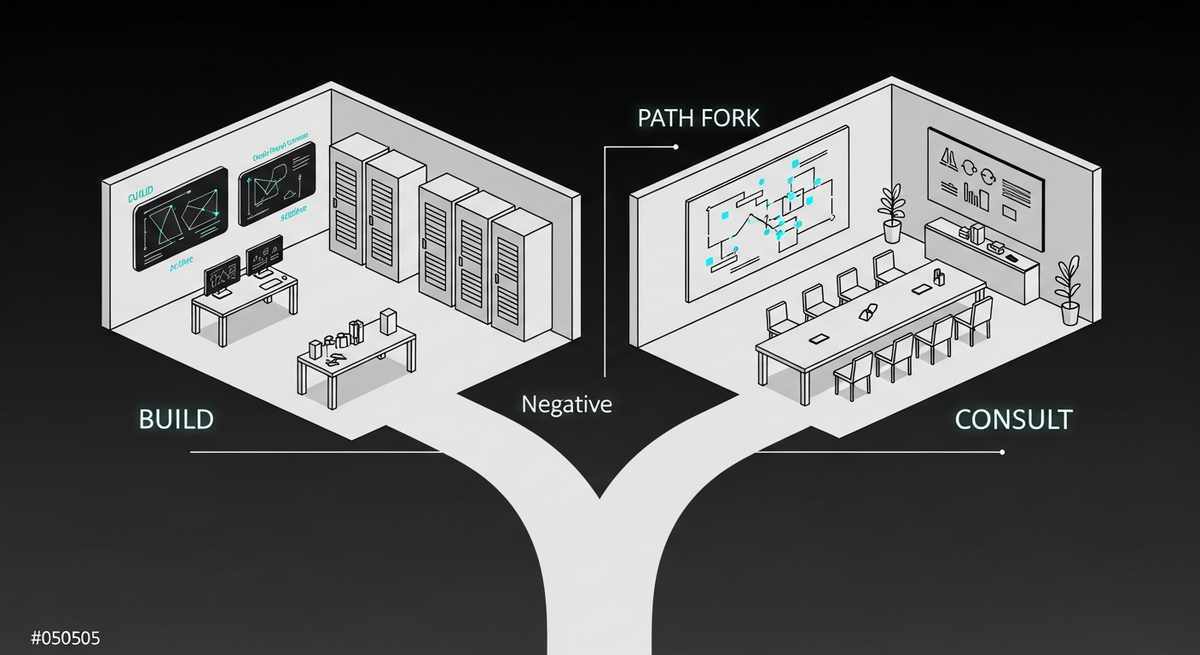
Most generative ai consulting buyers have the same problem: budget approved, board-deck use case, three vendor quotes reading like the same document. What's missing is a way to decide whether to hire a consultant, staff the work internally, or run a hybrid where the consultant exits after week six. This generative ai consulting guide is our rubric, with generative ai consulting examples from our audit inbound.
We've been on both sides of that table. We're an operator studio that ships Gen AI systems for clients and runs Claude Code on our own delivery. So we wrote the decision rubric we wished buyers had: when consulting pays off, when it doesn't, what engagements actually cost, what to ask in an RFP. Numbers below come from our public pricing and named-source benchmarks, not invented client wins. When the decision lands on build, our AI development engineering team runs the delivery.
When generative ai consulting actually pays off
Consulting pays off when the buyer has a real production target, a usable corpus, and no in-house pattern for evaluating LLM systems. The first 4-6 weeks save more time than they cost because someone outside has already failed at the same problem and knows which sub-decisions matter. Model choice, retriever architecture, eval gate, observability stack: each has two or three serious options and a dozen distracting ones.
It doesn't pay off when the buyer has a senior ML engineer on staff, the use case is a single-model OpenAI Assistants integration, and data lives in one warehouse. That team needs Cursor licenses and a deadline, not a consultancy.
The 4 build-vs-consult decision factors
Four factors: maturity (anyone on staff shipped one of these before?), surface area (one use case or a portfolio?), regulation (does a model-risk committee gate the system?), time pressure (board target this quarter?). The decision matrix below is what we walk through on the kickoff call.
| Buyer shape | Build in-house | Hybrid: audit then build | Hire a consultancy |
|---|---|---|---|
| Senior MLE on staff + single use case + low regulation | Yes: best fit | No | No (overspend) |
| No ML staff + multi-use-case portfolio + light regulation | No (won't ship) | Strong fit | Considered |
| Regulated industry + first Gen AI system + quarterly board target | No (model risk gate stalls) | Considered | Yes: best fit |
| Existing AI team + new modality (voice, agents) + named benchmark required | Considered | Yes: typical engagement | No (you have the team) |
| Strategy team needs use-case prioritization, not code | No | Audit only, no build | Yes (advisory scope) |
What 'AI maturity' actually measures
Vendors talk about maturity in vague stage names. Operationally, the only thing that matters is whether your team has shipped a measured LLM system to production once. Stage 1 has a LangChain pilot on a laptop. Stage 3 has an eval gate (we use Ragas on most pilots) refusing deploys that drop recall below threshold. Stage 5 has Braintrust traces feeding a regression suite and has retired two models because the numbers said so.
Practices: ad-hoc prompts, no eval set, copy-pasted LangChain demos, vendor accuracy numbers taken at face value. Tools: LangChain, GPT-4o, Anthropic Workbench, no observability. Consulting payoff is large because the buyer hasn't yet picked architecture they'll regret. Most of the audit goes to translating the use case into a measurable system shape and arguing them out of decisions that look free but compound.
Practices: maintained eval set per use case, Ragas or LangSmith in CI, model swap is a config change, Braintrust dashboards reviewed weekly, post-incident reviews ship. Tools: Claude Sonnet 4 + GPT-4o routed by cost, pgvector or Pinecone with reranking, Braintrust + Helicone, Inngest queues for long jobs. Consulting at this stage usually adds little. We tell these teams to hire a contractor for a specific bottleneck.
Stage 3 is the interesting tier. The team can deploy but can't yet measure model regression. That's where a 4-6 week consulting pilot adds eval discipline without the team spinning up internal practice from scratch.
Engagement shape: from audit to continuous delivery
Top-5 SERP results for generative ai consulting won't show you a price. We will. Our engagements run in three shapes; most firms we compete with have similar bands but won't publish them.
Why the audit is fixed and the others are bands: scope variance is real. A single RAG flow over 5,000 documents costs different money than two retrievers + reranker + tool-calling agent wired into an existing CRM. Anyone quoting a fixed pilot price has either narrowed scope before understanding it or will renegotiate at week four.
Compare the buy-side anchor: tier-1 strategy firms run multi-quarter Gen AI strategy phases before any production code. That has a place — board-level alignment, regulatory framing — but it doesn't get a working classifier into your stack by week six. Engineering-first consulting trades the strategy phase for an eval-gated pilot and an honest exit term. The trade-off: you don't get a 200-slide deck. You get a system the eval set can prove out.
Eval-first consulting: how to measure consultant value
Every engagement starts with a measurement contract. The buyer picks the metric that decides whether the pilot succeeded, before we write a line of code. Usually recall@5 + cost-per-1k-tokens + p95 latency. On a 1,840-document RAG eval in 2026-Q1, Claude Opus 4 scored 88% recall@5, GPT-4o scored 71%, same corpus, same retriever. The Ragas run took 47 minutes and burned $14 in Claude API spend. Those three numbers separate a useful pilot from theatre. The exact harness we hand buyers for that contract — recall@5, faithfulness, answer-relevancy, cost-per-query — is documented in our RAG benchmark methodology.
# Minimum eval harness we hand a buyer on week one.
# If the consultant cannot run something like this against
# your corpus by week three, they are selling slide decks.
import time
from dataclasses import dataclass
from statistics import mean

@dataclass
class RunResult:
    recall_at_5: float
    cost_per_1k_tokens_usd: float
    p95_latency_ms: int
    wall_clock_min: float

GATE = dict(
    recall_at_5=0.80,         # internal floor for prod
    cost_per_1k_tokens_usd=0.05,
    p95_latency_ms=2500,
)

def passes(r: RunResult) -> bool:
    return (
        r.recall_at_5            >= GATE['recall_at_5'] and
        r.cost_per_1k_tokens_usd <= GATE['cost_per_1k_tokens_usd'] and
        r.p95_latency_ms         <= GATE['p95_latency_ms']
    )

# Example: 2026-Q1 internal run, 1,840-doc corpus
claude_opus_4 = RunResult(0.88, 0.030, 2100, 47.0)
gpt_4o        = RunResult(0.71, 0.025, 1800, 39.0)

for name, r in [('Claude Opus 4', claude_opus_4), ('GPT-4o', gpt_4o)]:
    print(name, 'PASS' if passes(r) else 'FAIL', r)
Run that script on your corpus before any pilot signs. If the consultant can't produce the inputs by week three, the engagement is in trouble.
Model selection: Claude vs OpenAI vs open-source
Every generative ai consulting engagement makes a model call in week one. We argue for model-agnostic routing and pick a default per workload. Agentic tool-calling and long-context reasoning: Claude Sonnet 4 default, Opus 4 reserved for harder eval-gate hops. Cost-sensitive retrieval-augmented Q&A: GPT-4o on commodity traffic, Claude fallback when scoring needs lift. On-prem: Llama 3 70B and Mistral via vLLM. We've written more on the Claude-specific agent patterns in our deep-dive on claude agents with LangGraph; the routing math is the same when you stack two providers behind a single eval gate. When the default lands on Claude — agentic tool-calling, long-context retrieval, multi-file coding — our Claude development practice owns delivery end-to-end with the eval harness already wired.
# Cost-routed model selection. Cheap model for commodity Q/A,
# strong model for reasoning hops. Eval gate decides routing thresholds.
from anthropic import Anthropic
from openai import OpenAI

anthro = Anthropic()
oai    = OpenAI()

def answer(query: str, complexity: float) -> str:
    if complexity < 0.4:
        # cheap path: GPT-4o for commodity RAG
        r = oai.chat.completions.create(
            model='gpt-4o',
            messages=[{'role':'user','content':query}],
        )
        return r.choices[0].message.content
    # strong path: Claude Sonnet 4 for reasoning + tool use
    r = anthro.messages.create(
        model='claude-sonnet-4-20250514',
        max_tokens=1024,
        messages=[{'role':'user','content':query}],
    )
    return r.content[0].text
// Same routing pattern in Vercel AI SDK.
import { generateText } from 'ai';
import { anthropic } from '@ai-sdk/anthropic';
import { openai }    from '@ai-sdk/openai';

export async function answer(query: string, complexity: number) {
  const model = complexity < 0.4
    ? openai('gpt-4o')
    : anthropic('claude-sonnet-4-20250514');

  const { text } = await generateText({
    model,
    prompt: query,
    maxTokens: 1024,
  });
  return text;
}
# Run eval gate on PR. Block deploy if recall drops vs main.
# 2026-Q1 baseline on 1,840-doc corpus: recall@5 = 0.88 (Claude Opus 4)
set -euo pipefail
python -m ragas run \
  --dataset golden.jsonl \
  --metric recall@5 \
  --metric cost_per_1k \
  --metric p95_latency \
  --gate recall@5=0.80 \
  --gate cost_per_1k=0.05 \
  --gate p95_latency=2500
Best for: agentic tool use, reasoning-heavy retrieval, regulated workloads where vendor SOC 2 covers the model. Trade-off: per-token cost, outage exposure, prompt portability work on swap. Claude Opus 4 is our default for the highest-stakes hop; GPT-4o for high-volume RAG where cost-per-1k dominates.
Best for: data-residency constraints, predictable unit economics at scale, fine-tuning on domain corpus. Trade-off: you own the inference stack (vLLM, autoscaling, GPU procurement), Llama 3 70B lags Claude Opus 4 by 12-18 points on multi-step reasoning evals we've run, fewer agent integrations. Most engagements end up hybrid.
Build-in-house: when DIY beats consulting
Most companies underestimate how much team they need to ship a real Gen AI system without help. The honest minimum: one ML engineer who has shipped at least one LLM system, one product engineer for the application layer, one data engineer for the corpus pipeline, plus a part-time SRE owning the eval gate and rollback. Thinner staffing stalls in week four.
Staffing fresh? Our sibling brand can hire flutter + ai engineers directly on contract or contract-to-hire; that's a different purchase from consulting and worth pricing both ways. Building also needs a 90-day plan: weeks 1-3 corpus + eval set, 4-7 retrieval + model selection, 8-10 agent layer + tool calls, 11-13 observability (Braintrust, Helicone, OpenTelemetry traces) + rollback drill. Skip a swimlane and the system goes live without a recovery path.
Our perspective on building in-house also overlaps with the broader question of ai software development as a discipline; the team shape above is the floor regardless of whether you stand it up yourself or staff through a partner.
Hybrid path: audit-then-build engagements
Most of our work lands in a hybrid shape: a short discovery audit, a written spec, an optional pilot, then handoff to your team. The consultancy exits when the eval gate holds without us. If the audit recommends building in-house, you take the spec and staff up — no awkward retainer churn, no consultant trying to expand scope.
How to evaluate Gen AI consultants — 7-question RFP
This is the rubric we'd want a buyer to send us. If we can't answer all seven in a 30-minute call, we don't deserve the engagement. Most firms we compete with can't answer questions 1, 4, or 7 without a follow-up.
| Question | What a good answer looks like | Red-flag answer |
|---|---|---|
| 1. What eval methodology will you use, and what dataset? | Names Ragas or Braintrust, builds a golden set from your corpus in week one | 'We'll measure success at the end of the pilot' / no named tool |
| 2. Which models are you proposing and why those? | Claude Sonnet 4 for reasoning hop, GPT-4o for cost-sensitive RAG, Llama 3 for residency — with named trade-offs | 'We use the latest model' / single-vendor lock-in by default |
| 3. Do we get audit-log access to all model calls? | Yes, Langfuse or Helicone or self-hosted OpenTelemetry, raw traces exportable | 'You get a dashboard' / no raw access |
| 4. What does pricing actually include, line by line? | Fixed audit price + banded pilot price + named scope items + retainer terms | Single number, 'all-inclusive,' no scope detail |
| 5. What's the rollback plan if a model regresses post-deploy? | Feature flags, staged kill switch, prior-model fallback path, rehearsed once | 'We use OpenAI's SLA' / no plan |
| 6. What's your compliance posture for our industry? | Knows SR 11-7, HIPAA, GDPR specifics; names the artifacts the model-risk committee will want | 'We've worked in regulated industries' / no named framework |
| 7. Under what terms can we exit and take the code? | MIT or buyer-owned IP, repo handover, written runbook, no vendor lock-in | Source escrow only / consultancy keeps prompts as 'methodology' |
Red flags in Gen AI consultants
Same patterns repeat in losing engagements. Most are visible on the first call if you know what to listen for. The SERP for generative ai consulting is currently dominated by vendor service pages (itrexgroup, n-ix, sageitinc among them) that don't surface this list because surfacing it argues against their own pitch.
Sample 6-week pilot: weekly deliverables
Our typical 4-6 week pilot has a deliverable each week and an eval gate at the midpoint. The schedule below is our default; clients tighten or loosen based on corpus readiness.
| Week | Deliverable | Eval gate |
|---|---|---|
| Week 1 | Golden eval set (≥200 Q/A pairs), corpus ingestion pipeline scaffolded, model + retriever shortlist | Eval set signed off by domain reviewer |
| Week 2 | First retrieval run (pgvector or Pinecone), Ragas recall baseline, cost-per-1k-tokens measured on Claude Sonnet 4 + GPT-4o | Recall@5 ≥ 0.65 on golden set |
| Week 3 | Reranker added, prompt tuning, Braintrust traces wired, p95 latency budget set | Recall@5 ≥ 0.80, p95 < 2.5s |
| Week 4 | Agent layer (LangGraph), tool calls to two systems, HITL handoff path for low-confidence answers | Tool-call success ≥ 0.90 on test fixtures |
| Week 5 | Observability complete (Helicone, OpenTelemetry, Datadog), rollback drill rehearsed, runbook drafted | Rollback time-to-revert < 5 min |
| Week 6 | UAT with buyer team, handoff doc + runbook + retraining schedule, optional retainer scoped | Buyer team can run the eval gate without us |
5 failed Gen AI initiatives we've seen — and why
Across engagements we've audited after another vendor stalled, five failure archetypes account for nearly everything. The bar chart shows the share of pilots we've reviewed that fit each archetype (n=24 audits on stalled Gen AI projects, 2024-2026). It's our own inbound triage data, not a customer survey.
We've also written about how production AI work gets staffed in our deep-dive on agentic AI vs traditional automation; the failure archetypes above show up in non-agentic pilots too, but agents surface them faster.
FAQ — build vs consult
What does generative ai consulting actually cost?
An engineering-first audit + optional pilot. Working code from day one, eval gates set before pilot starts, audit logs delivered, model trade-offs documented honestly. Buyer team owns the spec on day one.
How long is a typical Gen AI consulting engagement?
1-2 weeks for an audit, 4-6 weeks for a production-shaped pilot, optional monthly retainer for model swaps and eval refresh. If a vendor quotes 12+ weeks for a first pilot, scope is wrong or the team is learning on your budget.
When should I build in-house instead of hiring a consultant?
When you have a senior ML engineer who has shipped at least one LLM system, your use case is single-modality with one data source, you're not regulated, and your timeline isn't board-locked. In that shape, a contractor and eight weeks beats any consultancy.
When does generative ai consulting clearly win?
First Gen AI system in a regulated industry, multi-use-case portfolio with no internal ML practice, eval methodology missing entirely, or a board target this quarter with no team. Payoff is cycle time on decisions you'd re-learn the hard way.
What's a hybrid engagement and why is it usually the answer?
The audit produces a written spec and recommendation. If the recommendation is build-in-house, you take it and staff up. If the recommendation is pilot, we scope a measurable engagement. Either way, you own the spec.
What questions matter most in an RFP?
Named eval methodology (Ragas, Braintrust, LangSmith), named models with trade-off arguments, audit-log access, line-item pricing, rehearsed rollback plan, industry compliance posture, buyer-owned IP on exit. If the consultant can't answer those seven in 30 minutes, pass.
How should we measure whether the consultant added value?
Pick the metric before the engagement starts. Defaults: recall@5 + cost-per-1k-tokens + p95 latency for RAG; tool-call success + HITL escalation rate for agents. The consultant hands you the eval set and the script. After handoff, your team re-runs it without us.
Which vendors should we consider beyond GetWidget?
The current SERP names itrexgroup, n-ix, diceus, and sageitinc among others. Their service pages don't publish pricing or eval methodology, so insist on both in discovery before judging fit. Bring our 7-question RFP rubric to all of us.
Decision: build, consult, or hybrid?
The final call is rarely binary. Most buyers end up in a hybrid shape: a paid audit that becomes either a pilot or a build-in-house handoff. Pick the row that fits your situation, then take the column the row points to.
| Your situation | Build in-house | Hybrid (audit + handoff) | Full consulting engagement |
|---|---|---|---|
| Senior MLE, single use case, no regulation, 8-week timeline | Go | Skip | Skip |
| No internal ML practice, multi-use-case portfolio, light regulation | Won't ship | Go | Overspend |
| Regulated industry, first Gen AI system, quarterly board target | Won't ship | Consider | Go |
| Existing AI team, new modality (voice/agent), eval bar to clear | Consider | Go | Skip |
| Need use-case prioritization, not code | Skip | Audit only | Go (advisory) |
Whichever column you land in, the principles stay the same: eval-first, model-agnostic, audit-logged, rollback-rehearsed. The work we'd want to be judged on is the eval gate we install, not the slide deck we present. The best generative ai consulting partner is whoever publishes their generative ai consulting architecture on the first call, with named tools, dated benchmarks, and a written exit term. If that's the engagement you want, the audit is where we start.


AI Use-Case Prioritization Framework
An AI implementation consulting framework that scores AI use cases on value, feasibility, data readiness, and risk into a sequenced delivery roadmap.

The ROI of AI Business Consulting: How Value Is Measured
Where AI business consulting ROI comes from, the payback and NPV math with worked examples, leading vs lagging indicators, and when it does not pay.
How to Run an AI Readiness Assessment
Run an AI readiness assessment in 14 days: a six-dimension weighted scorecard, the rubric, a Python scoring formula, and what to do with a low score.

AI Strategy Consulting: What to Expect
What to expect from AI strategy consulting: the 4 engagement phases, deliverables, maturity models, opportunity scoring, and the red flags of bad strategy work.