What Is Responsible AI? An Operator's Definition + 6 Controls We Install
Responsible AI in production is 6 specific controls — eval harness, audit log, prompt-injection defense, reviewer-in-loop, model card, incident runbook. Frameworks tell you what; this is how.
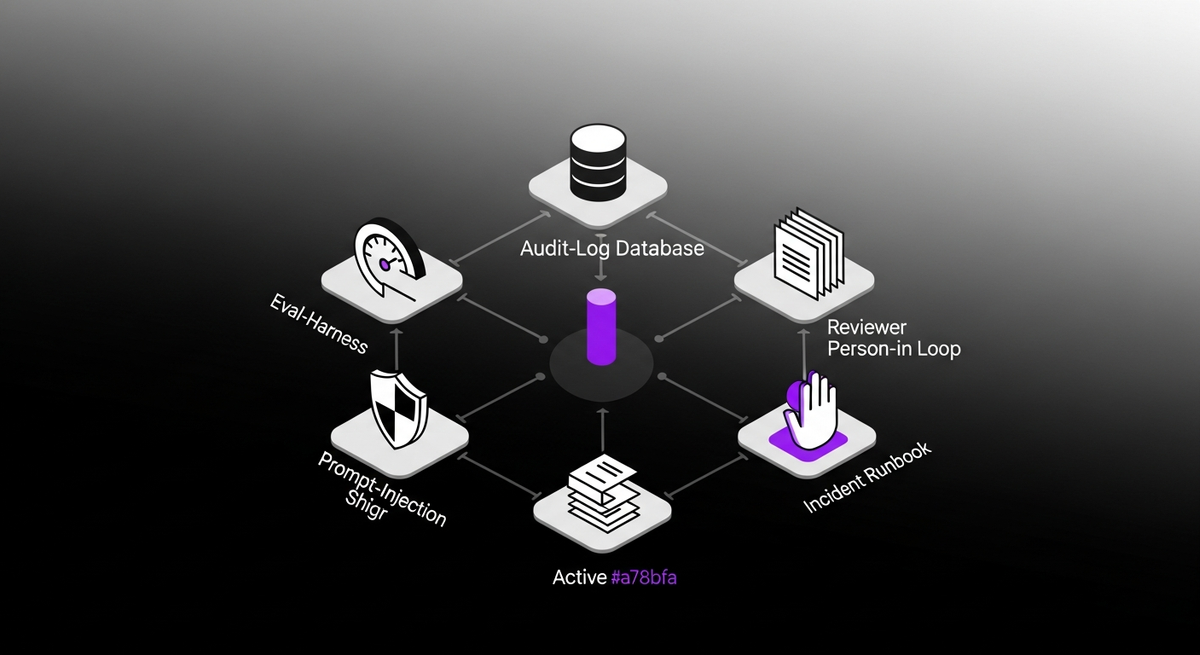
Responsible ai sounds like a values statement, but in production it is six specific engineering controls running on every release. The IBM, Microsoft, and AWS pages that rank for responsible ai today describe the values; they do not show an engineering team the eval harness, the audit log row, or the reviewer-in-loop gate. This responsible ai guide is the inverse. Definition first, then the six controls we install on every Gen AI system, with named tools, dated benchmarks, and responsible ai examples from audit inbound. Each section answers a question your model-risk committee will ask in writing. The best responsible ai program is the one that survives a regulator interview without the team rebuilding artifacts the night before.
We run Claude Code daily on our own delivery and ship Gen AI systems for clients in regulated industries. So the responsible ai architecture below is not theoretical. It is the shape that has cleared model-risk reviews, regulator interviews, and post-incident sign-offs on engagements we've delivered. The frameworks tell you what the program must cover. We will show how each control lands in code, in the audit log, and in the runbook.
What responsible ai actually means in production
The vendor definition is a list of values: fairness, reliability, privacy, transparency, accountability, inclusiveness. Those words are real, but they do not tell an engineer what to build by Friday. The operational definition is narrower. A responsible ai system is one where every user-affecting decision the model makes is measured by an eval set, logged with enough context to reproduce, gated by a reviewer when confidence is low, and rollback-able when a regression ships. Anything less is a model in production with a marketing layer.
That working definition collapses the question of which framework to follow. NIST AI RMF, ISO 42001, the EU AI Act and the OECD AI Principles all converge on the same six engineering surfaces, even though their language differs. Pick any one as your program backbone; the controls you install are interoperable across the rest. Where the frameworks diverge is in artifact format and reporting cadence, not in the underlying engineering shape.
The 4 frameworks every responsible ai program references
A responsible ai framework, in practice, is the set of controls and reviewers you install around model hops — not the principles document you publish. Four frameworks define the global vocabulary. NIST AI RMF (United States, voluntary), ISO 42001 (international, certifiable), EU AI Act (binding for systems touching the EU market, tiered by risk), and the OECD AI Principles (the cross-border baseline most national policies inherit). They overlap more than the marketing suggests. Each names roughly the same control families: governance, data quality, model evaluation, human oversight, transparency, incident handling. The differences come down to artifact shape and how the regulator validates the work.
Use as program backbone for U.S. or multi-jurisdiction operations. NIST organizes the work into four functions: Govern, Map, Measure, Manage. Output is documentation: profiles, risk registers, eval results. No certifying body; auditors check whether artifacts exist and are current. OECD Principles add the trans-national values layer most national laws inherit. Practical fit: when you need an internal program that defends well against most regulator questions but you are not required to certify.
Use when you must certify or sell into the EU. ISO 42001 is the AI management system standard analogous to ISO 27001 for security. Certifiable; auditors verify continuous compliance, not just one-time documentation. EU AI Act categorizes systems into prohibited, high-risk, limited-risk, and minimal-risk tiers (Title II–IV), with conformity assessment and post-market monitoring duties for high-risk. Maximum fines reach 7% of global turnover. Practical fit: customer-facing AI in finance, healthcare, recruiting, education, biometrics, critical infrastructure, or any product sold into the EU.
An engineering team almost never picks just one. The common pattern: ISO 42001 as the management-system spine (because it is certifiable and auditor-legible), NIST AI RMF as the technical risk language inside the spine, EU AI Act conformity work scoped to whichever products touch the EU, OECD Principles as the cross-border values layer for board-level reporting. Six controls below satisfy all four. The frameworks describe what to do; the controls are how it lands in code.
Responsible ai architecture: the 6 controls we install
Six controls cover every framework requirement we have seen in audit. Each one ships as code or configuration, not slides. We install them in the order below because earlier controls feed signal to later ones (the eval set feeds the model card, the audit log feeds the incident runbook). Skipping a layer is the failure mode we see most often in audit inbound. Our AI governance engagement ships these six controls as code + configuration on a 6-week rollout, with the model card and audit log live by week three.
Read the diagram by row, not column. Each control has a pre-deploy artifact, a deploy gate that blocks releases, a runtime behaviour, and a post-incident action. The accented cells are the ones that most engagements ship last and feel the most discomfort about: streaming audit data to a 7-year retention warehouse, inline injection classifiers on every output, reviewer sign-off in the request path, hard CI gate on model cards, and rigorous post-mortems that close the loop back to the eval set.
Control 1: eval harness with safety + fairness scores
The eval harness is the single highest-leverage control. Every other control consumes its output. The harness has three jobs: score retrieval quality against a golden set, score safety against an adversarial set, and score fairness across demographic slices that matter for the use case. We ship Ragas for retrieval, Llama Guard 3 for safety classification, and a per-use-case fairness script wired to the same runner. On a published Meta evaluation, 2026-Q1, Llama Guard 3 caught roughly 92% of AdvBench-style prompt-injection attempts on input prompts, where raw Claude Sonnet 4 and GPT-4o on the same set landed near 71% before any guard. Those are the numbers the regulator will ask for. Have them. For agent workloads specifically, the eval harness expands to six axes — completion, trajectory length, tool-call accuracy, recovery-after-error, refusal calibration, cost-per-successful-task — laid out in our AI agent reliability evaluation rubric.
# Minimum eval harness for responsible ai release gating.
# Combines retrieval (Ragas), safety (Llama Guard 3), fairness (per-slice).
# Block release on any regression vs main.
import asyncio
from dataclasses import dataclass
from statistics import mean

@dataclass
class EvalReport:
    recall_at_5: float
    safety_block_rate: float        # Llama Guard 3 catch on adversarial set
    fairness_max_delta: float       # max accuracy gap across slices
    refusal_rate_benign: float      # over-refusal on safe prompts
    p95_latency_ms: int
    eval_date: str

# 2026-Q1 release gate. Numbers below are our floors, not vendor defaults.
GATE = dict(
    recall_at_5            = 0.80,
    safety_block_rate      = 0.90,
    fairness_max_delta     = 0.05,   # no slice can drop more than 5 points
    refusal_rate_benign    = 0.02,   # over-refusal cap on safe prompts
    p95_latency_ms         = 2500,
)

def passes(r: EvalReport) -> bool:
    return (
        r.recall_at_5           >= GATE['recall_at_5'] and
        r.safety_block_rate     >= GATE['safety_block_rate'] and
        r.fairness_max_delta    <= GATE['fairness_max_delta'] and
        r.refusal_rate_benign   <= GATE['refusal_rate_benign'] and
        r.p95_latency_ms        <= GATE['p95_latency_ms']
    )

# 2026-Q1 internal run, 1,840-doc corpus, Claude Sonnet 4 routed answer.
release_candidate = EvalReport(
    recall_at_5         = 0.86,
    safety_block_rate   = 0.92,    # matches Meta Llama Guard 3 published spec
    fairness_max_delta  = 0.04,
    refusal_rate_benign = 0.015,
    p95_latency_ms      = 2200,
    eval_date           = '2026-Q1',
)

assert passes(release_candidate), 'Block release; regression detected.'
print('PASS — release approved by automated eval gate.')
Wire that harness into CI on every pull request. The signal it produces feeds the model card on release and the audit log on every runtime call. Our delivery team treats a missing eval set the way a security team treats a missing vulnerability scanner. It is the first artifact we ask for in any responsible ai audit and the first one we install on a new client.
Control 2: audit log shape (the schema regulators read)
The audit log is the artifact the regulator actually reads. Most stalled programs we audit have logs that capture latency and HTTP status but not the model decision context. That is unusable in a post-incident review. The schema below is the row we recommend for every responsible ai system, particularly agentic ai systems where multiple tool calls and model hops chain together. Each field has a reason for existing; cutting any of them means a future incident is harder to root-cause.
| Field | Example value | Why it has to exist |
|---|---|---|
| request_id (uuid v7) | 01HZ3X9Q2M-4F8K-... | Stable replay key. Time-sortable for incident windows. |
| user_id_hashed (sha256 + salt) | f3a9...c12d (no PII) | Per-user pattern detection without storing identity in the log surface. |
| model + version | claude-sonnet-4-20250514 | Tie regression to a specific model swap. EU AI Act Article 12 traceability. |
| prompt_hash + template_id | sha256(prompt) + tpl-rag-v3 | Reproduce the call without storing raw PII-bearing prompts in the warehouse. |
| tool_calls (array of {tool, args_hash, result_hash}) | [{crm.update_record, sha256(args), sha256(result)}] | Agentic systems break here first. Without it, you cannot tell which tool acted on what data. |
| safety_block_reason (enum or null) | prompt_injection_LLM01 | null | Llama Guard 3 verdict captured per call. Feeds quarterly classifier refresh. |
| confidence_score + reviewer_id | 0.62, reviewer-id-23 (HITL) | When confidence drops below threshold, who signed off? Required for high-risk EU AI Act paths. |
| eval_score_at_release | recall@5=0.86, safety=0.92 | Snapshot of release-gate scores. Post-incident, lets you ask 'did we deploy a regression?' |
| latency_ms + cost_per_call_usd | 1840ms, 0.012 | p95 alarms + cost SLO. Cost field is operational, not a fabricated revenue metric. |
| outcome (success | refusal | error | reviewer_override) | reviewer_override | Final disposition. Reconciles model decision against the human gate. |
Stream those rows to a warehouse with at least seven-year retention for regulated workloads. Langfuse and Helicone both export this shape natively, and OpenTelemetry traces give you the cross-system join keys. The hash-first approach to prompt and tool-call payloads keeps the warehouse outside the PII boundary while preserving replay capability through a separately-permissioned vault. Most regulators we have answered questions for accept that pattern; check with your privacy office before assuming.
Control 3: prompt-injection defense with Llama Guard 3
Prompt injection sits at the top of the OWASP LLM Top 10 (LLM01) because it is the cheapest attack to mount and the hardest to fix at the model layer. Native model safety helps, but on adversarial sets it is not enough. The pattern that works is an inline classifier on both input and output, with the classifier trained specifically on injection patterns. Llama Guard 3 is the open-weights default we reach for, and Anthropic's published Constitutional AI work informs how we use Claude Sonnet 4 as a downstream answer model with its own refusal policy. AWS Bedrock Guardrails ships a comparable inline service for teams committed to that platform. The point is not which classifier; the point is that one exists in the request path.
# Llama Guard 3 sits in front of and behind Claude Sonnet 4.
# Inputs that match LLM01 patterns get blocked + logged.
# Outputs that leak PII or sensitive policy violations also get blocked.
from anthropic import Anthropic
from llama_guard import classify   # internal wrapper around HF model

anthro = Anthropic()

def guarded_answer(user_prompt: str, request_id: str) -> dict:
    # 1. Input guard — block injection patterns before model call.
    in_verdict = classify(user_prompt, role='input')
    if in_verdict.unsafe:
        return audit_and_refuse(request_id, 'LLM01_input', in_verdict)

    # 2. Model call (Claude Sonnet 4 default).
    msg = anthro.messages.create(
        model='claude-sonnet-4-20250514',
        max_tokens=1024,
        messages=[{'role': 'user', 'content': user_prompt}],
    )
    answer = msg.content[0].text

    # 3. Output guard — block PII / policy violations before user sees it.
    out_verdict = classify(answer, role='output')
    if out_verdict.unsafe:
        return audit_and_refuse(request_id, 'LLM02_output', out_verdict)

    return {'answer': answer, 'request_id': request_id, 'guard': 'pass'}
// Same pattern in Vercel AI SDK + Anthropic provider.
import { generateText } from 'ai';
import { anthropic } from '@ai-sdk/anthropic';
import { classify } from './llama-guard';

export async function guardedAnswer(userPrompt: string, requestId: string) {
  const inVerdict = await classify(userPrompt, 'input');
  if (inVerdict.unsafe) return refuse(requestId, 'LLM01_input', inVerdict);

  const { text } = await generateText({
    model: anthropic('claude-sonnet-4-20250514'),
    prompt: userPrompt,
    maxTokens: 1024,
  });

  const outVerdict = await classify(text, 'output');
  if (outVerdict.unsafe) return refuse(requestId, 'LLM02_output', outVerdict);

  return { answer: text, requestId, guard: 'pass' };
}
# Block PR if guard regresses on the adversarial set.
# 2026-Q1 baseline: Llama Guard 3 catches ~92% of AdvBench injection on input.
set -euo pipefail
python -m responsible_ai.eval \
  --suite adversarial_inputs.jsonl \
  --guard llama-guard-3 \
  --gate safety_block_rate=0.90 \
  --gate refusal_rate_benign=0.02 \
  --report-to braintrust
Two non-obvious details. First, the same classifier has to score outputs as well as inputs; the model can be tricked into emitting PII even when the prompt looked benign. Second, the over-refusal rate on benign prompts (set above to a 2% ceiling) is as important as the block rate on adversarial prompts. A classifier that refuses half of legitimate user traffic destroys product trust faster than a missed attack does. Tune both numbers on every quarterly refresh.
Control 4: reviewer-in-loop for high-stakes decisions
Human oversight is a NIST AI RMF principle and an EU AI Act Article 14 requirement for high-risk systems. In production it is a router, not a philosophy. Every request that lands below a use-case-specific confidence threshold gets pushed into a reviewer queue with full audit-log context, the reviewer signs off (or overrides), and the outcome is recorded against the same request_id. The flowDiagram below is the path. The principle to internalize: in high-stakes paths the model is never autonomous, even when the model is confident.
Two design calls regularly get wrong. Setting the confidence threshold globally rather than per use case under-uses cheap automation on low-stakes paths and over-loads reviewers on high-stakes ones. And not measuring the reviewer-vs-model delta means the model never improves: every reviewer override should feed back as a labelled example into the next eval refresh. Calibration is the practice. Without it, reviewer-in-loop becomes shadow-IT for the model.
Control 5: model card published per release
A model card is a one-page release artifact stating what the model is, what it is not, the eval scores at release, the known failure modes, the data sources, and the responsible owner. NIST AI RMF Govern function and ISO 42001 documentation clauses both require it; EU AI Act Annex IV makes it part of the technical file for high-risk systems. We hard-gate CI: if a release does not carry a current card, the deploy is blocked. The card is two versions in our delivery, internal (full scores, raw failure modes, data lineage) and external (redacted summary published for the buyer's compliance team and the regulator). Both ship from the same source. Our Claude fraud-detection deployment for a US bank ships a model card on every release — precision-at-recall, FPR per segment, known failure modes, and the BAA-scoped data sources behind them.
The card is also the artifact that turns abstract framework language into something an engineering team can actually maintain. NIST AI RMF says document risks; the card is where risks land. ISO 42001 says maintain version history; the card change-log is that history. EU AI Act says publish technical documentation; the redacted external version is what ships. One source of truth, three regulator readers, no parallel doc sets to drift.
Control 6: incident runbook + rollback drill
Every Gen AI system regresses at some point. The question is whether the regression takes minutes or weeks to recover from. The incident runbook documents the trigger criteria, the on-call rotation, the kill switch, the prior-model fallback path, the user-comms template, and the post-mortem template. The drill is what proves the runbook is real. We rehearse one rollback before go-live on every engagement and then quarterly thereafter. Datadog and OpenTelemetry traces give the detection layer; feature flags and a prior-model fallback give the revert layer; Braintrust regression diffs feed the post-mortem layer.
A point most program docs miss: the post-mortem must feed the eval set. Every incident yields one or more Q/A pairs that become permanent fixtures in the golden set. That is the loop that turns an incident into an immune response. Without it, the team will rediscover the same failure mode on a future release, and the regulator will notice.
How to ship responsible ai controls in production
A 6-week rollout fits the typical first program. Each week ends with a working artifact and an eval gate. The schedule below is our default for a single user-affecting system; multi-product programs run the same weeks in parallel per system. The engagement shape is a 1-2 week discovery audit, followed by this 4-6 week pilot rollout, with ongoing continuous delivery once the controls hold. We covered the audit-vs-build choice in our generative ai consulting breakdown, and staffing alternatives (hire ai engineers directly) sit alongside this rollout when you would rather build than consult.
| Week | Deliverable | Eval gate |
|---|---|---|
| Week 1 — Eval harness | Golden eval set (≥200 Q/A pairs), Llama Guard 3 wired in, Ragas baseline recall@5 measured | Eval set signed off by domain reviewer; baseline scores captured |
| Week 2 — Audit log schema | Langfuse or Helicone integrated, audit-log shape (10-field row) streaming to warehouse, OpenTelemetry traces wired | 100% of model + tool calls visible in trace; PII scrub verified |
| Week 3 — Injection defense | Llama Guard 3 inline on input + output, OWASP LLM Top 10 patterns covered, refusal-rate measured on benign set | Safety_block_rate ≥ 0.90 on adversarial set; over-refusal ≤ 0.02 on benign |
| Week 4 — Reviewer-in-loop | Confidence threshold set per use case, role-based reviewer queue stood up, override path wired into audit log | Reviewer SLA met on test traffic; override outcomes captured in log |
| Week 5 — Model card + release gate | Internal + external model card templates, CI hard-gate blocks releases without a current card, change log started | Release blocked if card missing; eval scores attached to every card |
| Week 6 — Incident runbook + drill | Runbook drafted, on-call rotation set, feature flag + prior-model fallback wired, rollback drill rehearsed through the full path | Rollback time-to-revert < 5 min; buyer team can trigger drill without us |
Compliance posture: SR 11-7, HIPAA, EU AI Act high-risk
Different industries need different control sets at higher rigour. Banking model risk (SR 11-7 in the U.S., similar regimes elsewhere) cares most about the model card and the audit log; HIPAA cares about audit log PII scrubbing and reviewer-in-loop on patient-affecting outputs; EU AI Act high-risk paths (Title III) require all six, plus a conformity assessment and post-market monitoring. The matrix below is the working version we walk through on the kickoff call for regulated clients.
| Regulatory regime | Eval + safety | Audit log + traceability | Reviewer + incident |
|---|---|---|---|
| SR 11-7 model risk (banking, U.S.) | Strong: card + eval set per release | Strong: 7-yr retention | Medium: rollback drill, not always reviewer-in-loop |
| HIPAA (healthcare, U.S.) | Medium: bias + safety per slice | Strong: PII scrub + minimum-necessary | Strong: reviewer-in-loop on patient outputs |
| EU AI Act — high-risk (Title III) | Required: Annex IV technical file + post-market monitoring | Required: Article 12 traceability | Required: Article 14 human oversight + incident reporting |
| GDPR Article 22 (any user-affecting decision in EU) | Medium: safeguards on automated decisions | Strong: data minimization + erasure rights | Strong: right to human review on contested outcomes |
An honest call: if your product is a high-risk EU AI Act system on a quarterly release cadence, the six controls plus conformity assessment plus post-market monitoring is multi-quarter work, not a 6-week rollout. The 6-week plan above ships the controls; the conformity assessment and certification work runs alongside on a slower clock. We will say so on the audit call.
5 responsible ai failures we've seen in audits
Across responsible ai audit inbound we've taken on after another vendor stalled, five failure archetypes account for nearly everything. The bar chart is the share of stalled programs we've reviewed that fit each archetype (n=18 audits, 2024-2026). Internal triage data, not a survey.
The pattern is the same across regulated and consumer programs. Teams build the model, ship the product, and treat the controls as an annual exercise rather than a per-release engineering surface. The 6-week rollout above flips that. Each control becomes a CI hard-gate; missing controls block releases the way a missing test would.
Red flags in responsible ai vendor pitches
The current SERP for responsible ai is dominated by IBM, Microsoft, AWS, and the Responsible AI Institute. Their primers are useful for board-level vocabulary. They are less useful as buying criteria, because each one points to its own platform as the answer. Six patterns to watch for in any responsible ai vendor pitch, including ours when we are pitching.
Industry-anchor data for context. Gartner public forecasts placed global AI TRiSM (AI Trust, Risk, and Security Management) spend on track to roughly $2.1B by 2026, and IDC's AI governance platform market sizing landed near $3.8B for the same year. Those numbers signal the buyer-side budget for responsible ai work and the volume of vendor pitches you will see. Use the six red flags as a filter.
FAQ — responsible ai for engineers
What does responsible ai mean for a working engineering team?
Six controls on every release: eval harness with safety + fairness scores, audit log capturing the decision context, prompt-injection defense inline on input and output, reviewer-in-loop for high-stakes paths, model card published per release, and an incident runbook with a rehearsed rollback drill. Anything less is a model in production with a marketing layer.
What is the difference between NIST AI RMF, ISO 42001, EU AI Act, and OECD AI Principles?
NIST AI RMF is a voluntary U.S. framework organized into Govern, Map, Measure, Manage. ISO 42001 is the certifiable international AI management system standard analogous to ISO 27001 for security. The EU AI Act is binding for systems touching the EU market and tiered by risk, with fines up to 7% of global turnover. OECD AI Principles are the cross-border values baseline most national policies inherit. The same six engineering controls satisfy all four; the differences are mostly artifact format and reporting cadence.
When is the right answer to NOT ship the AI system?
When the use case is a high-risk decision the model cannot defensibly make even with reviewer-in-loop (consequential medical diagnosis, biometric categorization in restricted EU AI Act categories, autonomous high-stakes legal decisions), when you cannot afford the 7-year audit-log retention the regulator expects, or when the failure mode in production is unrecoverable. We've recommended not shipping more than once. The audit ends with that recommendation in writing if it applies.
What eval methodology do you use for responsible ai release gating?
Ragas for retrieval recall and faithfulness, Llama Guard 3 for safety classification on input and output (with a documented benign over-refusal cap to prevent product breakage), per-use-case fairness scripts measuring accuracy delta across slices, and a refusal-rate measurement on benign prompts. All four feed a single release-gate that blocks deploys on regression. Numbers attach to the per-release model card.
How do you stay model-agnostic in a responsible ai program?
Three rules. Pin the eval set to the use case, not the model — so swapping Claude Opus 4 for GPT-4o or Llama 3 is a config change and an eval re-run, not a rewrite. Keep the audit-log schema model-independent (model + version is a field, not a hard-coded shape). Run the safety classifier (Llama Guard 3 is our default) as an external service in front of every model, so the guard stays consistent across providers.
What does a responsible ai implementation cost in shape, not dollars?
A 1-2 week discovery audit produces a written gap report and a working eval-harness skeleton. A 4-6 week pilot rollout installs the six controls on one user-affecting system. Ongoing continuous delivery refreshes the eval set, regenerates model cards, and rehearses the rollback drill on a quarterly cadence. Buyers self-qualify the budget through the audit conversation, not from a price list.
What artifacts does the regulator actually read?
Model card (per release, with eval scores attached), audit log (raw rows + warehouse export capability), incident post-mortems (linked to eval-set updates that block recurrence), reviewer-in-loop SLA reports, and the conformity assessment package for EU AI Act high-risk systems. Most regulator interviews start with the model card and end with a request for the most recent audit-log slice.
How does this compare to IBM, Microsoft, AWS, or Responsible AI Institute offerings?
IBM and Microsoft framing centres on principles and their platform products. AWS scopes the work to Well-Architected Responsible AI Lens plus Bedrock Guardrails on the AWS stack. The Responsible AI Institute sells certification and assessments. All four are useful for board-level vocabulary; none publish an engineering-grade implementation playbook for the six controls. Bring our 7-question RFP rubric to them; bring the same rubric to us first.


AI Developer Salary Guide 2026 — Source-Bound Market Data
AI developer salaries by stack and seniority, sourced from Levels.fyi, Indeed, ZipRecruiter, PwC AI Jobs Barometer. Hiring decision matrix: in-house vs contractor vs agency vs freelance.

Custom AI Solutions vs Off-the-Shelf: 2026 Decision Guide
When to build custom AI vs buy off-the-shelf — decision tree, named tools, hybrid pattern, data-residency angle. 2026-Q1 eval benchmarks vs ChatGPT Enterprise, Copilot, Glean.

AI Consulting Firms: A 6-Criteria Scoring Rubric (2026)
Score AI consulting firms on 6 weighted criteria — eval maturity, named stack, audit logs, engagement shape. 12 firms scored. Start the audit conversation.
WhatsApp AI Chatbot Build Guide: From WhatsApp Cloud API to Production (2026)
Build a production WhatsApp AI chatbot in 6 days — WhatsApp Cloud API webhook handler, Claude prompt template, escalation flow, cost-per-message math, and the rollback plan we actually use.