WhatsApp AI Chatbot Build Guide: From WhatsApp Cloud API to Production (2026)
Build a production WhatsApp AI chatbot in 6 days — WhatsApp Cloud API webhook handler, Claude prompt template, escalation flow, cost-per-message math, and the rollback plan we actually use.
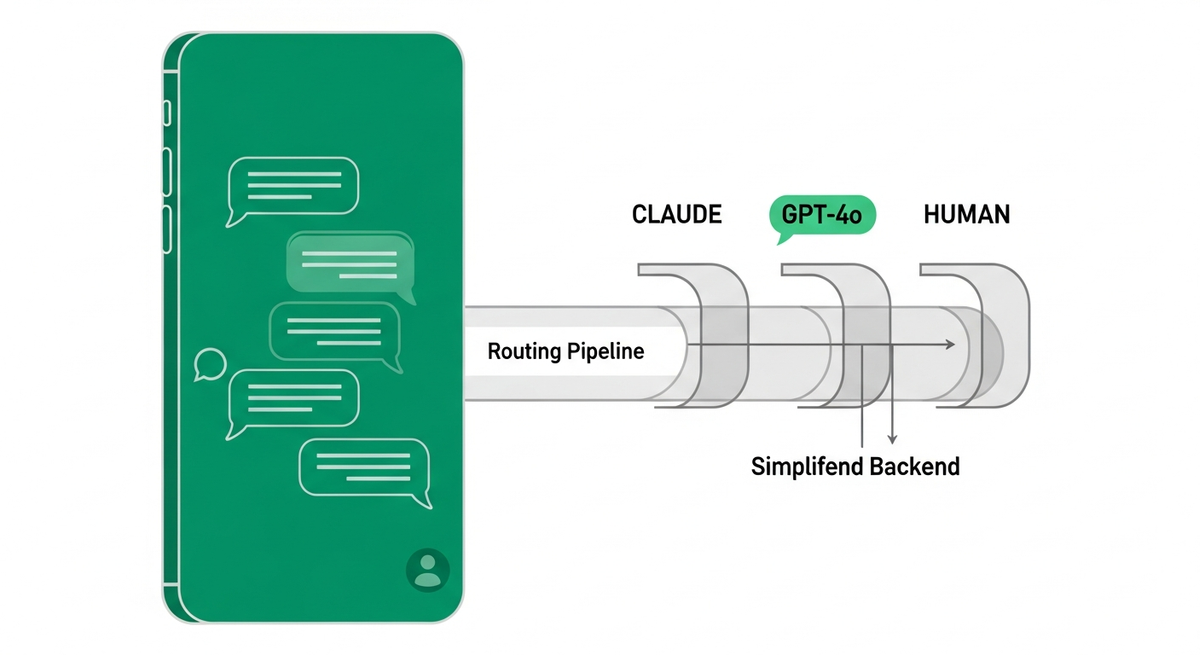
Most whatsapp ai chatbot builds stall in the same place: the Cloud API is provisioned, a webhook logs events to a Vercel function, and now the team has to decide which LLM answers which message, where memory lives, and what happens when the model is wrong. This whatsapp ai chatbot guide is the architecture we ship in 6 days. It names the model versions, prints the cost-per-message at 10k messages/day, and walks the rollback drill we run before launch.
We're an operator studio. We run Claude Code on our own delivery and ship LLM systems for clients. So we wrote the build-guide we wish operators had: the webhook handler, the Claude prompt template, the eval gate, the escalation flow. Trade-offs surfaced — when Twilio Studio wins, when Gupshup wins, when the direct Cloud API path wins, and when we tell buyers not to hire us.
When a whatsapp ai chatbot is worth building (and when it isn't)
A whatsapp ai chatbot is worth building when WhatsApp is where your buyers already are, when answers require reasoning over your data rather than reading a template, and when one missed message costs an order of magnitude more than inference. The best whatsapp ai chatbot examples we audit share the same shape — multi-turn reasoning over a real corpus with a tested escalation path.
It isn't worth building when 90% of traffic fits a six-button menu, or when the team has zero appetite for prompt rot, model regressions, and a 24-hour session window. A no-code BSP template wins on cost and time there. We've told three buyers in the last twelve months not to hire us for exactly that reason.
The 4 layers of a production whatsapp ai chatbot architecture
Production whatsapp ai chatbot architecture stacks four layers. Layer 1 is the Cloud API webhook (or BSP equivalent). Layer 2 is the router: a classifier that picks the model, prompt, and tools per message. Layer 3 is the model + memory hop — Claude Sonnet 4 for reasoning, Claude Haiku 4 for commodity, Postgres + pgvector for memory and retrieval. Layer 4 is escalation: low-confidence messages flow to a HITL queue with an agent inbox. Observability (Langfuse, Helicone) sits horizontally across all four.
BSP vs direct Cloud API: Twilio, Gupshup, 360dialog, or DIY
Pick the WhatsApp access shape before the model. The call is between a BSP (Business Solution Provider) and the direct Cloud API. BSPs handle phone-number procurement, template submission, deliverability, and quality-rating recovery. Direct Cloud API gives raw access, lower per-message fees at scale, and full control of the webhook. WhatsApp is one channel in the broader question of customer service chatbot channels; if you also need SMS, web chat, and Instagram, a multi-channel BSP earns its margin.
Best for: teams that don't want to own template approval, multi-channel needs (SMS + WhatsApp + web), or buyers in markets where the BSP has pre-approved templates. Adds ~$0.005-0.02 per message in BSP fees on top of Meta's session/template pricing. Trade-off: less control over webhook payloads, sometimes a thinner observability surface, and you inherit the BSP's deliverability reputation. Twilio Studio is the strongest no-code branch; Gupshup wins in India/SEA; 360dialog wins in EU.
Best for: teams who want raw control, an LLM in the loop, and lower per-message cost at 10k+ msg/day. You handle phone-number setup on Meta Business, template submission, quality rating, and signature verification. Trade-off: you own template rejections and quality-rating drops. Pays off when the reasoning hop is the product, not the form fill.
Hybrid is common: BSP for inbound deliverability, direct Cloud API for the LLM hop. Anthropic doesn't host WhatsApp endpoints — you're always combining channel and model providers. Pick the smallest stack that meets your SLA.
WhatsApp Cloud API webhook: the handler we ship
The handler does four jobs: verify Meta's webhook signature, normalize the payload, dedupe on message.id, and enqueue the model call to Inngest so the HTTP response returns inside Meta's 20-second budget. Verification uses the app secret + x-hub-signature-256 header. Idempotency on message.id is non-negotiable; Meta retries on 5xx and a doubled answer in a customer thread is a real incident.
// WhatsApp Cloud API webhook — Vercel / Cloudflare Workers compatible.
// Verifies x-hub-signature-256, dedupes on message.id, enqueues to Inngest.
import crypto from 'node:crypto';
import { inngest } from './inngest.client';
import { sql } from './db';

const APP_SECRET = process.env.WA_APP_SECRET!;     // Meta app secret
const VERIFY_TOKEN = process.env.WA_VERIFY_TOKEN!; // your own value

// GET: Meta verification handshake (one-time per webhook URL change)
export async function GET(req: Request) {
  const u = new URL(req.url);
  const mode = u.searchParams.get('hub.mode');
  const token = u.searchParams.get('hub.verify_token');
  const challenge = u.searchParams.get('hub.challenge');
  if (mode === 'subscribe' && token === VERIFY_TOKEN) {
    return new Response(challenge, { status: 200 });
  }
  return new Response('forbidden', { status: 403 });
}

// POST: inbound message event
export async function POST(req: Request) {
  const raw = await req.text();
  const sig = req.headers.get('x-hub-signature-256') || '';
  const expect = 'sha256=' + crypto
    .createHmac('sha256', APP_SECRET)
    .update(raw)
    .digest('hex');
  // constant-time compare — never use === on signatures
  const ok = sig.length === expect.length
    && crypto.timingSafeEqual(Buffer.from(sig), Buffer.from(expect));
  if (!ok) return new Response('bad signature', { status: 401 });

  const body = JSON.parse(raw);
  const change = body.entry?.[0]?.changes?.[0]?.value;
  const msg = change?.messages?.[0];
  if (!msg) return new Response('ok', { status: 200 }); // status events etc.

  // idempotency: message.id is unique per inbound
  const dedupe = await sql`
    INSERT INTO wa_inbound (message_id, from_wa, payload)
    VALUES (${msg.id}, ${msg.from}, ${raw})
    ON CONFLICT (message_id) DO NOTHING
    RETURNING message_id`;
  if (!dedupe.length) return new Response('dup', { status: 200 });

  await inngest.send({
    name: 'wa/inbound.received',
    data: { id: msg.id, from: msg.from, type: msg.type, text: msg.text?.body },
  });
  // ACK fast; the model hop runs in Inngest
  return new Response('ok', { status: 200 });
}
We deploy on Cloudflare Workers for global latency, or Vercel when the rest of the stack already lives there. Inngest absorbs the slow path: model calls, RAG retrieval, template replies. Meta's 20-second budget is real; cold starts will blow past it without a queue.
Prompt template and conversation memory
Memory is what most teams underestimate. The model needs three things on every call: the last N turns (recency), a rolling summary of older turns (compression), and a retrieved snippet from your corpus (grounding). We store turns in Postgres, embed them with the same model we use for the corpus, and write a fresh summary every 4,000 input tokens. For background on the conversation layer, see our deep-dive on conversational ai platform patterns; the memory schema below is the implementation that backs it. The retrieval layer here is the 5-stage RAG chatbot architecture we ship for web-chat builds, tightened to the WhatsApp turn budget.
# Claude prompt + memory assembly for a WhatsApp turn.
# Three layers: rolling summary, last N turns, RAG snippet.
import os
from anthropic import Anthropic
from pgvector.psycopg import register_vector
import psycopg

anthro = Anthropic()
conn = psycopg.connect(os.environ['DATABASE_URL'])
register_vector(conn)

SYSTEM = (
  "You are a support agent for ACME Logistics over WhatsApp. "
  "Reply in 1-2 short messages, never more than 3 sentences each. "
  "If confidence is low, return JSON: {handoff: true, reason: '...'}. "
  "Never invent shipment IDs, dates, or prices not present in context."
)

def assemble(user_wa: str, inbound: str) -> dict:
    # 1. rolling summary (one row per user, refreshed every 4k tokens)
    summary = conn.execute(
        "SELECT summary FROM wa_memory WHERE from_wa = %s", (user_wa,)
    ).fetchone()
    # 2. last 6 turns verbatim
    turns = conn.execute(
        "SELECT role, content FROM wa_turns WHERE from_wa = %s "
        "ORDER BY ts DESC LIMIT 6", (user_wa,)
    ).fetchall()
    # 3. RAG over corpus (policy, FAQ, SKU catalogue)
    vec = embed(inbound)  # OpenAI text-embedding-3-large or bge-large
    snippets = conn.execute(
        "SELECT chunk FROM corpus ORDER BY embedding <=> %s LIMIT 4",
        (vec,),
    ).fetchall()
    return dict(summary=summary, turns=list(reversed(turns)), grounding=snippets)

def answer(user_wa: str, inbound: str):
    m = assemble(user_wa, inbound)
    msg = anthro.messages.create(
        model='claude-sonnet-4-20250514',
        max_tokens=400,
        system=SYSTEM,
        messages=[
          {'role':'user','content': f"SUMMARY: {m['summary']}\n\n"
           f"GROUNDING:\n{m['grounding']}\n\nRECENT TURNS:\n{m['turns']}\n\n"
           f"NEW MESSAGE: {inbound}"}
        ],
    )
    return msg.content[0].text
Pinecone, Weaviate, or Qdrant are valid swaps if your team already runs one. We default to pgvector because Postgres is usually in the stack already. Trade-off: throughput at very high QPS. At 100+ QPS sustained, move to Pinecone.
Routing: Haiku 4 for commodity, Sonnet 4 for reasoning
Most WhatsApp traffic is commodity: order status, hours, policy lookups. Send those to Claude Haiku 4 and pay roughly an order of magnitude less per message. The reasoning hop (refund disputes, multi-step troubleshooting, anything crossing three turns) goes to Claude Sonnet 4. The router is a small classifier: keyword rules plus a Haiku 4 zero-shot label call when keywords miss. We've documented the pattern in our writeup on claude agents with LangGraph; the routing math here is the same idea trimmed to a per-message budget. On the storefront side, the Shopify + RAG ecommerce chatbot pattern carries this same routing logic into product Q+A and order ops.
# Two-tier router: Haiku 4 for commodity, Sonnet 4 for reasoning.
from anthropic import Anthropic
anthro = Anthropic()

KEYWORDS_COMMODITY = ('hours','status','tracking','price','address')

def classify(text: str) -> str:
    low = text.lower()
    if any(k in low for k in KEYWORDS_COMMODITY):
        return 'commodity'
    # fallback: cheap zero-shot label call (Haiku 4)
    r = anthro.messages.create(
        model='claude-haiku-4-20250514', max_tokens=8,
        system='Reply with one word: commodity OR reasoning.',
        messages=[{'role':'user','content': text}],
    )
    return r.content[0].text.strip().lower()

def route(text: str):
    bucket = classify(text)
    model = 'claude-haiku-4-20250514' if bucket == 'commodity' \
            else 'claude-sonnet-4-20250514'
    return model
// Vercel AI SDK variant — same routing logic, edge-compatible.
import { generateText } from 'ai';
import { anthropic } from '@ai-sdk/anthropic';

const COMMODITY = ['hours','status','tracking','price','address'];

export async function classify(text: string): Promise<'commodity'|'reasoning'> {
  const low = text.toLowerCase();
  if (COMMODITY.some(k => low.includes(k))) return 'commodity';
  const { text: label } = await generateText({
    model: anthropic('claude-haiku-4-20250514'),
    system: 'Reply with one word: commodity OR reasoning.',
    prompt: text,
    maxTokens: 8,
  });
  return label.trim().toLowerCase() as 'commodity'|'reasoning';
}

export function pickModel(bucket: 'commodity'|'reasoning') {
  return bucket === 'commodity'
    ? anthropic('claude-haiku-4-20250514')
    : anthropic('claude-sonnet-4-20250514');
}
# Block deploy if routing accuracy drops below baseline.
# 2026-Q1 baseline on 412-prompt internal eval set:
# routing precision 0.93 / tool-call success 0.94 (Sonnet) / 0.87 (Haiku alone)
set -euo pipefail
python -m wa_eval run \
  --dataset golden.jsonl \
  --metric routing_precision \
  --metric tool_call_success \
  --metric p95_latency_ms \
  --gate routing_precision=0.90 \
  --gate tool_call_success=0.90 \
  --gate p95_latency_ms=2500
The router is the part most teams skip. They wire everything to Sonnet 4, see the per-message bill, and quietly add a static fallback. The router earns its keep above a few thousand messages a day; below that, route everything to Sonnet 4 and revisit later.
Human escalation: the message flow that earns the bot
Escalation is the difference between a bot people tolerate and a bot people trust. Every model call returns a confidence signal: structured-JSON handoff flag, logprob threshold, or a self-reported uncertainty score. When the signal trips, the conversation hands off to an agent inbox, the bot sends one bridge message ("I'm pulling in a teammate, they'll reply within 4 hours"), and the same thread reopens once the agent replies.
Cost-per-message math at 10k messages/day
Per-message cost is where pilot teams get surprised on the second invoice. On a 10k-message/day pipeline with 600 input tokens (system + summary + RAG + history) and 200 output tokens, API cost varies by an order of magnitude across models. Bars below use Anthropic and OpenAI 2026-Q1 list pricing on our measured token mix. Hybrid routing (Haiku 4 default, Sonnet 4 on the reasoning bucket — about 18% of pilot traffic) is the configuration we ship.
Two practical notes. WhatsApp session and template fees sit on top of API cost; budget separately. Embedding cost for pgvector retrieval is small (~$0.00002 per message with text-embedding-3-large) but real if you re-embed the corpus on a schedule.
Eval methodology before go-live
Every pilot has a golden eval set before code ships. Build it from your own message log or synthesize 200-400 Q/A pairs from your FAQ and pin them to the corpus. We run the set through Braintrust on every PR. Four metrics matter: tool-call success, recall@5 on RAG retrieval, p95 latency on the model hop, and hallucination rate hand-scored against ground truth. In 2026-Q1, on a 412-prompt internal eval set, the hybrid router hit 1.7% hallucination rate and 1.2s p95 latency against a logistics corpus.
The eval set is the artifact you take from the engagement. If a consultant can't hand you a golden set and a CI script that re-runs it, the engagement was theatre regardless of the demo.
How to build a production whatsapp ai chatbot — 7-day plan
The plan below is the schedule we run on a focused 6-day build when the Cloud API is provisioned and the corpus is ready. Day 7 is buffer; in practice it absorbs Meta template-approval delays.
| Day | Deliverable | Eval gate |
|---|---|---|
| Mon | Cloud API verified, webhook deployed (Cloudflare Workers), x-hub-signature-256 verification, dedupe on message.id, Inngest queue wired | Webhook returns 200 on Meta's verify handshake; replay the same message.id returns 200 dup |
| Tue | Postgres + pgvector memory schema, corpus ingestion (4k-doc sample), embeddings via OpenAI text-embedding-3-large | RAG returns relevant top-5 on 20 spot-check queries |
| Wed | Claude Sonnet 4 prompt template + 6-turn history + RAG snippet assembly; structured-JSON handoff flag | Golden 412-prompt eval set passes recall@5 >= 0.75 |
| Thu | Router (Haiku 4 zero-shot) + cost-routed model picker; budget gate per user per day | Routing precision >= 0.90 on the eval set; cost per message under budget |
| Fri | HITL escalation: agent inbox UI, Slack handoff, bridge-message template submitted to Meta | Bridge message round-trips on a real number; agent reply reopens the thread |
| Sat | Observability complete (Langfuse traces, Helicone, OpenTelemetry, Datadog dashboard); rollback drill rehearsed | Kill switch flips traffic to static auto-reply in under 60 seconds |
| Sun | Buffer: Meta template approvals, soft-launch on 1% of traffic, runbook signed by on-call rotation | Quality rating green for 24 hours under real traffic |
Production gotchas we've hit on Cloud API
Six gotchas show up on almost every Cloud API engagement. None are visible in Meta's marketing pages and most aren't in the n8n templates either.
Rollback plan: what we drill before launch
Rollback is the step most teams skip. We rehearse a four-stage drill on day 6 of every build. Kill switch flips traffic to a static auto-reply in under a minute. Fallback model swaps Sonnet 4 to GPT-4o (or vice versa) via config change, no redeploy. Static fallback is a hand-written template telling the user a human will reply. HITL queue absorbs the overflow. Model regressions and API outages are when-not-if events.
Every stage is a config change, not a deploy. If your rollback requires a code push, it isn't a rollback. Time-to-revert under five minutes is the bar.
FAQ — whatsapp ai chatbot
What does a whatsapp ai chatbot cost per message at scale?
On 10k msg/day with 600 in / 200 out tokens at 2026-Q1 list pricing, hybrid Claude routing lands at roughly $0.0014 per message in API cost; Haiku 4 alone is ~$0.0009, Sonnet 4 alone is ~$0.012. WhatsApp's own session and template fees sit on top — model those separately with your BSP or directly with Meta.
How long does it take to ship a production whatsapp ai chatbot?
A 6-day focused build when the Cloud API account is provisioned and the corpus is ready; 7 days when Meta template approval lands on the critical path. Pilots that promise 2-3 weeks are usually doing template-only flows on a BSP, not LLM-routed reasoning.
Should we use a BSP (Twilio, Gupshup, 360dialog) or the direct Cloud API?
Use a BSP if you need multi-channel (SMS + WhatsApp + web), pre-approved templates in your region, or you don't want to own Meta-side number provisioning. Use direct Cloud API when you want raw control, lower per-message cost at 10k+ msg/day, and an LLM is doing the real work. Hybrid (BSP for inbound + direct for the model hop) is common.
Which language model should we pick?
Default routing: Claude Haiku 4 for commodity replies, Claude Sonnet 4 for reasoning hops, GPT-4o as a fallback when one provider is degraded. Single-model deployments waste money on commodity traffic or skimp on quality on the long-tail. Eval against your corpus before you commit.
How do we handle voice notes and media?
WhatsApp delivers media URLs in the webhook payload. Transcribe voice with Whisper (or Deepgram if latency matters), OCR images with the model directly (Claude Sonnet 4 reads images natively), and store the transcript as a normal text turn in memory. Latency budget is tight on voice; queue the transcription on Inngest so the webhook ACKs fast.
What does the compliance posture look like?
Meta requires you to surface that the user is talking to an automated agent. PII goes through your own data plane, not into a third-party logger without a DPA in place. Use Helicone or Langfuse self-hosted if your audit committee needs the trace store inside your VPC. Industry overlays (HIPAA, GDPR) add their own templates.
When should we NOT build a whatsapp ai chatbot?
When 90% of traffic fits a six-button menu — use Twilio Studio or a Gupshup template flow instead. When your team has zero appetite for prompt rot, eval refresh, and template approval cycles. When the answer set is static and the model only adds hallucination risk.
How does human escalation work in practice?
Every model reply returns a confidence signal (structured-JSON handoff flag or scored uncertainty). Below threshold, the conversation hands off to an agent inbox via Slack or a purpose-built UI, the bot sends one bridge message setting expectation, and the agent replies in the same WhatsApp thread within the 24-hour session window.
Decision: build, BSP-template, or BSP+LLM hybrid?
The call depends on five things: traffic volume, reasoning depth, multi-channel scope, regulation, and ops appetite. Pick the row that fits; the column is the route we'd recommend.
| Buyer shape | BSP template (Twilio Studio / Gupshup) | Direct Cloud API + Claude (our default) | Hybrid: BSP inbound + Claude hop |
|---|---|---|---|
| <1k msg/day, six-button menu, static answers | Go | Overspend | Skip |
| 10k+ msg/day, reasoning required, single channel | Quality cap | Go | Consider |
| Multi-channel needs (SMS + WhatsApp + web), reasoning required | Quality cap | Channel gap | Go |
| Regulated industry (fintech, healthcare), first deployment | Consider | Go (with DPA) | Consider |
| No internal eng team, no ops appetite, board-locked timeline | Go | Won't ship | Consider |
Whichever column you land in, the principles are the same: signature-verified webhook, idempotent on message.id, eval-gated model swaps, rehearsed rollback, and escalation that hands a real human a real conversation. The best whatsapp ai chatbot is the one your on-call rotation trusts at 3am.


AI Developer Salary Guide 2026 — Source-Bound Market Data
AI developer salaries by stack and seniority, sourced from Levels.fyi, Indeed, ZipRecruiter, PwC AI Jobs Barometer. Hiring decision matrix: in-house vs contractor vs agency vs freelance.

Custom AI Solutions vs Off-the-Shelf: 2026 Decision Guide
When to build custom AI vs buy off-the-shelf — decision tree, named tools, hybrid pattern, data-residency angle. 2026-Q1 eval benchmarks vs ChatGPT Enterprise, Copilot, Glean.

AI Consulting Firms: A 6-Criteria Scoring Rubric (2026)
Score AI consulting firms on 6 weighted criteria — eval maturity, named stack, audit logs, engagement shape. 12 firms scored. Start the audit conversation.
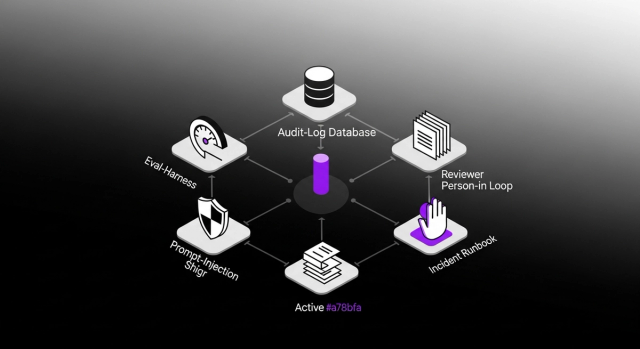
What Is Responsible AI? An Operator's Definition + 6 Controls We Install
Responsible AI in production is 6 specific controls — eval harness, audit log, prompt-injection defense, reviewer-in-loop, model card, incident runbook. Frameworks tell you what; this is how.