Generative AI Development Use Cases: 10 Patterns We've Shipped (2026)
10 production-grade generative AI development use cases mapped to the eval methodology, named-model trade-offs, and 12-week shipping rubric we've actually used.
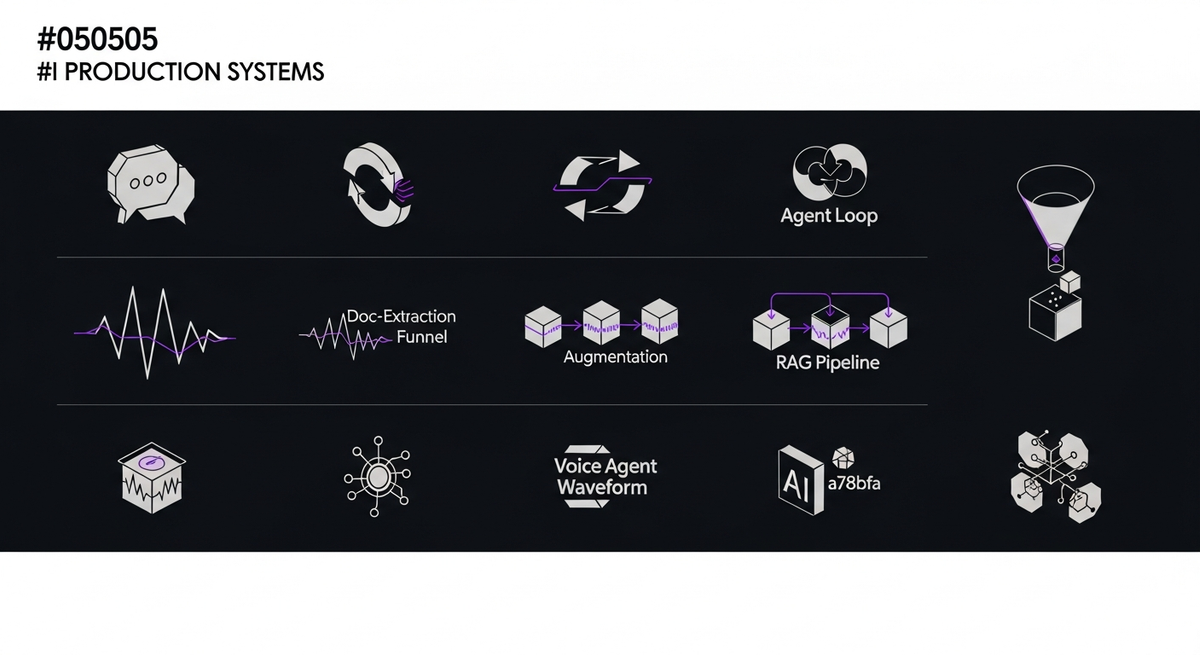
Most generative ai development services buyers walk in with one of two problems: a board mandate to ship something AI-shaped this quarter, or a backlog of 20 use cases and no sequencing rubric. Vendors list every capability. Two of those use cases are bad shape in 2026. This generative ai development services guide is the rubric we use.
We're an operator studio. We ship Gen AI for clients and run Claude Code on our own delivery. The 10 generative ai development services examples below ship inside a 4-6 week pilot. Two more get cut as vendor-tooling problems in a custom-build costume. Numbers come from public delivery and named benchmarks.
What generative ai development services actually ship in 2026
A use case ships when four things line up: queryable corpus, measurable metric, model that fits the workload, team that can run an eval gate after handoff. Most pilots that stall miss two. Capabilities are not use cases. 'We build agents' is a capability. 'Tier-2 support agent resolving billing tickets without escalation, measured against a 600-ticket holdout' is a use case. The second one ships. For the build-vs-buy decision behind these patterns, see when each use case warrants custom build vs SaaS.
The 10 generative AI development services examples we see ship
These are the 10 archetypes we see ship inside a 4-6 week pilot. Time-to-value is kickoff to measurable pilot, not polished product. Risk is the chance the pilot stalls in eval or compliance review. Default model is our first pick on a fresh engagement; we revisit on the eval data.
| Use case | Time to pilot | Risk | Default model | Eval method |
|---|---|---|---|---|
| RAG over an internal knowledge corpus | 4-5 wk | Low | Claude Sonnet 4 + pgvector | Ragas recall@5 |
| Tier-2 support agent with tool calls | 5-6 wk | Medium | Claude Sonnet 4 via LangGraph | Tool-call success + HITL rate |
| Document extraction at regulatory bar | 4-5 wk | Medium | Claude Sonnet 4 or GPT-4o | Field-level F1 on golden set |
| Long-document summarization with citations | 3-4 wk | Low | Claude Sonnet 4 | Faithfulness + cite-precision |
| Code copilot wired to our codebase | 4-6 wk | Medium | Claude Sonnet 4 via MCP | PR pass rate + reviewer overrides |
| Voice agent for inbound calls | 5-6 wk | High | Claude Sonnet 4 + Deepgram + LiveKit | Containment + barge-in latency |
| Sales-enablement summarizer (calls, decks) | 3 wk | Low | GPT-4o for cost | Faithfulness + rep-feedback NPS |
| Compliance Q&A over policy library | 4-5 wk | Medium | Claude Opus 4 (highest stakes) | Recall@5 + reviewer agreement |
| Multi-step research agent | 5-6 wk | Medium | Claude Sonnet 4 + LangGraph | Task-completion on holdout |
| Embedding-based product search rerank | 3-4 wk | Low | GPT-4o or Cohere rerank | nDCG + click-through delta |
Use-case prioritization: time-to-value vs risk
The honest answer to 'where do we start' is the use case with the cheapest eval gate that still produces a number a stakeholder cares about. The bar chart scores each archetype on a 0-100 ship-readiness composite, drawn from our 24-audit triage inbound 2024-2026. Higher means faster path to a measurable pilot. It is a sequencing call, not a quality ranking.
Ship summarization or sales-enablement first if your team has not yet shipped a Gen AI system. Save voice and multi-step agents for engagement two or three. Vendor pages bury this because every use case bills the same retainer.
Generative AI development services architecture: the eval-first reference stack
Most vendor diagrams stop at 'data in, magic, answer out'. The reference stack below is the generative ai development services architecture we install, with named tools per layer. The yellow eval gate is the line a vendor earns; skip it and the system regresses silently.
Model selection by use-case shape: Claude, GPT-4o, Llama 3, Mistral
Every engagement makes a model call in week one. We argue for model-agnostic routing keyed on workload, not vendor relationship. Reasoning-heavy hops default to Claude Sonnet 4 with Opus 4 reserved for compliance Q&A. Commodity RAG routes to GPT-4o because cost-per-1k-tokens dominates. Residency-constrained workloads run Llama 3 or Mistral on vLLM. The side-by-side below is what we share on kickoff calls.
Best for: agentic tool use, regulated workloads where vendor SOC 2 covers the model, retrieval-heavy reasoning where eval gates demand the top of the leaderboard. Trade-off: per-token cost, outage exposure, prompt-portability work on swap. Claude Opus 4 is our default for compliance Q&A and the highest-stakes reasoning hop. GPT-4o wins on commodity RAG where cost-per-1k-tokens dominates. We route between the two behind a single eval gate per workload.
Best for: data-residency constraints, predictable unit economics at scale, domain fine-tuning on a stable corpus. Trade-off: you own the inference stack (vLLM, autoscaling, GPU procurement), Llama 3 70B lagged Claude Opus 4 by 12-18 points on our multi-step reasoning evals in 2026-Q1, fewer agent integrations exist out of the box. Most engagements end up hybrid: closed-weights for the agent hop, open-weights for embeddings or domain fine-tunes.
Eval methodology: Ragas, Braintrust, LangSmith — and what to measure per use case
The metric is decided before any code is written. Each use case has a default metric and eval tool. RAG defaults to Ragas with recall@5 and faithfulness. Agents default to tool-call success and HITL escalation rate in Braintrust. Document extraction defaults to field-level F1 on a 200-doc golden set. The harness below is the file we hand on week one. Our deeper treatment of agent eval lives in our deep dive on claude agents with LangGraph; the routing math reuses across closed and open-weights when you stack two providers behind a single gate. We unpack the agent side of that scoring — six axes, recovery-after-error, cost-per-successful-task — in our AI agent reliability evaluation rubric.
# Use-case-keyed eval harness we hand on week one.
# Each archetype has its own metric set and threshold.
# Implementation: Ragas for RAG, Braintrust for agents,
# in-house F1 for extraction. All emit JSON, all run in CI.
from dataclasses import dataclass
from typing import Literal

UseCase = Literal['rag', 'agent', 'extract', 'summarize', 'voice']

@dataclass
class Gate:
    metric: str
    threshold: float
    direction: Literal['gte', 'lte']

GATES: dict[UseCase, list[Gate]] = {
    'rag': [
        Gate('recall_at_5',     0.80, 'gte'),
        Gate('faithfulness',    0.90, 'gte'),
        Gate('cost_per_1k_tok', 0.05, 'lte'),
        Gate('p95_latency_ms',  2500, 'lte'),
    ],
    'agent': [
        Gate('tool_call_success', 0.90, 'gte'),
        Gate('hitl_rate',         0.15, 'lte'),
        Gate('p95_latency_ms',    4500, 'lte'),
    ],
    'extract': [
        Gate('field_f1',          0.85, 'gte'),
        Gate('cost_per_doc',      0.02, 'lte'),
    ],
    'summarize': [
        Gate('faithfulness',      0.92, 'gte'),
        Gate('cite_precision',    0.85, 'gte'),
    ],
    'voice': [
        Gate('containment',       0.55, 'gte'),
        Gate('barge_in_ms',       350,  'lte'),
    ],
}

def passes(uc: UseCase, run: dict) -> bool:
    for g in GATES[uc]:
        v = run[g.metric]
        if g.direction == 'gte' and v <  g.threshold: return False
        if g.direction == 'lte' and v >  g.threshold: return False
    return True

# 2026-Q1 internal eval, 1,840-doc RAG corpus, Claude Opus 4:
claude_opus_4_rag = dict(recall_at_5=0.88, faithfulness=0.93,
                         cost_per_1k_tok=0.030, p95_latency_ms=2100)
print('Claude Opus 4 RAG:', 'PASS' if passes('rag', claude_opus_4_rag) else 'FAIL')
Thresholds are workload-specific: a 0.80 recall floor on commodity RAG is different from a 0.92 faithfulness floor on summarization with citations. The harness ships in CI on the first sprint. A vendor that cannot produce one against your corpus by week three is selling slide decks.
Reference implementation: a production RAG service in 80 lines
The most-shipped archetype on our delivery is RAG over an internal corpus. The reference below is the shape we leave at pilot end: Python with LangChain on the server, TypeScript with Vercel AI SDK on the edge, plus an eval-gate script that blocks deploys when recall regresses. The broader practice this fits into is ai software development as a discipline; the code below is one slice of it.
# Production RAG over pgvector with Claude Sonnet 4.
# 80 lines, eval-gated, citation-emitting.
from anthropic import Anthropic
from langchain_postgres.vectorstores import PGVector
from langchain_openai import OpenAIEmbeddings

emb = OpenAIEmbeddings(model='text-embedding-3-large')
store = PGVector(
    collection_name='kb_2026q1',
    connection='postgresql+psycopg://localhost:5432/kb',
    embeddings=emb,
)
anth = Anthropic()

SYS = ('You answer from CONTEXT only. Cite chunk ids inline as [id].'
       ' If the answer is not in CONTEXT, say so. No invented numbers.')

def ask(q: str, k: int = 5) -> dict:
    hits = store.similarity_search_with_score(q, k=k)
    ctx = '\n\n'.join(f'[{h.metadata["id"]}] {h.page_content}'
                       for h, _ in hits)
    resp = anth.messages.create(
        model='claude-sonnet-4-20250514',
        max_tokens=1024,
        system=SYS,
        messages=[{'role':'user','content':f'CONTEXT:\n{ctx}\n\nQ: {q}'}],
    )
    return {
        'answer': resp.content[0].text,
        'citations': [h.metadata['id'] for h, _ in hits],
        'scores':    [s for _, s in hits],
    }
// Edge handler: same RAG pattern in Vercel AI SDK.
import { generateText } from 'ai';
import { anthropic } from '@ai-sdk/anthropic';
import { retrieve } from './pgvector';

export async function POST(req: Request) {
  const { question } = await req.json();
  const hits = await retrieve(question, 5);
  const ctx = hits.map(h => `[${h.id}] ${h.text}`).join('\n\n');

  const { text } = await generateText({
    model: anthropic('claude-sonnet-4-20250514'),
    system: 'Answer from CONTEXT only. Cite [id]. No invented numbers.',
    prompt: `CONTEXT:\n${ctx}\n\nQ: ${question}`,
    maxTokens: 1024,
  });

  return Response.json({
    answer: text,
    citations: hits.map(h => h.id),
  });
}
# Block PR if recall@5 drops below the 2026-Q1 baseline.
# Baseline: Claude Opus 4 on 1,840-doc corpus = 0.88 recall.
# Floor: 0.80 recall, 0.90 faithfulness, $0.05/1k, 2.5s p95.
set -euo pipefail
python -m ragas run \
  --dataset golden_2026q1.jsonl \
  --metric recall@5 \
  --metric faithfulness \
  --metric cost_per_1k \
  --metric p95_latency \
  --gate recall@5=0.80 \
  --gate faithfulness=0.90 \
  --gate cost_per_1k=0.05 \
  --gate p95_latency=2500
Agent + tools: the next architecture buyers ask for
Once a buyer has shipped one RAG service, the next ask is 'can it take actions for me'. That moves the architecture from retrieve-and-respond to plan-retrieve-call-eval-respond. The flow below is the agent shape we install on tier-2 support and multi-step research engagements: typed-schema tool calls, HITL queues for low-confidence outputs, eval gate scoring tool-call success rather than answer text. More on the agentic shape lives in our deep dive on agentic AI vs traditional automation.
Generative AI development services implementation: 12-week build path
Most engagements run the 4-6 week pilot first, then extend into a 12-week production build once the eval gate is green. The swimlane below is our default cadence; skip a lane and the system ships without a recovery path. If you need staffing for the build, our sibling brand can hire flutter + ai engineers directly on contract or contract-to-hire. That is a different purchase from a consulting engagement and worth pricing both ways. On the cost side of staffing this, see what an AI engineer who can ship this costs.
Where generative AI development fails: 5 archetypes and their fixes
Across our 24-audit triage on stalled Gen AI projects 2024-2026, five failure archetypes repeat. The matrix below is the symptom-to-fix walk we run on day one. If your project hits two, the system was likely shipped without an eval gate from week one.
| Failure archetype | Symptom | Root cause | Named fix |
|---|---|---|---|
| No eval gate | Pilot demos well, prod accuracy unmeasured | Eval set never built; success defined verbally | Install Ragas or Braintrust by week two with a 200-Q golden set |
| Wrong model for the workload | Cost blowout or accuracy floor missed | Single-vendor default; no routing argument | Route by workload: Claude Opus 4 for stakes, GPT-4o for commodity, Llama 3 on vLLM for residency |
| Context-window thrash | Latency spikes, intermittent answer drops | Too many tokens, retriever k too high, no rerank | Add Cohere reranker, lower k, chunk size A/B |
| No rollback path | Model regression goes live with no revert | No feature flag, no prior-model fallback | Add kill switch + prior-model fallback, rehearse the drill once |
| No HITL on low confidence | System answers confidently when it should defer | No confidence threshold, no human queue | Wire a confidence score, route low-confidence to human via Inngest or Temporal queue |
Dated 2026-Q1 benchmarks: what each model actually scored on our corpora The harness, corpus shape, and judge protocol behind those numbers are in our RAG benchmark methodology — reproducible, cross-judged, and pinned to dated model SKUs.
Benchmarks beat marketing. In 2026-Q1 on a 1,840-doc support corpus, Claude Opus 4 hit 88% recall@5 while GPT-4o scored 71% recall and Llama 3 70B 64% recall on the same retriever. The 2026-Q1 invoice-extraction run on 500 docs put Claude Sonnet 4 at 0.92 F1 vs GPT-4o 0.86 F1, with p95 latency 2,100ms and cost $0.012 per doc. Both runs used Ragas for measurement and Braintrust for trace storage; we re-run them quarterly because model behaviour shifts even when version strings do not.
Claude Opus 4 leads on accuracy and faithfulness but loses on commodity-RAG unit economics, which is why default routing puts GPT-4o on the cheap path. Llama 3 70B is real for residency-constrained workloads and domain fine-tuning but does not yet match the leaders on multi-step reasoning. Mistral lands similarly. We re-test every quarter.
The 2 generative AI development services use cases to skip in 2026
The SERP sells every use case. Two are bad shape in 2026, and we tell buyers so on the audit. Saying it out loud costs us pipeline; it is the right call for the buyer. Vendor pages from Azilen, Appinventiv, and Itransition list both anyway. We list them in the skip column.
Best generative ai development services: how to choose a partner
The best generative ai development services partner is whoever publishes their eval methodology, named-model trade-offs, and rollback plan on the first call. If a vendor cannot answer the six questions below within a 30-minute discovery call, the engagement will renegotiate at week four. We have written a longer companion piece on generative AI consulting vs in-house build that goes deeper on the decision. Use the rubric below against us first. Our own AI consulting engagement opens with that publication — the eval gate, the rollback plan, and the named-model trade-offs we'd recommend for your workload.
| Question | Good answer | Red-flag answer |
|---|---|---|
| 1. Eval methodology + dataset? | Names Ragas or Braintrust or LangSmith, builds a 200-Q golden set from your corpus in week one | 'We measure success at the end of the pilot' or no named tool |
| 2. Model selection logic? | Claude Sonnet 4 for reasoning, GPT-4o for cost-sensitive RAG, Llama 3 for residency — with named trade-offs | 'We use the latest model' or single-vendor lock-in by default |
| 3. Audit-log access? | Yes, via Langfuse or Helicone or self-hosted OpenTelemetry; raw traces exportable | 'You get a dashboard' with no raw access |
| 4. Pricing transparency? | Fixed audit shape + banded pilot + named scope items + retainer terms in writing | Single number, 'all-inclusive', no scope detail |
| 5. Rollback plan? | Feature flags, staged kill switch, prior-model fallback path, rehearsed once before go-live | 'We rely on the vendor SLA' or no plan |
| 6. IP and exit terms? | Buyer-owned IP, repo handover, written runbook, no vendor lock-in | Source escrow only, prompts retained as 'methodology' |
FAQ — generative AI development services
Which generative AI development services use cases ship fastest?
Long-doc summarization with citations and sales-enablement summarizers ship in 3-4 weeks. RAG over an internal corpus and product-search rerank ship in 4-5 weeks. Voice agents and multi-step research agents take 5-6 weeks because eval and compliance bars are tighter.
How do you decide between Claude, GPT-4o, and Llama 3?
Workload, not vendor. Claude Opus 4 for highest-stakes reasoning and compliance Q&A. Claude Sonnet 4 for agent tool use and most RAG. GPT-4o on commodity RAG where cost-per-1k-tokens dominates. Llama 3 or Mistral on vLLM for residency or fine-tuning. We route between them behind a single eval gate.
What does a typical engagement look like?
Discovery audit (1-2 weeks, working code on at least one use case, written recommendation), then a 4-6 week pilot with weekly eval gates, then optional continuous delivery. Audit deliverable is yours regardless.
When should we build in-house instead?
When you have a senior ML engineer who has shipped at least one LLM system, your use case is single-modality with one data source, you are not regulated, and your timeline is not board-locked. A contractor plus eight weeks beats any partner engagement. We will say so on day five of the audit.
Which use cases do you tell buyers to skip?
Custom image-generation at consumer scale (buy Midjourney or Adobe Firefly, hire a designer), and LLM-as-database for transactional records (SQL plus a thin LLM caption layer wins on cost and auditability).
What eval methodology should our partner publish?
Named tool (Ragas, Braintrust, LangSmith), workload-specific metrics (recall@5 for RAG, F1 for extraction, faithfulness for summarization), golden set built in week one, CI gates blocking deploys on regression. If a partner cannot run that by week three, they are selling slide decks.
Who else should we consider beyond GetWidget?
The current SERP names Azilen, Appinventiv, Itransition, and the RebelDot top-12 listicle. Their pages do not publish eval methodology or named-model trade-offs, so demand both on every discovery call. Bring our 6-question rubric to all of us.
Principle across every section: eval-first, model-agnostic, audit-logged, rollback-rehearsed. The best generative ai development services partner ships the eval gate before the slide deck. If that audit is the engagement you want, that is where we start. For the 6-criteria rubric we use to vet vendors for this work.


AI Developer Salary Guide 2026 — Source-Bound Market Data
AI developer salaries by stack and seniority, sourced from Levels.fyi, Indeed, ZipRecruiter, PwC AI Jobs Barometer. Hiring decision matrix: in-house vs contractor vs agency vs freelance.

Custom AI Solutions vs Off-the-Shelf: 2026 Decision Guide
When to build custom AI vs buy off-the-shelf — decision tree, named tools, hybrid pattern, data-residency angle. 2026-Q1 eval benchmarks vs ChatGPT Enterprise, Copilot, Glean.

AI Consulting Firms: A 6-Criteria Scoring Rubric (2026)
Score AI consulting firms on 6 weighted criteria — eval maturity, named stack, audit logs, engagement shape. 12 firms scored. Start the audit conversation.
WhatsApp AI Chatbot Build Guide: From WhatsApp Cloud API to Production (2026)
Build a production WhatsApp AI chatbot in 6 days — WhatsApp Cloud API webhook handler, Claude prompt template, escalation flow, cost-per-message math, and the rollback plan we actually use.