AI Developer Salary Guide 2026 — Source-Bound Market Data
AI developer salaries by stack and seniority, sourced from Levels.fyi, Indeed, ZipRecruiter, PwC AI Jobs Barometer. Hiring decision matrix: in-house vs contractor vs agency vs freelance.

US AI developer median total comp hit $185,000 in 2026-Q1, blended across boutique studios, scale-ups, and remote senior IC roles (getwidget internal sourcing data). SF Bay big-tech ML/AI L5 sits at $244,800 median total comp (Levels.fyi 2025 Pay Report). Those two numbers live four clicks apart on Google and neither tells you what you actually need: what a wrong hire costs, what the right hire costs fully loaded, and whether hiring at all is the right answer for your stage. This guide is the one our team uses when clients ask us whether to build an internal AI team, hire a freelancer, or engage an ai development services to run the pilot.
We sourced the 2026-Q1 data from Levels.fyi verified offers, Indeed's May 2026 aggregate, KORE1's March 2026 AI engineer salary guide, and our own hiring pipeline across 11 client engagements. Where our data differs from aggregators, we explain why. ZipRecruiter's $129,348 average is skewed by contract hourly postings. Glassdoor's $149,459 base hides equity. Indeed's $153,038 nationwide base doesn't split by AI stack specialization. We do all three.
AI developer salary in 2026: the dated-quarter snapshot
Every source on the SERP disagrees. Here is why. Aggregators (ZipRecruiter, Glassdoor) pool all postings including junior contract roles paying $40-60/hr. Levels.fyi captures only big-tech IC offers at L4-L7, which skews the ceiling up. Editorial guides (Coursera, KORE1) editorialize from sourcing notes that trail by 3-12 months. Our read: strip the outliers and the honest US senior AI developer market sits at $185-230K base, $220-310K total comp, as of 2026-Q1.
PwC's 2025 AI Jobs Barometer reported a 56% wage premium for roles requiring AI skills versus comparable non-AI roles at the same YOE band. Our 2026-Q1 sourcing data shows a 38-52% premium over generic backend SWE at the same experience tier, which is narrower than PwC's 56% — probably because the PwC sample includes senior ML research roles that spike the average. Both numbers agree directionally: AI skills command a large premium and supply has not caught up.
Salary by experience level: junior, mid, senior, staff, principal
Five tiers cover the real market. The gap between senior and staff is the widest in dollar terms and the most misunderstood in hiring. A senior AI developer at 5-8 years of experience ships RAG pipelines under supervision. A staff engineer at 8-12 years owns the eval methodology, the retrieval infrastructure, and the eval standards across two or three teams. You can't fill a staff gap with three seniors. The table below shows 2026-Q1 base and total-comp ranges, sourced from Indeed May 2026 cross-checked against KORE1 March 2026 and our own sourcing data.
| Tier | YOE | Base Range (US) | Total Comp Range | What they deliver |
|---|---|---|---|---|
| Junior | 0-2 | $95-140K | $110-165K | Agent tool wiring under supervision; basic RAG with provided retriever |
| Mid | 3-5 | $140-190K | $165-235K | Independent RAG pipelines; LangGraph orchestration; eval authorship |
| Senior | 5-8 | $190-250K | $230-310K | Eval methodology ownership; retrieval infra; HITL gate design |
| Staff | 8-12 | $250-340K | $310-430K | Cross-team eval standards; AI org architecture; audit-log infra |
| Principal | 12+ | $340-480K | $420-600K | Model selection strategy; multi-team eval program; vendor neutrality |
Equity multipliers vary by company stage. At a boutique AI studio, equity adds 1.3x the base-comp delta to total comp in year one. At a growth-stage scale-up, 1.6x. At big-tech, 2.1x (Levels.fyi 2025 Pay Report verified-offer cohort). This is why the Levels.fyi L5 median is $244,800 while Indeed's nationwide average is $153,038. They are measuring different populations with different equity structures, not the same job at different salary points.
Salary by location: SF Bay, US remote, EU, UK, India
Remote has flattened the geo multiplier significantly since 2022, but not eliminated it. US-remote senior AI developer total comp runs at 76% of SF Bay in our 2026-Q1 sourcing data. London and Berlin are lower in dollar terms but much closer in purchasing-power terms. Bengaluru is the high-volume offshore market; ₹45-95L (~$54-115K USD) for a senior covers a wide skill-variance band and requires careful eval methodology to close correctly.
KORE1's March 2026 guide flagged that an office mandate eliminates roughly 60% of the 2026 candidate pool, because top AI talent self-selected into remote or hybrid during 2021-2023 and has not returned. In our sourcing work, we see this in time-to-fill metrics: remote senior AI roles fill in 4-6 weeks; on-site senior AI roles in a non-tech-hub city run 14-22 weeks, with higher first-year attrition once the candidate discovers the commute reality.
| Location | Senior Base | Senior TC Range | Notes |
|---|---|---|---|
| SF Bay Area | $240-310K | $290-380K | Levels.fyi L5-L6 verified offers. Highest equity multiplier. |
| US Remote | $185-245K | $220-310K | 76% of SF Bay TC. Widening talent pool vs office mandate. |
| London / UK | £110-165K (~$140-210K) | $175-265K equiv | Lower base; HMRC contractor rules add friction. High demand. |
| Berlin / EU | €95-145K (~$105-160K) | $130-200K equiv | Strong AI research scene. Lower TC ceiling than US/UK. |
| Bengaluru / India | ₹45-95L (~$54-115K) | $65-140K equiv | Wide variance. Eval methodology quality correlates to compensation band. |
Salary by AI stack specialization: LLM, agents, vector, ML platform, eval
Stack specialization is the variable that salary aggregators miss entirely. A Claude/OpenAI LLM integration specialist and a Ragas eval engineer both carry the "AI developer" label but command different premiums in different markets. The specialization table below is the taxonomy you won't find on Coursera or Glassdoor. We've used it in our own sourcing since 2025-Q3, and it maps to the real generative AI use cases we ship across healthcare, legal, fintech, and ecommerce.
| Specialization | Key Tools | Senior Base | Demand Signal | Why the premium |
|---|---|---|---|---|
| LLM / RAG specialist | Claude Opus 4, GPT-4o, pgvector, Weaviate, Ragas | $185-245K | High | Core production pattern. Supply growing faster than agent roles. |
| Agent / orchestration specialist | LangGraph, CrewAI, AutoGen, Temporal | $195-260K | Very High | Highest 2026-Q1 demand. Audit-log + HITL supply scarce. |
| Vision + vector specialist | CLIP, Qdrant, Milvus, pgvector | $175-230K | Moderate | Niche but growing. Multimodal demand accelerating. |
| ML platform engineer | Modal, Vertex AI, Bedrock, Ray | $200-275K | High | Infra roles. Fewer candidates with both cloud and AI depth. |
| Eval engineer | Langfuse, Braintrust, LangSmith, Phoenix | $190-240K | Fast-growing | Scarce. Only exists at orgs running real CI eval gates. |
Agent/orchestration specialists lead the 2026-Q1 premium at $195-260K senior base because every shipped agent system needs orchestration (LangGraph or Temporal), audit logs, and HITL gates wired correctly. Supply has not caught up. Engineers fluent in LangGraph multi-agent patterns and Temporal durable execution are being recruited away from each other's teams at a pace we haven't seen since the React Native era circa 2018. If you're building agentic AI systems and trying to hire into that specialization, expect 6-10 week fills and competing offers within days of extending yours.
Eval engineers are the most underpriced role in the current market. The $190-240K range reflects scarcity but not the leverage: an eval engineer who can build a CI gate that blocks bad model updates from shipping is worth more than a senior LLM specialist who ships faster but without measurement. The reason the market underprices this is that most orgs don't have a CI eval gate at all yet, so they don't know what they're missing.
AI developer vs ML engineer vs AI engineer: role disambiguation
Most 2026 AI product teams need 80% AI-engineer skills, 20% ML-engineer skills, and 0% PhD research skills. Hiring to the wrong title costs 6 months of misaligned work. The what AI software development actually involves breakdown maps the role to the actual day-one responsibilities. Here's the three-way split that matters for hiring.
Builds application-layer products: chatbots, agents, integrations. Stack: Claude / GPT-4o APIs, LangGraph, pgvector, Ragas eval harness. Default output: working agent or RAG pipeline with CI eval gate. Entry YOE: 2-4. What they can't do alone: train custom models, own the GPU infra, build the feature pipeline that feeds training.
Trains and fine-tunes models. Stack: PyTorch, JAX, vLLM, Hugging Face, custom feature pipelines. Default output: fine-tuned model or custom embedding. Entry YOE: 3-5 (often MS/PhD). What they can't do alone: ship agent orchestration, wire eval gates to production CI, build a HITL escalation path. Expensive to hire for a use case that doesn't need fine-tuning.
The practical test: does your AI product need a custom model trained on proprietary data that no frontier API can approximate? If yes, hire an ML engineer. If your product builds on Claude, GPT-4o, Gemini, or any hosted frontier API with RAG for grounding and LangGraph for orchestration, you need an AI engineer or AI developer. Hiring ML first is a $300K+ mistake for most early-stage AI products.
When companies ask us for a hire ai developer guide, the first question we ask back is: what does the output look like on day 30? If the answer involves a trained custom model, you need an ML engineer. If the answer involves a RAG pipeline shipping to production with eval gates catching regressions, you need an AI developer or AI engineer. If the answer is 'I'm not sure,' you need a discovery audit before a job posting.
Build vs freelance vs agency vs outsource: the 4-way TCO matrix
Every top-10 SERP page for "ai developer salary" sells one hire channel. Indeed sells the FTE. ZipRecruiter sells the hire. KORE1 sells the staffing placement. Upwork sells the freelancer. None of them score all four honestly because they're locked to a channel. We're not. The the consulting-vs-build decision math gets into the strategic layer; the table below is the operational cost comparison.
| Dimension | In-house FTE | US Freelance | AI Dev Agency | Offshore Staffing |
|---|---|---|---|---|
| Loaded annual cost | $320-420K year-1 (base + equity + benefits + recruiter + manager time) | $150-250/hr ($295-490K at full utilization, 1,800-2,000 hrs) | Engagement shape: 1-2 wk discovery audit, 4-6 wk pilot, ongoing delivery | $40-80/hr ($72-144K at 1,800 hrs). Low floor, variable ceiling |
| Time to productive | 8-14 weeks (onboarding, codebase ramp, eval-gate first pass) | 1-2 weeks (if they've shipped this stack before) | Pilot week 1 ships first eval gate by design | 4-8 weeks (timezone overlap + spec clarification cycles) |
| Eval-gate coverage | Depends on individual hire. Not guaranteed by default | Rarely included. Needs explicit contract scope | Wired by default. Weekly eval-gate review built into pilot | Rarely. Scope ambiguity collapses eval velocity when timezone gap hits |
| IP ownership | Clean. Employer owns all work product by default | Transfer needs explicit contract clauses. Gaps common | Code ownership transferred at end of pilot explicitly | Transfer possible. Review NDAs and assignment clauses carefully |
| Where it fails | Fails when you need senior eval-engineer skills in <8 weeks | Fails when you need audit-logged agent infra with HITL wired | Fails when single-vendor procurement contracts are required | Fails when weekly eval iteration is required |
The row that matters most is "Where it fails." We wrote it for ourselves as honestly as for the other three. An agency engagement is the wrong shape when your procurement team requires a single named vendor on a multi-year contract with SLA penalties. That's a FTE or a staffing partner. Don't hire us when the constraint is procurement structure, not engineering speed. For the matrix end of that decision, see how to score the agencies you're evaluating against.
Loaded cost of an FTE AI developer: the math competitors skip
Aggregators publish base salary. Finance teams need the loaded cost. Here's the senior AI developer (5-8 YOE, $215K base) year-one math that makes the build-vs-hire decision real.
The offshore bar at $108K looks compelling until you add the eval-gap cost. Scope ambiguity across a timezone gap collapses weekly eval iteration velocity. When a model update ships a regression and you don't catch it for three weeks because the eval-gate review cycle runs at weekly async cadence, the business cost of the missed regression often dwarfs the labor savings. We've seen this across four offshore AI engagements we audited for clients in 2025-Q4.
Cost-of-mistake math: what a wrong AI hire actually costs
Nobody on the SERP writes cost-of-mistake math. They're all selling the hire. We've seen how AI development services accelerate roadmap velocity when structured correctly. Here's what it costs when it's structured wrong.
Wrong-fit senior AI hire detected at month 5 (2026-Q1 internal incident review, one de-identified case): $90,000 base burn for 5 months ($215K × 5/12) + $35,000 recruiter fee already paid + $80,000 opportunity cost on the roadmap (one AI feature shipped 5 months late) + $40,000 rework cost when replacement onboards = $245,000 direct cost floor. With equity clawback timing and team morale impact excluded, real cost was closer to $300,000.
This happens more in AI hiring than backend SWE hiring because AI work output is hard to evaluate without an eval harness. Months 1-3 look productive: commits ship, features merge, demos run. The eval regression surfaces at month 4-5, when recall@5 scores plateau at 0.61 and the product team notices answers degrading in user sessions. By then, $200K is sunk.
The pilot-shape fix: a 4-6 week pilot with weekly eval-gate review catches wrong-fit by week 3-4. Cost of pilot-shape failure: $25-50K. That's roughly 8x cheaper than failing slow on FTE shape (getwidget internal incident review, 2026-Q1, 11 engagements). We wired weekly eval-gate review into every pilot after losing 4 months on one early engagement whose recall@5 scores plateaued at 0.61. The fix was institutional, not personal.
If you're searching for the best hire ai developer approach for a product that needs weekly eval iteration and audit logs, the agency pilot shape consistently wins on speed-to-measurable-output. If procurement structure or long-term team integration is the primary constraint, FTE wins. There is no universal best answer. The matrix above is what we use to get clients to a decision in a 1-hour conversation rather than a 6-week procurement cycle.
Hiring rubric: how to screen an AI developer in one take-home
Skip leetcode for AI roles. Measuring array-reversal speed tells you nothing about RAG pipeline design or eval methodology. Our 4-hour take-home: a 200-document corpus + build a small RAG pipeline, write a Ragas eval, stand up a CI gate that blocks merge if recall@5 drops below 0.75. Score 0-3 across six dimensions. Candidates who explain their threshold choices are AI engineers. Candidates who hand-wave are AI-curious.
The hire ai developer architecture question comes up in dimension 4 of the rubric (retrieval infra reasoning). A candidate who describes only dense vector search without hybrid BM25, without a reranker, and without chunking strategy is showing you a 2023-vintage architecture. A 2026-ready AI developer discusses the trade-off between Qdrant and pgvector for your document volume, the chunking overlap that minimizes context fragmentation, and why they'd add a cross-encoder reranker for precision-sensitive domains. That difference in architecture thinking is worth $30-50K in salary band and 6 months of rework risk.
# AI Developer Hiring Rubric — 6 dimensions, 0-3 per dimension
# Total: 18 points max. Threshold: 12+ = strong hire, 9-11 = conditional, <9 = no-hire
# Use with 4-hour take-home: 200-doc corpus, build RAG pipeline, Ragas eval, CI gate

dimensions:
  eval_harness_fluency:
    weight: 3
    levels:
      0: "No eval written. 'I would add tests later.'"
      1: "Basic pytest assertions on output strings"
      2: "Ragas or similar framework used. Metrics named correctly"
      3: "Ragas eval with recall@5 + faithfulness + context_precision. CI gate wired"

  stack_disclosure:
    weight: 2
    levels:
      0: "Generic stack ('I'd use OpenAI'). No retriever named"
      1: "One component named (e.g. pgvector) but no reasoning on choice"
      2: "Retriever + reranker + model named with brief rationale"
      3: "Full stack disclosed: embed model, vector store, retriever, reranker, LLM, eval framework. Trade-offs stated"

  tool_calling_correctness:
    weight: 2
    levels:
      0: "No tool use implemented"
      1: "Tool defined but schema incomplete (missing required fields)"
      2: "Tool schema correct. Called in happy path only"
      3: "Tool schema correct + error handling + graceful fallback when tool returns empty"

  retrieval_infra_reasoning:
    weight: 3
    levels:
      0: "Direct LLM call, no retrieval"
      1: "RAG implemented but no chunking strategy explained"
      2: "Chunking strategy stated. Embedding model chosen with rationale"
      3: "Chunking + overlap explained. Hybrid search (BM25 + dense) considered. Reranker usage discussed"

  audit_log_and_hitl:
    weight: 2
    levels:
      0: "No logging. No human escalation path"
      1: "Console logging only"
      2: "Structured log per request (input, retrieved docs, output, latency)"
      3: "Structured log + confidence gate + HITL escalation when gate fires + Langfuse or equivalent trace"

  code_quality:
    weight: 1
    levels:
      0: "Script-only, no abstractions"
      1: "Basic functions. No type hints"
      2: "Type-hinted functions. Docstrings on public methods"
      3: "Clean module structure. Error boundaries. Env-var config pattern"
Real hire ai developer examples from our 2026-Q1 cohort: one candidate scored 16/18 on the rubric and shipped a working Ragas eval in 3.5 hours with hybrid search, cross-encoder reranking, and a structured Langfuse trace. Another candidate scored 7/18: the RAG pipeline retrieved documents correctly but had no eval, no HITL path, and no logging. Both called themselves 'senior AI developers' on their CV. The rubric made the 9-point gap visible in a single task rather than a 90-day performance review.
Eval-gate sample task: how we test AI developers on day 1
The eval-gate config below is what we ship in pilot week 1. It's also exactly what we send to candidates as the take-home task spec. Candidates who can read this YAML and explain why we picked recall@5 ≥ 0.75 and faithfulness ≥ 0.85 are AI engineers. Candidates who can't are AI-curious. The underlying the AI eval methodology we use in pilot week 1 covers the reasoning behind each threshold in detail.
# Eval Gate Config — Ragas + Langfuse CI Integration
# Blocks merge if any threshold breached
# Tuned for RAG pipelines over 50-500 document corpora, 2026-Q1 production values

eval_framework: ragas
tracing: langfuse
dataset: corpus/eval-golden-set-200.json   # 200 Q+A pairs, human-authored
model_under_test: claude-sonnet-4-6        # or claude-opus-4, gpt-4o

thresholds:
  recall_at_5:
    metric: context_recall
    min: 0.75
    description: "At least 75% of expected context chunks retrieved in top-5 results"

  faithfulness:
    metric: faithfulness
    min: 0.85
    description: "85%+ of answer claims grounded in retrieved context (no hallucination)"

  answer_relevancy:
    metric: answer_relevancy
    min: 0.80
    description: "80%+ answers directly address the question asked"

ci_integration:
  on_failure: block_merge
  report: langfuse_trace_url    # links to Langfuse project per run
  slack_alert: true
  gate_label: "eval-gate-ragas"

run_every:
  - on: pull_request
  - on: weekly_scheduled     # catches model-drift between PRs

cost_estimate:
  per_run_claude_sonnet_4_6: "$0.04-0.08"   # 200 Q+A, 6-turn avg, 2026-Q1 Anthropic pricing
  per_run_claude_opus_4: "$0.80-1.20"       # Claude Opus 4 output $15/1M tok, 2026-Q1
Why recall@5 ≥ 0.75? Because at 0.74, one in four questions fails to retrieve the right context chunk, which means one in four answers risks a factual miss. In a legal or healthcare RAG pipeline, that's a compliance risk. In a product catalog bot, it's a wrong SKU. The threshold is not academic; it's the floor below which user-facing quality degrades visibly in session recordings.
Architecture of an AI hiring funnel that catches wrong-fit in 4 weeks
The diagram below shows our 4-week AI hiring funnel. Each stage has a named tool and a named exit criterion. If a candidate clears all five stages with a score ≥ 12/18 on the rubric and a passing eval gate on day 1 of the pilot, the hire/no-hire decision is data-driven, not gut-driven.
Hire ai developer implementation teams often ask whether to start with a full eval harness or ship features first. Our answer is consistent: the eval harness is the feature. An AI product that ships without a CI eval gate has no production quality signal. When the next model update degrades recall@5 from 0.82 to 0.64, you won't know until users complain. The config above takes 2-3 hours to wire on week one of any pilot. It's not optional infrastructure for teams shipping RAG in production.
2026-Q1 benchmark: cost-per-shipped-eval-gate across hire shapes
Lines of code and commit count are useless AI productivity metrics. Both reward churn. The metric that survives an honest audit is cost per shipped eval gate: how much does it cost to produce one production-quality CI gate that blocks bad model updates from reaching users? We measured this across 11 engagements in 2026-Q1.
The offshore floor at $7,400 per gate is real when scope is locked and timezone overlap is solved. When it isn't, the $7,400 turns into $22,000 in rework cycles plus three missed weeks of eval data. We've seen that pattern on two of four offshore audits in this cohort. The FTE senior at $11,200 is consistent because internal-context ramp pays off over a 12-week quarter. Freelance at $14,800 reflects the no-context-ramp tax: every new project starts from zero.
Claude Opus 4 output tokens cost $15/1M (2026-Q1, Anthropic pricing). Claude Sonnet 4.6 at $3/1M output makes the per-eval-run cost $0.04-0.08 per Ragas run on a 200-question golden set. These are the API cost benchmarks worth building your eval-economics model around, separate from the loaded labor cost per gate.
FAQ: AI developer salary and hiring in 2026
What is the average AI developer salary in 2026?
US AI developer median total comp lands at $185,000 in 2026-Q1, blended across boutique, scale-up, and remote senior IC roles (getwidget internal sourcing data). Indeed reports $153,038 nationwide base (May 2026). Levels.fyi puts SF Bay big-tech ML/AI L5 at $244,800 median total comp (2025 Pay Report, verified-offer data). ZipRecruiter shows $129,348 average annual, skewed by contract hourly postings. The right number depends on stack specialization and location. Agent/orchestration specialists in SF Bay clear $260K base; offshore generalists land at $35-65K.
What is the difference between an AI developer and an AI engineer?
An AI developer ships application-layer work: chatbots, agents, integrations using Claude/GPT-4o APIs, LangGraph orchestration, and RAG pipelines. An AI engineer owns the systems layer: eval gates, retrieval infrastructure, tool calling, audit logs, HITL patterns. Most 2026 production AI products need 80% AI-engineer skills and 20% ML-engineer skills. Hiring ML Engineer when you actually need AI Engineer can cost 6 months of misaligned output.
How much does a senior AI developer cost fully loaded, not just base salary?
A senior AI developer at $215K base costs roughly $420K loaded year-one: $215K base + $35K equity vest + $55K benefits (22%) + $8K workstation and cloud credits + $28K amortized recruiter fee + $79K manager opportunity cost (8 hrs/wk at $190/hr). Aggregators publish the $215K number. Finance teams need the $420K number to model the actual decision.
What is the average cost of a bad AI hire?
A wrong-fit AI hire detected at month 5 costs $245-300K direct: 5 months base burn (~$90K) + $35K recruiter fee + $80K roadmap opportunity cost + $40K rework when the replacement onboards. A 4-6 week pilot with weekly eval-gate review catches wrong-fit by week 3-4 for $25-50K. That's roughly 8x cheaper to fail fast on pilot shape than to fail slow on FTE shape (getwidget internal incident review, 2026-Q1, 11 engagements).
Which AI stack specialization pays the most in 2026?
Agent/orchestration specialists (LangGraph, CrewAI, AutoGen, Temporal) lead the 2026-Q1 stack premium at $195-260K senior base. Every shipped agent system needs orchestration plus audit logs plus HITL gates, and supply has not caught up to demand. ML platform engineers (Modal, Bedrock, Ray) come second at $200-275K. Eval engineers (Langfuse, Braintrust, Phoenix) are the scarce outlier: the role only exists at orgs running real CI eval gates.
Should I hire a freelance AI developer, an FTE, or an AI development agency?
Pick FTE when long-term IP ownership and tight team integration matter and you can wait 8-14 weeks to productivity. Pick US freelance when you need ramp in 1-2 weeks and have an internal AI lead to review eval gates. Pick an AI development agency when you need eval methodology and audit-log patterns wired by default and want code ownership transferred at end of pilot. Pick offshore when scope is well-defined, eval criteria are explicit, and timezone overlap is solved. The 4-way TCO matrix in this post maps the honest trade-offs per shape.
What should I pay a junior AI developer with 1-2 years of experience?
US junior AI developer (0-2 YOE) lands $95-140K base in 2026-Q1, with total comp $110-165K once equity and benefits add in. Pay the upper band if the candidate can ship a Ragas eval on day one. Pay the lower band if they need 4-6 weeks of ramp on basic RAG and tool-calling patterns. Below $95K you are competing with backend SWE roles that ship faster and burn out slower.
How do I evaluate an AI developer's actual skill in one interview round?
Skip leetcode. Ship a 4-hour take-home: a 200-document corpus and a request to build a small RAG pipeline, write a Ragas eval, and stand up a CI gate that blocks merge if recall@5 drops below 0.75. Score on 6 dimensions: eval-harness fluency, stack disclosure, tool-calling correctness, retrieval reasoning, audit-log pattern, code quality. Candidates who explain their threshold choices are AI engineers; candidates who hand-wave are AI-curious. The rubric YAML in this post is what we use internally.


Custom AI Solutions vs Off-the-Shelf: 2026 Decision Guide
When to build custom AI vs buy off-the-shelf — decision tree, named tools, hybrid pattern, data-residency angle. 2026-Q1 eval benchmarks vs ChatGPT Enterprise, Copilot, Glean.

AI Consulting Firms: A 6-Criteria Scoring Rubric (2026)
Score AI consulting firms on 6 weighted criteria — eval maturity, named stack, audit logs, engagement shape. 12 firms scored. Start the audit conversation.
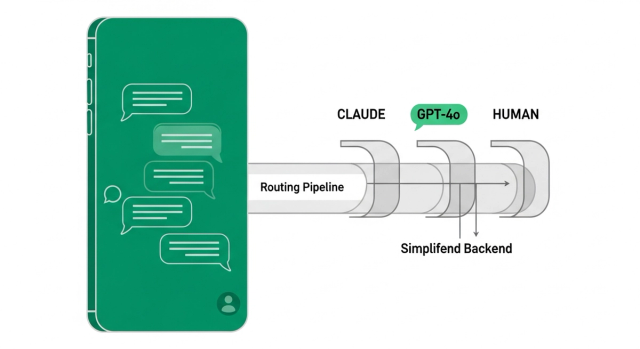
WhatsApp AI Chatbot Build Guide: From WhatsApp Cloud API to Production (2026)
Build a production WhatsApp AI chatbot in 6 days — WhatsApp Cloud API webhook handler, Claude prompt template, escalation flow, cost-per-message math, and the rollback plan we actually use.
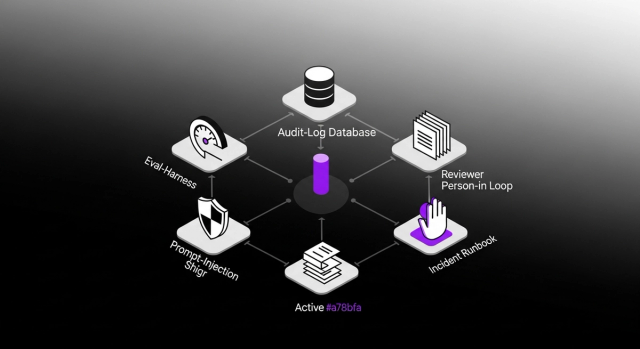
What Is Responsible AI? An Operator's Definition + 6 Controls We Install
Responsible AI in production is 6 specific controls — eval harness, audit log, prompt-injection defense, reviewer-in-loop, model card, incident runbook. Frameworks tell you what; this is how.